

Stress can change your gut in as little as 90 minutes. In these 4 studies, I see the same pattern again and again: stress can lower gut bacterial diversity, weaken the gut lining, shift immune activity, and affect the brain.
Here’s the short version:
- Acute stress was linked to a drop in small-intestine bacterial diversity within 90 minutes
- Chronic stress was tied to a “leaky gut,” more inflammatory cytokines, and brain immune activation
- Stress-linked loss of Lactobacillus changed immune cells in ways that were tied to social behavior
- Stress hormones cut Lgr5-positive intestinal stem cells by about 1.5-fold, which hurt gut repair in mice
What this means for you: if stress keeps hitting day after day, your gut, immune system, and brain may all feel it. The most useful takeaways are simple: sleep on a steady schedule, eat more fiber-rich plant foods, move often, and use stress-control habits like slow breathing or mindfulness.
How Stress Affects Your Gut, Immune System & Brain: 4 Studies
Stress Is Damaging Your Gut Health. Here's How to Repair It.
sbb-itb-1bbfe7f
Quick Comparison
| Study | Stress Type | Main Gut Change | Main Body Effect |
|---|---|---|---|
| Study 1 | Acute cold-water stress | Lower alpha diversity | Higher cortisol and ACTH |
| Study 2 | Chronic unpredictable stress | More permeability | More cytokines and microglial activation |
| Study 3 | Chronic social stress | Less Lactobacillus | More IL-17 γδ T-cell activity tied to behavior |
| Study 4 | Psychological stress | Fewer gut stem cells | Slower gut lining repair, worse colitis |
So if you want the main answer fast, it’s this: stress does not just affect mood. It can also change the gut and immune system in ways that may keep the stress cycle going. If you're feeling these effects, a microbiome reset can help restore balance.
4 studies on stress, microbiome shifts, and immune function
Studies 1 and 2: Stress-driven dysbiosis and inflammatory signaling
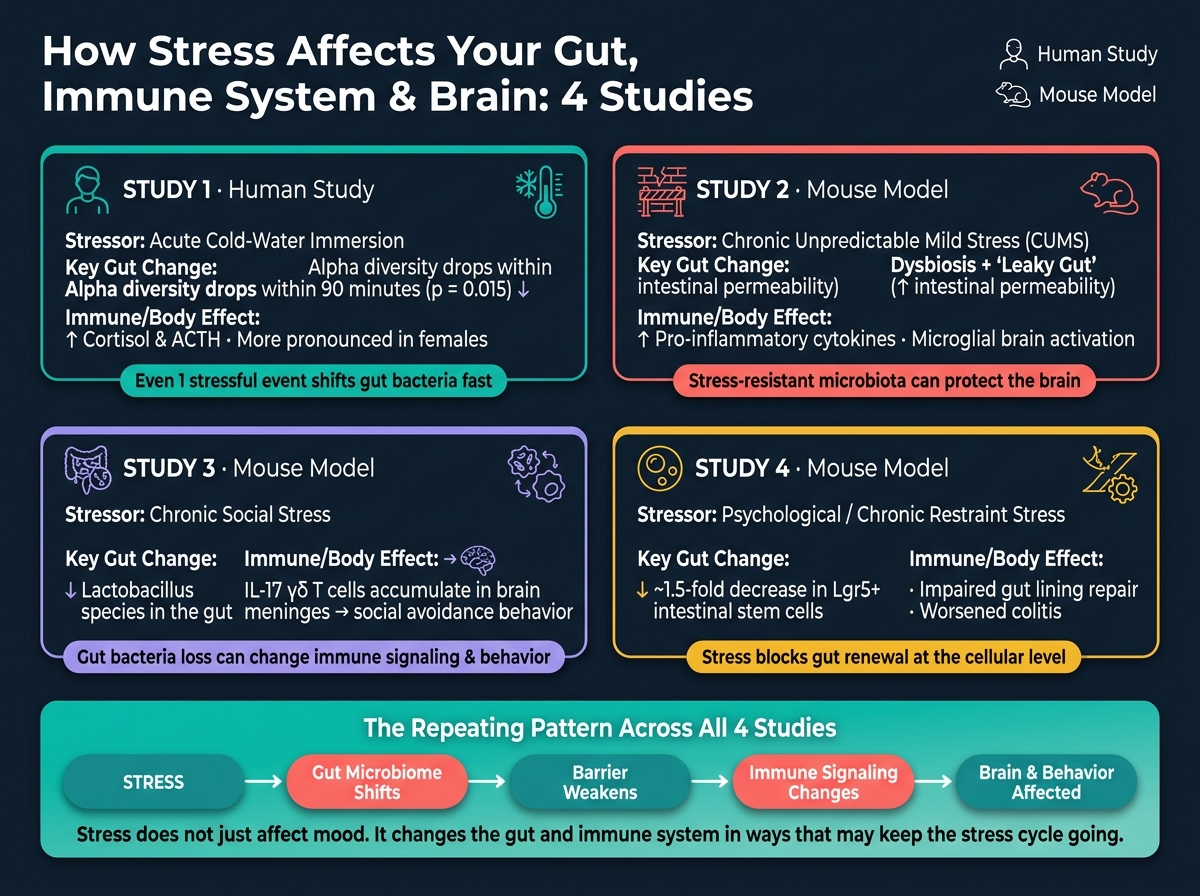
Study 1 looked at what acute physical stress does to the gut. Researchers exposed healthy volunteers to cold-water immersion stress and then measured jejunal bacteria 90 minutes later. Alpha diversity dropped (p = 0.015), with a bigger effect in females, along with higher cortisol and ACTH [5]. So even one stressful event can shift the small-intestine microbiome in less than two hours.
That matters because short-term stress can change bacterial diversity fast. With long-term stress, the damage moves past the microbiome and into barrier problems and immune disruption.
Study 2 moved to chronic stress and gut barrier function. Using a chronic unpredictable mild stress (CUMS) model, researchers found that stress-sensitive animals developed increased intestinal permeability - a "leaky gut" - along with higher serum pro-inflammatory cytokines and microglial activation [4]. Fecal microbiota from stress-resistant mice also helped protect untreated mice from microglial activation when transplanted [4]. In plain English: chronic stress didn't just alter the gut. It kept gut-barrier and brain inflammation going.
The next two studies take that same pattern one step further, showing how stress reaches immune cells and gut repair systems.
Studies 3 and 4: Psychosocial stress, gut barrier health, and immune balance
Study 3 focused on the immune side of the gut-brain axis. Chronic social stress reduced specific Lactobacillus species in the gut [3]. That drop triggered the differentiation of colonic IL-17-producing gamma-delta T cells, which then built up in the brain's meninges and promoted social-avoidance behavior [3]. When those bacteria fall, immune signaling can shift enough to affect behavior.
Study 4 looked at repair. Psychological stress increases corticosterone, which binds NR3C1 receptors on intestinal stem cells [1]. That interaction led to about a 1.5-fold decrease in Lgr5-positive intestinal stem cell frequency, which weakened gut lining repair and worsened colitis [1]. In other words, stress can interfere with gut renewal at the cellular level.
Comparison table: what each study adds
This table brings the four studies into one view.
| Study | Type | Stressor Examined | Key microbiome or gut change | Immune/Barrier Effects | Main Takeaway |
|---|---|---|---|---|---|
| Acute Small Intestine Shift [5] | Human study | Cold-water immersion stress | Rapid drop in alpha diversity within 90 minutes | More pronounced in females; alongside higher cortisol and ACTH | Even short-term stress can shift the small-intestine microbiome quickly |
| Chronic Stress & Permeability [4] | Mechanistic (mouse) | Chronic unpredictable mild stress (CUMS) | Dysbiosis in stress-sensitive animals | Increased intestinal permeability; higher serum pro-inflammatory cytokines; microglial activation | Fecal microbiota from stress-resistant mice can help protect the brain |
| T-Cell Immune Activation [3] | Mechanistic (mouse) | Chronic social stress | Reduced Lactobacillus species | IL-17-producing gamma-delta T cells accumulate in the brain's meninges | Preserving Lactobacillus may matter for stress resilience , a key focus in the study of psychobiotics. |
| Intestinal Stem Cell Sabotage [1] | Mechanistic (mouse) | Psychological stress / chronic restraint stress | About a 1.5-fold decrease in Lgr5-positive intestinal stem cell frequency | Worsened colitis; impaired gut lining repair | Stress can block gut renewal at the cellular level |
Taken together, these four studies point to the same pattern from different angles: microbes shift, barriers weaken, and immune signaling changes.
What the studies mean in plain language
The repeating pattern across all 4 studies
All four studies point to the same basic loop: stress affects the gut, gut changes affect the immune system, and inflammation circles back to the brain.
When your body is under pressure, the HPA axis releases stress hormones like cortisol [8][2]. In plain English, those signals can lower microbial variety, weaken the gut lining, and slow repair. If that gut barrier gets leaky, bacterial byproducts can slip into the bloodstream and set off inflammation [7][2].
That inflammation doesn’t just stay in the gut. It can affect the blood-brain barrier and add to neuroinflammation, which may make anxiety, mood, and thinking problems worse - and keep the stress loop running [7][9]. On a day-to-day level, that can look like more gut sensitivity, more inflammation, and a slower bounce-back after stress. Some of these effects can show up within hours. Others seem to wear down gut repair over time.
The pattern is hard to ignore. But there’s still a gap between seeing a pattern and proving every step of it.
What the research can and cannot prove
The findings line up well across studies, but there are limits to what the research can say right now. A lot of the strongest lab-based work comes from animal models, where researchers can track things very closely - for example, how stress hormones affect intestinal stem cells or how immune cells move and send signals through the body. Those pathways look promising, but they are not yet fully confirmed in humans [3][1].
The human studies add support, but many are small or cross-sectional. So they can show that stress and gut changes often appear together, but not always which one started the chain reaction [5][6][10].
There’s also a technical catch. 16S rRNA sequencing can show broad changes in bacterial groups, but it can miss species-level and function-level shifts that metagenomic sequencing may pick up [6]. So a study can be solid and still miss some of the finer microbial detail.
What the research does support is the big-picture direction: chronic stress tends to reduce microbial variety, weaken gut barriers, and shift immune signaling in ways that can affect both the body and the brain. That pattern is strong enough to take seriously, even as the science keeps moving.
A daily microbiome support plan based on the research
Core habits that support gut and immune resilience
The research keeps coming back to the same small group of daily habits. Stress can disrupt gut microbes, weaken barrier function, and throw off immune signaling. The clearest areas to work on are sleep, diet, movement, and stress control.
Sleep comes first because steady sleep timing helps calm stress signaling. Poor sleep can increase TNF-α and disrupt serotonin signaling [7]. And because about 90% of the body's serotonin is produced in the gut [2], stable sleep patterns can help support gut stability too.
Food is the next big lever. A fiber-rich diet helps the gut recover from stress by increasing short-chain fatty acids (SCFAs) like acetate, propionate, and butyrate. These compounds help maintain tight junction integrity in the gut lining and the blood-brain barrier [2][7]. A simple way to support this process is to eat a wider mix of plant foods, which can help SCFA-producing microbes do their job. Polyphenol-rich foods like grapes and berries may also help support immune balance [11].
Stress can also drain the colon of B vitamins and increase inflammatory signaling [12]. That's where fermentable fibers such as galactooligosaccharides (GOS) and polydextrose (PDX) come in. They help Bifidobacterium species synthesize those vitamins again.
Stress control matters for a simple reason: the nervous system affects the gut barrier, not just your mood. Practices like mindfulness and slow breathing may help lower stress signaling before chronic stress is linked with lower levels of Akkermansia and Faecalibacterium over time [6].
Regular movement also helps. It supports gut motility and can help regulate stress responses.
Matching support strategies to common stressors
The same daily habits can be adjusted based on the kind of stress you're dealing with.
| Stressor | Likely Microbiome & Immune Effect | Practical Action |
|---|---|---|
| Sleep deprivation | Reduced alpha diversity; elevated TNF-α; disrupted serotonin signaling [7][6] | Consistent sleep schedule; SCFA-supportive fiber intake |
| Work burnout / chronic stress | Depletion of B vitamins (B1, B3, B5, B6); lower Akkermansia and Faecalibacterium; elevated IL-6 [12][6] | GOS and PDX fiber intake; increase plant diversity; targeted prebiotic + probiotic support |
| Chronic social stress | Increased Bacteroides; reduced Lactobacillus; elevated IL-6 [12][4] | Multi-strain probiotic support (L. plantarum, B. longum); regular physical activity [4] |
| Acute stress | Rapid drop in alpha diversity within 90 minutes; increased intestinal permeability [5] | Slow breathing; fiber-rich foods later [5][11] |
Where Rebirth RE-1 may fit into a stress-related microbiome plan
The research suggests that synbiotics - combinations of prebiotics and probiotics - may do more to support behavioral resilience during chronic and recurrent stress than either one on its own [11].
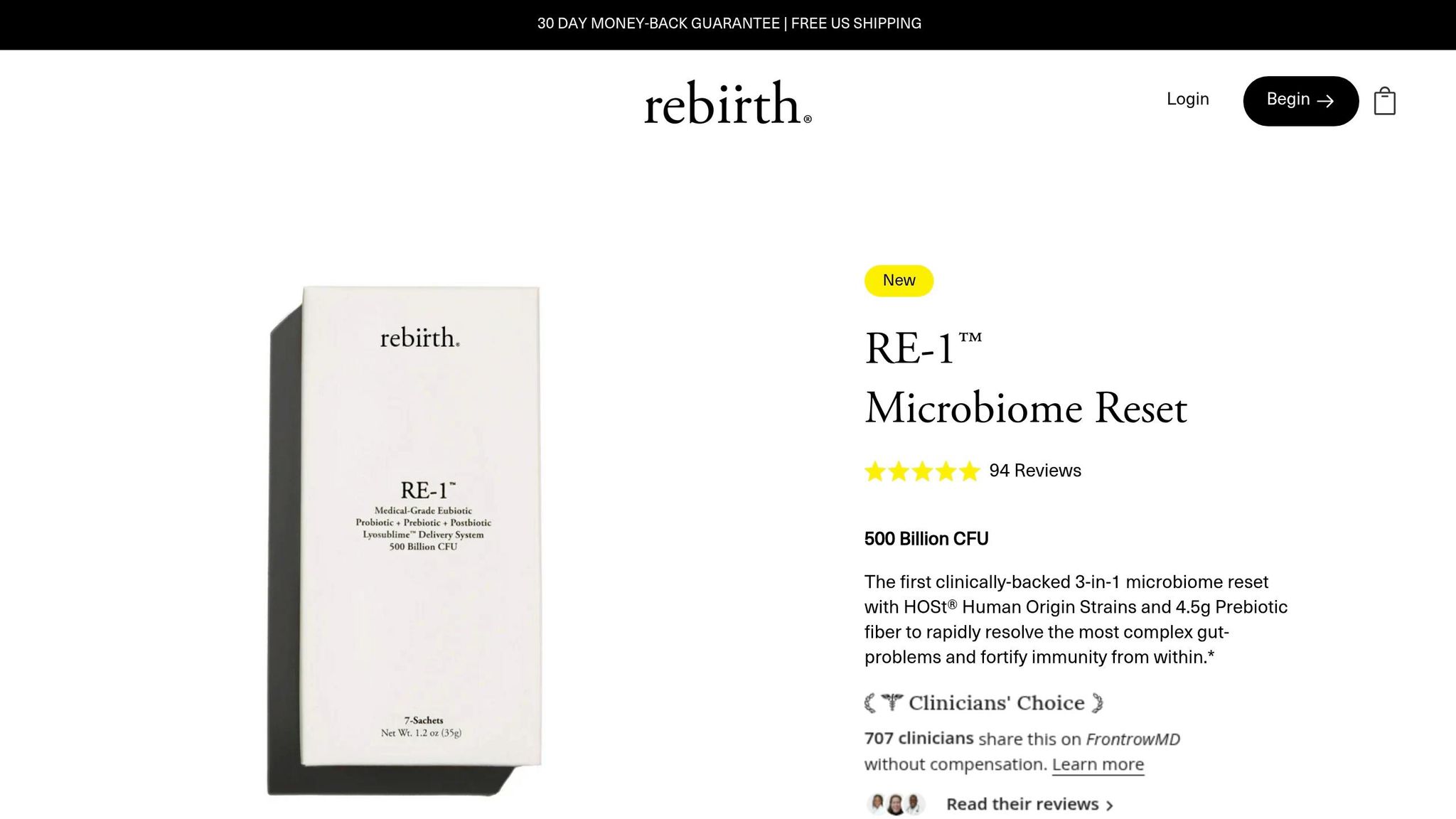
Rebirth RE-1 is a 3-in-1 eubiotic synbiotic that combines prebiotics, probiotics, and postbiotics to support gut microbiome balance during stress-related disruption. The best way to think about it is as an add-on to sleep, food, movement, and stress control, not a substitute for those habits.
Conclusion: 4 study-backed lessons for stress, immunity, and gut health
Across all four studies, the pattern is pretty clear: stress shifts the gut microbiome, weakens barrier defenses, and ramps up immune signaling. This doesn't look like a set of random gut effects. It points to a broader feedback loop.
The gut-brain axis works in both directions. Stress can change the microbes in the gut, and those microbes can help shape how the body responds to stress [8]. That's why gut health matters so much for stress resilience.
You can see this link in immune activity too. Stress doesn't just spark general inflammation. It turns on specific immune pathways. Stress-driven microbial shifts can activate colonic γδ17 T cells, which build up in the meninges and contribute to behavioral changes [3]. That helps connect the dots between immune effects and changes in behavior. Put simply, dysbiosis, barrier leak, and neuroinflammation can show up together.
The day-to-day takeaway is simple: use fiber, targeted probiotics, and synbiotics alongside sleep, movement, and stress control [2][11]. It gives you a practical direction.
FAQs
Can stress really change my gut that fast?
Yes. Stress can change your gut microbiome fast. Research shows that acute stress can alter bacteria in the small intestine in a short time, along with shifts in gut barrier function, hormones, and psychological markers.
Over time, chronic stress can deepen those effects. It may lower microbial diversity and push the gut toward inflammatory changes that can affect brain health through the gut-brain axis.
How does stress affect the gut, immune system, and brain together?
The gut, immune system, and brain are in constant contact through the gut-brain axis. When stress kicks in, it sets off hormone and nerve signals that can alter gut motility, nutrient absorption, and intestinal permeability.
That shift doesn’t stay in the gut. It can disturb the gut microbiota, set off immune activity, and send inflammatory signals back to the brain. In turn, this may affect hippocampal function and play a part in stress-related behaviors and depression.
What daily habits best protect my microbiome from stress?
Focus on steady, gut-friendly habits:
- Eat a high-fiber diet with prebiotics and fermented foods.
- Cut back on ultra-processed foods, refined sugars, and saturated fats.
- Stick to regular eating patterns.
Intermittent fasting may also help shift gut microbes. Targeted support like butyrate can help restore barrier function, and Rebiirth RE-1 offers a broader microbiome reset to support gut balance and immune health.