

If you want the short answer: diet is the base, but a synbiotic may help gut recovery sooner after antibiotics. Antibiotics can disrupt up to 50% of the gut microbiome, and about 25% of patients deal with antibiotic-associated diarrhea. So this is not just about digestion. It can affect stool patterns, bloating, sleep, and mood too.
Here’s how I’d sum it up:
- Diet alone can help rebuild the microbiome if you eat enough prebiotic fiber every day.
- Synbiotics add prebiotics, probiotics, and postbiotics in set amounts, which may help when your gut feels off or your meals are inconsistent.
- Research in adults on broad-spectrum antibiotics found a multi-species synbiotic improved microbial diversity by Day 7 and supported recovery through Day 91.
- That same trial also reported better gut barrier integrity: about 25% higher by Day 7 and about 49% higher by Day 91.
- Mood support is possible, but the direct evidence after antibiotics is still limited.
If your symptoms are mild and your meals are steady, a food-first plan may be enough. If you have bloating, loose stools, or a hard time eating enough fiber, a synbiotic may give you a more structured path.
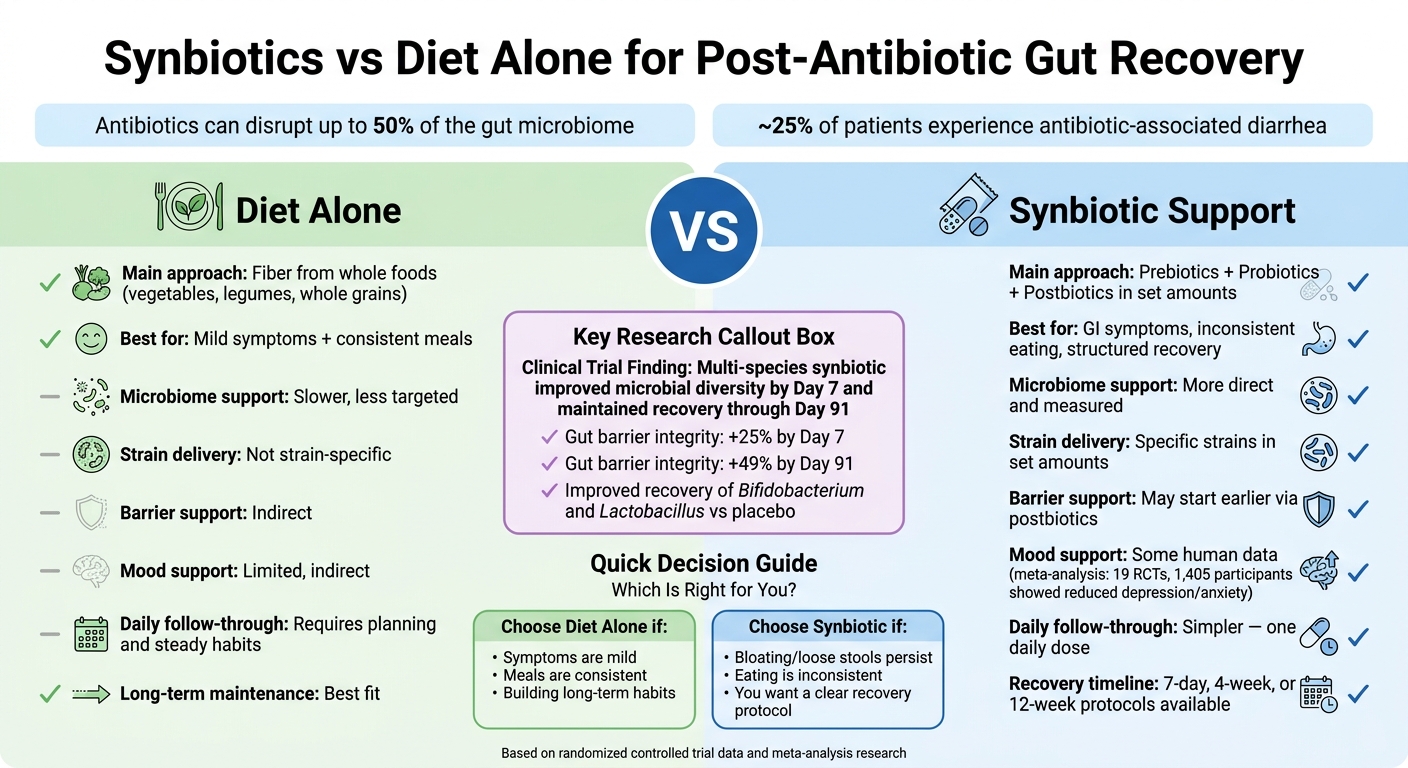
Synbiotics vs Diet Alone: Post-Antibiotic Gut Recovery Comparison
How to Heal Your Gut After Taking Antibiotics
sbb-itb-1bbfe7f
Quick Comparison
| Criteria | Diet Alone | Synbiotic Support |
|---|---|---|
| Main approach | Fiber from food | Prebiotics + probiotics + postbiotics |
| Best for | Mild symptoms, steady meals | GI symptoms, uneven eating, set recovery plan |
| Microbiome support | Slower and less targeted | More direct and measured |
| Strain delivery | Not specific | Specific strains in set amounts |
| Barrier support | Indirect | May start earlier through postbiotics |
| Mood-related support | Limited and indirect | Some human data, but not antibiotic-specific (see how stress and neuroinflammation impact this axis) |
| Daily follow-through | Harder for some people | Often simpler with one daily dose |
So if I strip it down: diet helps rebuild, while synbiotics may help rebuild with more direction.
Synbiotics for post-antibiotic gut-brain recovery
A synbiotic combines prebiotics, probiotics, and postbiotics in one formula. Instead of relying on food alone, you get set amounts of all three in one place. That can help after antibiotics, especially when appetite is off or the gut still feels touchy.
Postbiotics matter here for a simple reason: they may help support gut barrier integrity and immune signaling even while live microbes are still building back up. [7] So the way a product is delivered isn't a small detail. It can matter a lot when your stomach is sensitive and eating normally feels like work.
How synbiotics may speed up microbiome repair
The research here is promising. In a randomized, placebo-controlled trial of adults taking broad-spectrum antibiotics, a multi-species synbiotic led to better alpha-diversity and better recovery of Bifidobacterium and Lactobacillus by Day 7. Those improvements were still there through Day 91 compared with placebo. [2]
That same trial also found better gut barrier integrity - up about 25% by Day 7 and about 49% by Day 91 - along with recovery of short-chain fatty acid-related functions. [2] [4] That matters because microbial diversity and short-chain fatty acid production play a part in gut-brain signaling.
Gut symptom and mood-related support
When antibiotics cut down microbial diversity, short-chain fatty acid production can drop too. And that's often when people start noticing things like bloating, irregular stools, and general GI discomfort.
By increasing Bifidobacterium and Lactobacillus, synbiotics may help turn prebiotic fiber into butyrate and other short-chain fatty acids. Those compounds help support the gut lining and help regulate inflammation. [2] [3] [4] Better barrier integrity may also lower inflammatory signaling linked to fatigue and mood shifts. [2] [4] [7]
Still, it's worth keeping the mood claim in check. In psychobiotic research more broadly, a meta-analysis of 19 randomized controlled trials with 1,405 participants found that probiotics, prebiotics, or synbiotics significantly reduced depression and anxiety symptoms compared with controls. [8] But stronger data on mood or cognitive effects specifically after antibiotics is still needed, and no supplement should be sold as a sure fix. Symptom relief is part of recovery, not the whole story.
Adherence and day-to-day fit
This is where synbiotics may have a practical edge. Getting a good mix of fiber from food sounds easy on paper. In daily life, it's another story - especially if your gut is still sensitive, work is busy, or you're traveling and grabbing what you can.
A sachet format can fit better into that kind of routine because it's portable, shelf-stable, and simple to take every day. Rebirth RE-1, for example, uses a Lyosublime™ delivery system made to help protect strain viability through to the intestines. The reset programs also give people a set plan to follow, which may help with follow-through more than broad advice to "eat more fiber" with no clear end point. [5] [6]
Diet-only recovery depends on steady fiber intake and a gut that can handle it.
Diet alone for post-antibiotic recovery
Restoring gut health after antibiotics starts with diet. But it only works when you stick with it and get enough fiber day after day. What you eat on a regular basis helps decide which microbes hang on, which ones come back, and how fast your gut gets back on track. That makes diet helpful, but less precise than a synbiotic approach.
How diet supports microbial rebound
The main driver here is prebiotic fiber. Fibers like inulin and galactooligosaccharides (GOS) feed helpful gut bacteria and help them make metabolites that support gut health. GOS administration significantly increases bifidobacteria populations while reducing less beneficial microbial groups. [1]
Low fiber intake and repetitive eating patterns can slow microbiome recovery after antibiotics. [1] So the idea is pretty simple: if your gut microbes don’t get the fuel they need, rebound tends to drag.
Where diet may be slower or less targeted
Diet-based recovery can help, but it has clear limits. Food-based probiotics are often transient, which means they may move through the gut without sticking around for long. And if key strains are missing at the start, diet alone may not fully correct dysbiosis. [1]
That’s the tradeoff. Food can support the gut, but it doesn’t always deliver the same strains in the same amounts every day.
Adherence in everyday U.S. routines
For most people in the U.S., the hardest part isn’t knowing fiber matters. It’s doing it every single day. Hitting a steady fiber intake while juggling work, errands, takeout, and repeat meals can be tough. And when that pattern slips, microbial regrowth can slow down too.
Where prebiotics, probiotics, and postbiotics fit better than food alone
Food helps, but sometimes it moves too slowly or works too unevenly after antibiotics. That’s where targeted biotics can help. Each one can step in where diet-only recovery often falls short.
Prebiotics when fiber intake falls short
Most U.S. adults don’t hit fiber goals, and post-antibiotic gut symptoms can make that even tougher. Prebiotic supplements help fill that gap in a direct way.
Fibers like inulin and galactooligosaccharides (GOS) are selectively fermented by helpful bacteria such as Bifidobacterium and Lactobacillus. In plain terms, they give those microbes fuel, which can help them bounce back even when total dietary fiber is still modest. Research across 22 randomized controlled trials found steady increases in these helpful bacteria and in short-chain fatty acid (SCFA) production with prebiotic use. The same research also points to prebiotics helping soften the antibiotic-driven drop in Bifidobacterium and supporting faster recovery.[10]
So if fiber intake is still low, prebiotics are the most direct way to deal with that problem.
Probiotics and postbiotics for targeted support
Probiotics and postbiotics serve a different role. Probiotics add live strains. Postbiotics provide microbial compounds that may support the gut barrier even before full colonization happens. Human data also suggest probiotics can support mood and the gut-brain axis, which is a more targeted use than food-based recovery alone.[11]
Postbiotics matter for one simple reason: they don’t need to settle in the gut to start working. They include non-viable microbial cells and metabolites such as SCFAs, so they can act even when the gut is still unsettled after antibiotics. One of those SCFAs, butyrate, has been shown to fully protect against cytokine-induced epithelial permeability in experimental models.[12]
That makes postbiotics useful in an unstable post-antibiotic setting. They can provide gut barrier and immune support right away, without waiting for colonization. Food can help too, of course, but it’s harder to get this kind of precise support from diet alone.
Rebirth RE-1™ combines prebiotics, probiotics, and postbiotics in sachets for a structured post-antibiotic recovery plan. That’s why these tools often make more sense when recovery needs more structure or a shorter timeline.
Which approach fits your recovery goals
After looking at prebiotics, probiotics, and postbiotics, the next step is pretty simple: do you want faster support, or are you okay with a steadier, food-first rebuild? Diet is the foundation. Synbiotics can add more direction and help fill gaps.
Best fit for fast, targeted recovery
A synbiotic plan often makes the most sense if you're dealing with persistent bloating, loose stools, or mood changes after finishing antibiotics. It can also help if your diet is all over the place. Low-fiber diets can slow microbiome recovery[9], so if your meals are inconsistent, a synbiotic can help cover that gap while you work on better food habits and recovery steps.
A set reset schedule - like a 7-day, 4-week, or 12-week protocol - can also take the guesswork out of the process. You know what to take and how long to take it. That makes sticking with it a lot easier, especially if your routine is busy or unpredictable. Rebirth RE-1™ offers tiered reset plans in a single daily sachet format for this kind of structured recovery.
Best fit for food-based rebuilding
A diet-first plan makes sense when your gut is already calming down and symptoms are mild. It tends to work best when your routine already includes vegetables, legumes, and whole grains. The catch? It asks more of you day to day. You need steady habits and a bit more planning than you would with a set supplement plan.
Key takeaways
Use this quick match to pick the path that lines up with your situation.
| Priority | Diet Alone | Synbiotic Support |
|---|---|---|
| Mild symptoms, consistent meals | Best fit | Optional |
| Persistent GI or mood symptoms | Slower to act | Faster, more targeted |
| Inconsistent eating patterns | Harder to rely on | Bridges the gap |
| Long-term maintenance | Best fit | Adjunct |
| Time-limited recovery | Requires planning | Clear protocol |
FAQs
How soon after antibiotics should I start a synbiotic?
Start a synbiotic immediately after you finish your antibiotic course. That timing may help limit harmful bacteria from settling back into your gut.
Some people notice changes within the first week. But gut recovery often takes up to 3 months of steady use. A simple plan, like a 7-day reset followed by longer-term maintenance, may help support gut-brain axis and digestive recovery.
Can I use a synbiotic and a high-fiber diet together?
Yes. Pairing a synbiotic with a high-fiber diet is encouraged when the goal is gut recovery.
A high-fiber diet built around vegetables, fruits, and whole grains gives your gut the basics it needs day to day. A targeted synbiotic like Rebiirth RE-1™ adds beneficial bacteria plus prebiotic support. Used together, they can help support long-term gut-brain health and microbial diversity.
Who is most likely to benefit from synbiotic support?
People with gut microbiome disruption - especially after taking antibiotics - are the most likely to benefit from synbiotic support.
It may also help people dealing with SIBO, bloating, abdominal discomfort, or gut-brain axis issues tied to mood, stress, and overall mental well-being. Rebiirth RE-1™ uses a targeted 3-in-1 approach to help restore gut balance and address dysbiosis.