

If methane-linked constipation is your main issue, I’d start with the narrowest option first: Lactobacillus reuteri DSM 17938. It has the most direct fit for methane plus slow transit in this roundup. If you get more bloating from fibers or mixed blends, a high-fiber synbiotic sachet may be too much at the start.
Here’s the short version:
- Best for targeted methane + constipation: L. reuteri DSM 17938
- Best for a structured reset: probiotics vs. synbiotics for SIBO (including high-CFU sachets)
- Best after antibiotics or with mixed bowel patterns: S. boulardii
- Best for broader IBS-C support: multi-strain blends
- Best if you react to fermentable blends: spore-based Bacillus
A few numbers stand out:
- Some probiotic reviews found about 1.3 more bowel movements per week
- Whole-gut transit time improved by about 12.4 hours
- One small DSM 17938 study saw methane drop from 20.8 ppm to 8.9 ppm after 4 weeks
- High-strength synbiotic sachets can reach 500 billion CFU per serving
The main thing I’d check before buying is simple:
- the exact strain name
- CFU through expiration
- added prebiotics or fibers
- whether the format fits your routine
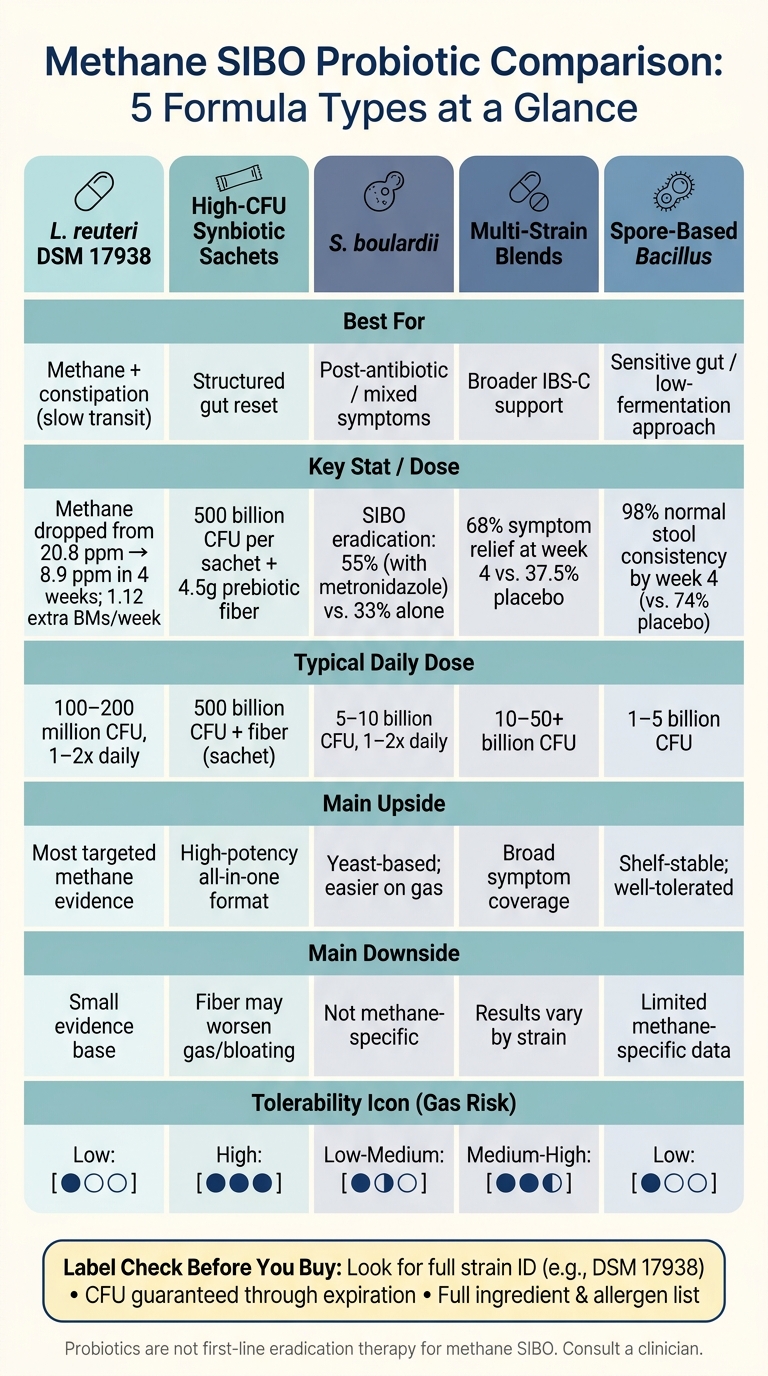
Methane SIBO Probiotic Comparison: 5 Formula Types at a Glance
Reduce Methane Dominant SIBO with TWO Simple Supplements
sbb-itb-1bbfe7f
Quick Comparison
| Formula type | Main fit | Main upside | Main downside | Best use |
|---|---|---|---|---|
| L. reuteri DSM 17938 | Methane + constipation | Most targeted option here | Small evidence base | Early support for slow transit |
| Synbiotic sachets | Reset plan | High-dose, all-in-one format | Fiber may worsen gas | Short-course structured use |
| S. boulardii | Mixed symptoms, post-antibiotic | Yeast option, often easier on gas | Not aimed at methane itself | Add-on support |
| Multi-strain blends | IBS-C + bloating | Broader symptom support | Results depend on exact strains | Later-phase support |
| Spore-based Bacillus | Sensitive gut, lower-fermentation approach | Shelf-stable, often easier to tolerate | Limited methane-specific data | If standard blends trigger symptoms |
My takeaway: don’t pick the biggest formula. Pick the one that matches your symptoms, your tolerance, and the label data. For methane-dominant SIBO or IMO, that usually means starting simple, watching symptoms for 2 to 4 weeks using a methane SIBO probiotic checklist, and stopping if gas, bloating, or constipation gets worse.
1. Rebirth RE-1 High-Strength Synbiotic Sachets
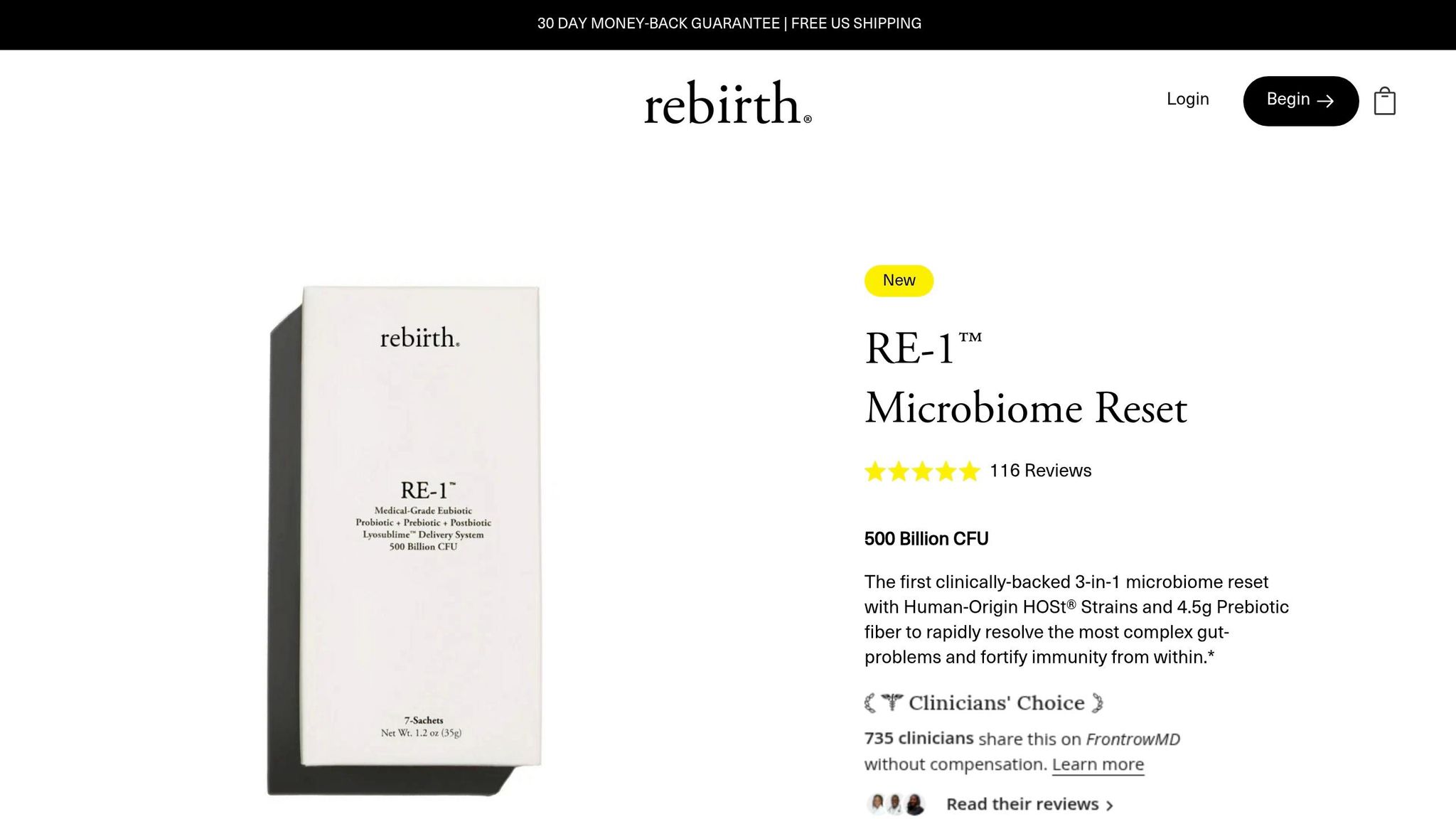
If you want a sachet-based gut reset, Rebirth RE-1 takes an all-in-one approach. Each daily sachet combines prebiotics, probiotics, and a postbiotic, which makes it a synbiotic. The formula delivers 500 billion CFU per sachet and includes bifidobacteria and lactobacilli species, a spore-forming strain, prebiotic fiber from GOS and low molecular weight inulin, plus a postbiotic component [7][8][11].
That mix is aimed at the symptoms people with methane-dominant SIBO often care about most: constipation, slow transit, and bloating. The bifidobacteria and lactobacilli strains are linked with better bowel regularity and IBS symptom support. On top of that, GOS prebiotic fiber has been studied for its potential to reduce methane levels and improve gut transit time [7][11][12][14].
There’s also a practical upside. Lyosublime™ freeze-drying helps preserve viability without refrigeration, which makes RE-1 easier to use during travel or as part of a steady daily routine [7][10][12].
RE-1 is available in a few reset lengths:
One thing to watch: inulin can make gas worse for some people. If fermentable fibers tend to set off your bloating, it makes sense to start with care. RE-1 is vegan, gluten-free, dairy-free, soy-free, nut-free, and non-GMO [7].
Next up is a simpler single-strain option for readers who want something more narrow.
2. Single-Strain Lactobacillus reuteri DSM 17938 Formulas
If you want fewer ingredients and tighter strain control, a single-strain formula is the cleanest next step. A narrow, label-clear pick is a formula built around Lactobacillus reuteri DSM 17938. The methane data here is still limited, and single-strain products make the most sense when you want one named strain and fewer moving parts.
In a 20-person retrospective study, 4 weeks of DSM 17938 lowered mean methane from 20.8 ppm to 8.9 ppm, and 11 participants dropped below 5 ppm. [3][22][23] In an RCT of 40 adults, bowel movements increased to 5.28 per week vs. 3.89 with placebo; a meta-analysis of five RCTs found an increase of 1.12 bowel movements per week. [15][16] Stool consistency changed very little, so this strain looks like a better fit for frequency support than stool softening.
Here’s the part that matters most: the label has to name Lactobacillus reuteri DSM 17938 exactly. The evidence applies only to Lactobacillus reuteri DSM 17938, not other L. reuteri products, so read the label with care before you buy. [17][18]
Common formats include drops, chewables, and capsules. Studied doses range from 10⁸ to 10⁹ CFU daily for 4 to 8 weeks. [17][6][18][19] The methane-focused study used 100 million CFU twice daily for 4 weeks. [3][22][23] Also check that the CFU count is guaranteed through expiration, not just at manufacture. [17][18]
Before buying, use a checklist for probiotic use and look for:
- Lactobacillus reuteri DSM 17938 listed on the label
- A daily CFU count that matches studied ranges
- Storage instructions that fit your routine
- A short excipient list without your allergens
Talk to your clinician first if you are severely immunocompromised, have a central line, are critically ill, or are recovering from major surgery. [19][20][21]
Next: a yeast-based option for readers with mixed bowel patterns or post-antibiotic support.
3. Single-Strain Saccharomyces boulardii Formulas
If you want a single-strain, non-bacterial option, Saccharomyces boulardii is the most straightforward pick. It’s a non-pathogenic probiotic yeast used to support gut-barrier function and microbial balance.[25][28] One thing to know up front: its effects stop when use stops.[25]
For methane-dominant SIBO, S. boulardii is more of a support tool than a methane-focused treatment. In plain English, it may help with tolerance and symptom control, but it is not a main methane-lowering approach. Most of the research is tied to diarrhea, antibiotic-associated diarrhea, and broader SIBO - not methane overproduction or constipation. So its role here is indirect. It may help support gut balance and make treatment easier to tolerate, rather than lowering methane on its own.
That said, it looks more useful when paired with other SIBO treatments. In one study, SIBO eradication rates reached 55% with metronidazole plus S. boulardii, compared with 33% with S. boulardii alone and 25% with metronidazole alone; abdominal pain, gas, and bloating also improved in the S. boulardii groups.[34] For constipation, though, the data is much less encouraging. A multicenter RCT across 10 university hospitals found that S. boulardii monotherapy produced only an 8.0% treatment success rate, defined as ≥3 bowel movements per week without incontinence at 12 weeks, compared with 26.1% with lactulose and 41.2% with the combination.[32][33]
The best-studied strain is S. boulardii CNCM I-745. It’s usually used at around 5–10 billion CFU per day or 250–500 mg twice daily for 4–8 weeks.[25][28][31] Capsules are the most common format, although some pharmacy products come in sachets.[25][28][31] A common problem in the supplement aisle is that many products list only "Saccharomyces boulardii" and leave out the strain code. That makes it much harder to match the product to a trial. Because of that, strain code and end-of-shelf-life potency matter more than the brand name.
When you compare products, look for:
- The full strain name, especially CNCM I-745
- CFU listed through expiration, not just at manufacture
- A full inactive ingredient list
There are also cases where S. boulardii should be avoided. Do not use it if you are immunocompromised, critically ill, hospitalized, or have a central venous catheter or port.[24][26][30] There is a rare but documented risk of fungemia in vulnerable patients.[35][36] It also makes sense to check for any yeast allergy or any past reaction to Saccharomyces-containing products before starting.
Use S. boulardii for antibiotic tolerance, bloating, and broader digestive support - not as a stand-alone fix for methane constipation.[25][27][28][29]
For a step-by-step approach to implementation, see our checklist for probiotic use in methane SIBO. Next: multi-strain blends for broader IBS-C and SIBO support.
4. Multi-Strain Probiotic Blends for IBS-C and SIBO Support
Multi-strain blends have the most IBS research behind them. But there’s a catch: results can shift a lot based on the exact strains, the daily dose, and how long someone takes them. For methane-dominant SIBO, these blends are best seen as support tools, not stand-alone treatment. If a single-strain product feels too limited, a multi-strain blend may offer broader support for IBS-C symptoms, especially constipation plus bloating.
Some trials do show symptom relief. In a randomized, double-blind, placebo-controlled trial with 150 IBS-C subjects, two multispecies formulas were tested for 60 days. One used Lactobacillus acidophilus + L. reuteri. The other used L. plantarum + L. rhamnosus + Bifidobacterium animalis subsp. lactis. Both had higher response rates than placebo for bloating, pain, and constipation, and those gains continued into the follow-up at day 90.[45][5] In another IBS trial, 68.0% of patients in the probiotic group had major symptom relief at week 4, compared with 37.5% in the placebo group.[47]
That said, these findings apply to the named formulas tested in the studies, not to every multi-strain blend on the shelf. That’s an important distinction. A product may help with overlapping constipation and bloating, but that does not make it a methane-focused answer.
Most IBS-C trials use daily doses in the 5–50 billion CFU range, and longer use tends to work better. In many studies, that means 8–12 weeks.[38][39] Capsules show up most often in clinical trials, though sachets are also used in higher-dose setups.[39][40][41] It’s also smart to read the full ingredient panel, not just the front label. Fructans, polyols, and extra lactose can make symptoms worse.[46]
Label detail matters a lot here. Each strain in a blend should have its own strain ID. In plain English, the label should list the full genus, species, and strain ID for each organism, not just a species name or a vague blend title.[42][43][44] And the CFU count should be guaranteed through expiration, not only at the time of manufacture.
The British Society of Gastroenterology advises trying probiotics for up to 12 weeks and stopping if there’s no clear improvement.[46] A practical approach is simple: use a labeled strain blend for 8–12 weeks, then stop if it’s not helping. If mixed-strain products seem to set off more fermentation, the next section covers spore-based Bacillus formulas.
5. Spore-Based Bacillus Probiotic Formulas
If multi-strain blends feel too fermentable, spore-based Bacillus formulas are a lower-load option. These strains form endospores, which helps them survive stomach acid, bile, and heat. Because of that, they usually don't need refrigeration.[13][54][53] That kind of stability may mean less fermentable activity in the small intestine. For methane-dominant SIBO, that can matter a lot, since lower fermentation, better tolerance, and easier day-to-day use are often the main goals.
Most human probiotic research in this category centers on Bacillus coagulans and Bacillus subtilis. The best constipation data come from named strains like B. coagulans Unique IS2, SNZ 1969, and LBSC (DSM17654). B. subtilis BS50 and MB40 also have human safety and tolerability data.[59][60][61][63][64] In one randomized trial, B. coagulans Unique IS2 brought 98% of participants to normal stool consistency by week 4, compared with 74% in the placebo group, along with a statistically significant increase in bowel movement frequency (p < 0.001).[61] In another trial, B. coagulans SNZ 1969 significantly improved colon transit time (p = 0.031) and complete spontaneous bowel movements at weeks 2 and 9.[60] Those results point to help with constipation and transit, not methane reduction.
So, Bacillus works better as a support tool than as a methane-focused treatment. It's often used as an add-on after antimicrobials, or as a fallback when standard Lactobacillus/Bifidobacterium blends lead to gas. In practice, these formulas are also used after antibiotic or herbal antimicrobial courses to help steady the microbiome, support gut balance, and reduce bloating.[48][51][55] When gas and constipation are still strong, it usually makes sense to start low and titrate up.[48][49]
This option tends to fit people who want low-ingredient, travel-friendly support and haven't done well with more fermentable blends. Common delivery formats include:
- Capsules
- Sachets or powders
- Liquid ampoules
Daily doses are often around 1–10+ billion CFU.[50][52][54][56] Single-strain liquid ampoules are more common for short, supervised courses, while multi-strain capsule blends are more often used for 4- to 12-week maintenance.[50][52][58][56]
Before buying, check the full strain ID on the label, such as DSM17654 or SNZ 1969, instead of relying on a generic Bacillus or soil-based probiotic claim. That detail matters. Safety reviews note that some Bacillus strains can produce toxins or carry transferable antibiotic-resistance genes, so it's smart to look for manufacturers that screen for both toxin production and transferable antibiotic-resistance genes.[62][65][66] Anyone who is severely immunocompromised should talk with a physician before using any live Bacillus product, since case reports have documented bacteremia in high-risk patients.[57] At that point, the main issue is pretty simple: does the strain, dose, and safety profile line up with your symptom pattern and SIBO checklist?
How These Formulas Compare: Clinical Fit, Label Quality, and Safety
After looking at each formula type on its own, it helps to line them up by symptom pattern.
Clinical Fit: Methane-Related Constipation vs. Broader IBS Symptoms
For methane-related constipation, L. reuteri DSM 17938 is the most targeted pick. High-dose synbiotic sachets make more sense for mixed symptoms and bloating. Yeast-based support plays a more indirect role, so it isn't aimed at methane itself. Multi-strain blends fit broader IBS-C cases, while spore-based Bacillus formulas tend to work better as low-fermentation support once symptoms have calmed down.
So the next filter is label quality. Two products can sit in the same formula category and still perform very differently if the strain ID or dose doesn't match what was studied.
Strain-Level Evidence and Label Transparency
SIBO research is inconsistent, which makes strain-level labeling a big deal. It's the only way to match a product to the strain used in the research.
Every label should show:
- genus, species, and strain ID
- CFU guaranteed through expiration
Some products lose CFU before they ever get to the shelf. That matters. If you're buying L. reuteri, use the exact DSM 17938 strain code. Other L. reuteri strains don't carry the same evidence. The same idea applies to Bacillus products. Look for named strain identifiers like DSM17654 or SNZ 1969, not just a vague spore-based claim.
Once the label passes that test, the next issue is day-to-day use: dose format and ingredient load.
Dose Format, Adherence, and Ingredient Load
| Formula Type | Typical Daily Dose | Format | Tolerability |
|---|---|---|---|
| L. reuteri DSM 17938 | ~100–200 million CFU, 1–2× daily [2][1][67] | Capsule or drops | Low gas risk |
| High-CFU synbiotic sachets | 500 billion CFU + 4.5 g fiber | Sachet in water; shelf-stable | May increase fermentation |
| S. boulardii | 5–10 billion CFU, 1–2× daily [27] | Capsule | Usually non-gas-forming |
| Multi-strain blends | 10–50+ billion CFU [4][48] | Capsule or powder | Watch for bloating |
| Spore-based Bacillus | ~1–5 billion CFU [4][48] | Capsule | Better tolerated later |
High-strength synbiotic gut microbiome modulation sachets can suit people who want a more structured, high-load reset and know they can handle the added fiber.
Safety Checks Before You Buy
Before you buy, check four label details that decide whether the product lines up with the evidence: CFU listed per strain, not just one combined total; CFU guaranteed through expiration, not only at manufacture; full ingredient and allergen disclosure; and storage instructions, since spore-based Bacillus products are usually shelf-stable while many Lactobacillus/*Bifidobacterium* blends need refrigeration. [4][48][70][71]
If someone is immunocompromised, they should talk with a physician before starting any live bacterial or yeast product.
The next section turns these comparisons into a simple pros-and-cons summary.
Pros and Cons of Each Formula Type
Use this table to match the stage of symptoms, label quality, and your tolerance. Don’t just reach for the strongest option.
| Formula Type | Pros | Cons | Best For | Main Watch-Outs |
|---|---|---|---|---|
| High-strength synbiotic sachets (e.g., Rebirth RE-1) | Defined reset periods (7-day, 4-week, or 12-week); very high potency at 500 billion CFU per serving | 4.5 g of prebiotic fiber per serving can aggravate gas and bloating during active methane overgrowth; harder to isolate the trigger; higher cost ($79–$749 depending on protocol) | Best after bloating eases; people who want a structured, time-limited reset | Check the prebiotic type and total fiber grams, especially GOS and inulin; consider starting with part of a sachet if you're sensitive; not ideal if bloating is severe or active |
| Single-strain L. reuteri DSM 17938 | How probiotics reduce methane data exists for this strain; in one small study, 55% of subjects had complete methane disappearance after 4 weeks [75]; usually easier to titrate | Evidence base is still small; some U.S. products do not list the DSM 17938 strain code clearly; temporary bloating or looser stools can happen when starting | Methane-dominant SIBO or IBS-C with slow transit; early- to mid-treatment targeted support | Make sure the label says DSM 17938, not just L. reuteri; start low and increase slowly |
| Single-strain S. boulardii | Non-bacterial yeast; in one study, SIBO eradication was 33% with S. boulardii alone and 55% with metronidazole [69]; useful when bacterial probiotics are poorly tolerated | Evidence specific to methane constipation is limited; rare fungemia risk in people with severe immunosuppression [27][28][37] | Post-antibiotic dysbiosis; mixed IBS patterns; adjunct use during antimicrobial phases | Avoid with central lines or severe immune suppression; confirm a documented strain such as CNCM I-745 from a reputable brand |
| Multi-strain lactic-acid blends | Broader IBS support; may help bloating, pain, and motility once methane is lower | High-dose blends can worsen gas in active methane SIBO; some strains may worsen intolerance [48][72][73][74] | Later-phase symptom support after overgrowth is better controlled | Watch for very high CFU counts and gas-producing strains; look for per-strain CFU disclosure, cGMP manufacturing, and third-party testing |
| Spore-based Bacillus formulas | Often better tolerated during active symptoms; no refrigeration needed | Evidence in methane SIBO is still limited and low-certainty [49]; product quality can vary widely | Active SIBO phases for people who react poorly to conventional probiotics; useful as a step-down option after antimicrobials | Verify the exact species and strain; avoid formulas that add herbal antimicrobials if you're already taking them |
The main idea is simple: pick the narrowest formula that lines up with your symptoms and what your gut can handle. If bloating is intense, a high-potency synbiotic with added fiber may be too much right now. On the other hand, if symptoms have started to calm down, a broader product may make more sense.
This side-by-side view helps you compare what matters most in practice: how strong the product is, how easy it is to tolerate, and how clearly the label tells you what’s inside.
Conclusion
There isn’t one best probiotic or synbiotic for methane-dominant SIBO and IMO. In practice, the main factors are your symptom pattern, what you can tolerate, and how clearly the product label matches the evidence.
Pick the formula that lines up with your symptoms, tolerance, and the data behind it. If constipation is the main problem, start with the clearest strain label you can find, such as Lactobacillus reuteri DSM 17938. If fermentable ingredients usually set you off, a high-fiber synbiotic may be tougher to start with. A sachet-based synbiotic makes more sense when you want a structured, time-limited reset and can handle added fiber.
After that, the label becomes the filter. A genus-only or species-only label isn’t enough. You want full strain designations like Lactobacillus reuteri DSM 17938 or Saccharomyces boulardii CNCM I-745.[3][15] Before buying, check:
- the full strain name
- the end-of-shelf-life CFU
- the ingredient list
- whether it includes prebiotics or other fermentable fillers
Delivery format matters too. Sachets can make adherence easier and give you more controlled dosing. Capsules may be a better fit if you want fewer ingredients.
If the label checks out, keep the trial simple. Use the simplest formula that fits your main symptom pattern, try one product at a time, and reassess after 2–4 weeks. Stop if bloating, gas, or constipation clearly gets worse. Probiotics are not first-line eradication therapy for methane-dominant SIBO or IMO.[68][76][77] They work best as one part of a broader plan, ideally guided by breath-test results and a clinician who knows gut motility and microbiome testing. For methane-dominant SIBO, the safest move is usually the narrowest formula that fits your main symptom and your tolerance.
FAQs
How do I know which formula type fits my symptoms?
Start with a symptom journal. Write down bowel movements, bloating, gas, and any stomach discomfort. That simple habit can help you spot patterns you might miss day to day.
Since SIBO can show up in different ways, it’s smart to talk with a healthcare professional and confirm your subtype with a hydrogen and methane breath test.
Once you know what you’re dealing with, look for clinically backed, medical-grade formulas that support the gut in a targeted way. For methane-dominant SIBO, some people respond well to synbiotic blends like Rebirth RE-1. It combines 500 billion CFU of Human Origin Strains, 4.5 g of prebiotic fiber, and the Lyosublime delivery system.
Why does the exact strain code matter?
The exact strain code matters because probiotics are strain-specific. Put simply, two probiotics can share the same species name and still act very differently in the gut.
That’s why a generic blend name isn’t enough. It doesn’t tell you if the formula includes the strains that have actually been studied for your symptoms.
For methane-dominant SIBO, this matters even more. Some strains may help lower methane. Others may support methane-producing microbes and make bloating, constipation, or discomfort worse.
Full strain identification gives you a way to check what’s in the product instead of guessing. You can compare the label with the organisms used in research and see whether the formula lines up with what has been studied.
When should I stop a probiotic if symptoms worsen?
If symptoms like bloating, gas, or constipation get worse, don’t panic right away. Sometimes your gut just needs time to adjust.
A simple first step is to change the dose or timing. For example, try taking it with a light snack instead of on an empty stomach.
If the symptoms stick around for several weeks, get worse, or you notice warning signs like brain fog, stop the probiotic and talk with a healthcare professional.