

Bottom line: I can’t say Bifidobacterium longum prevents or treats viral airway infections in people. What I can say is that some strains may support normal immune function through the gut-lung axis, with most of the data coming from animal work and a small amount of strain-specific human research.
If you want the short version, here it is:
- Human proof is limited
- Results depend on the exact strain
- Most oral use data point to immune support, not antiviral protection
- Intranasal data help explain mechanism, but they do not show human benefit
- Mixed-formula studies make it hard to know what one strain is doing
A few points stand out right away:
- B. longum is a gut bacterium, but researchers think gut signals may affect the lungs
- Oral use may influence GALT, TLR signaling, mucosal IgA, and T-helper balance
- One strain, B. longum BB536, has been linked with improved respiratory comfort in human research
- Some work also points to shifts in TNF-alpha and IL-10, which track with lung injury and viral load in animal models
- Prebiotics may matter too, because bifidobacteria often rely on them to grow and function
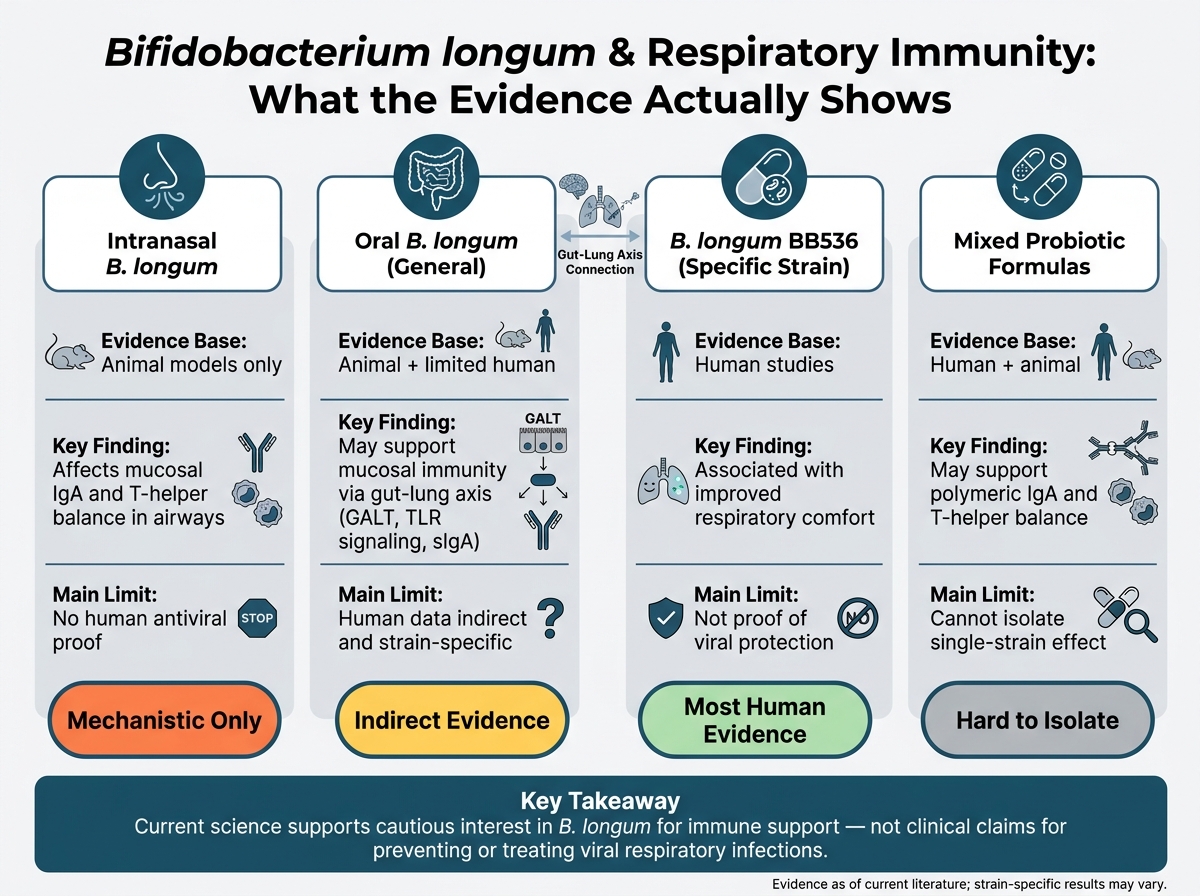
Bifidobacterium longum for Airway Health: Evidence Comparison by Approach
Quick comparison
| Approach | What I can say now | Main limit |
|---|---|---|
| Intranasal B. longum | Helps study airway immune signaling in animals | No clear human antiviral clinical evidence |
| Oral B. longum | Better match for daily use and gut-lung signaling | Human data are indirect and strain-specific |
| BB536 | Linked with respiratory comfort in people | Not proof of viral protection |
| Mixed probiotic formulas | May support mucosal immune markers like pIgA | Hard to isolate the effect of one strain |
So if you’re reading this for a simple answer, it’s this: the science supports cautious interest, not clinical claims. I’d treat B. longum as a topic in immune-support research, not as a stand-alone answer for colds, flu, or other viral airway illness.
sbb-itb-1bbfe7f
Intranasal Bifidobacterium longum in viral and airway models
Direct airway exposure gives researchers a way to test mechanism first. That matters here because intranasal B. longum data are limited. So this section focuses on mechanistic animal evidence, not proven human benefit.
Influenza findings: viral load, lung injury, and survival
The source set does not report intranasal B. longum influenza outcomes for viral load, lung injury, or survival.
Immune markers changed by direct airway exposure
The main airway markers reported are mucosal IgA and a more balanced T-helper response, but those findings do not show antiviral benefit in people [1].
What intranasal studies can and cannot tell us
Mouse studies help explain what may be happening in the airway. That's useful for understanding how direct exposure might affect immune signaling.
But mouse data don't map neatly onto routine human use. For that reason, oral studies are still the more practical evidence base for human use.
Oral Bifidobacterium longum and gut-mediated respiratory support
Oral B. longum works through gut-mediated immune signaling, not by making direct contact with the airways [1].
Animal and mechanistic findings: cytokines and lung outcomes
In viral lung models, TNF-alpha and IL-10 tend to move with viral load and lesion severity [4]. In plain terms, when those markers shift, lung damage and viral burden often shift too. Probiotic bacteria have also been shown to downregulate TNF-alpha production [1].
That helps explain how oral probiotics might affect respiratory health. But it does not count as clinical proof. It points to a mechanism, not a confirmed treatment effect in people.
Human evidence is less direct, and it seems to depend on the specific strain.
Human studies: respiratory comfort and immune support
One oral strain discussed here is B. longum BB536, a human-origin strain [2]. In available human data, BB536-containing formulas have been associated with improved respiratory comfort [2].
| Strain / approach | Evidence base | Dose / duration | Reported outcome |
|---|---|---|---|
| B. longum BB536 | Human studies | Not specified | Improved respiratory comfort [2] |
| Oral probiotics including bifidobacteria | General immune evidence | Varies | Increased polymeric IgA and balanced T-helper signaling [1] |
That distinction matters. These findings point to respiratory support, not proven antiviral protection. And because the human evidence is mostly strain-specific and often comes from mixed-formula products, it doesn't make sense to generalize the results to all B. longum supplements.
Why oral delivery is more relevant to everyday use
For everyday use, oral delivery is the more relevant route, even if the evidence is still indirect. Oral probiotics may support mucosal immune defenses through the gut-lung axis [1].
The key idea is simple: oral delivery matters because it works through mucosal immune signaling, not direct airway exposure. That said, the current evidence still stays one step removed from proving a direct respiratory effect [1].
Strain Specificity, Mechanisms, and Research Limits
Even when oral results look promising, the exact strain and formula matter a lot. B. longum isn’t one single thing. It includes many different strains, and their immune effects can change based on genetics, dose, route, and formulation.
Why Strain Identity Matters
The pathways these strains affect - including T-helper cell balance, GALT signaling, TLR interactions, and mucosal IgA production - are strain-specific [1]. In plain English: one B. longum strain can behave differently from another.
So, not every B. longum strain will support airway defense. And findings from one strain should not be carried over to another as if they were interchangeable.
| Strain / Approach | Route | Key Immune Mechanism | Reported Outcome |
|---|---|---|---|
| B. longum BB536 | Oral | General immune support | Improved respiratory comfort [2] |
| B. longum (general) | Oral | GALT signaling, sIgA stimulation | Enhanced mucosal surface protection [1] |
| B. longum (SynCom) | Oral | SCFA (butyrate) production | Regulation of inflammation and immune training [3] |
Mechanisms That May Link the Gut to the Lungs
One of the main routes being studied is gut-associated lymphoid tissue (GALT). When oral B. longum strains interact with Toll-like receptors (TLRs) on gut epithelial and lymphoid cells, they can shape both innate and adaptive immune responses [1]. Those gut-level signals may then influence respiratory immunity.
Another piece of the puzzle involves microbial metabolites, especially short-chain fatty acids (SCFAs) such as butyrate. These are produced when bifidobacteria ferment prebiotic fibers. SCFAs help regulate inflammation and may train immune cells to respond in a more measured way during infection [3].
Researchers are also looking at postbiotic activity. That means immune-signaling molecules from bacteria may stay active even when live cells are no longer present [2].
That all helps explain why this could work. But plausibility is not the same as proof.
Main Limitations in the Current Evidence
The biggest issue is that much of the evidence is still preclinical, so it only goes so far when applied to humans. Human trials are less common, and many use mixed multi-strain formulas. That makes it hard to tell what a single strain is actually doing.
There’s another catch: these studies often track indirect outcomes, such as self-reported respiratory comfort, instead of confirmed antiviral endpoints. On top of that, not every B. longum strain has been tested in respiratory settings, which leaves a big gap in interpretation.
So yes, the early signal is encouraging. But the current evidence does not support prevention or treatment claims for viral respiratory disease.
What the Findings May Mean for Human Use
How to Read the Evidence Without Overstating It
The evidence is still early. It points to biological plausibility, not proof of a clinical effect in people.
The bottom line is simple: current research does not support a firm claim that any B. longum strain prevents or treats viral respiratory infections in humans. Prebiotic fermentation helps sustain intestinal defenses and may shape mucosal immunity [1]. That gives us a reasonable immune-support pathway to look at. But a plausible mechanism is not the same thing as a proven human outcome.
So when people talk about human use, the right stance is caution. The science suggests possibility, not confirmation.
Where a Microbiome-Centered Product May Fit
If a product comes up, it should be positioned as general immune support tied to this mechanism, not as proof of treatment.
Prebiotics like inulin-type fructans are needed to stimulate the proliferation and protective functions of bifidobacteria [1]. That means a synbiotic approach lines up with the gut-lung axis model discussed here. It makes sense as a way to support normal immune maintenance.
That said, this is not evidence of antiviral treatment. It’s closer to supporting the body’s base systems than pressing an ON button for infection control.
Key Takeaways
A few points matter most here:
- Immune effects are strain-specific, so findings from one B. longum strain do not automatically carry over to another.
- Human evidence is still limited.
- Larger, well-controlled human trials are still needed before anyone makes clinical claims.
- For now, the research supports cautious interest, not clinical conclusions.
Think of microbiome support as building a foundation, not flipping a switch.
FAQs
Which B. longum strains have human respiratory data?
Based on the sources provided, the only named strain linked to human respiratory use is Bifidobacterium longum BR-BB536.
No other B. longum strains are named in these results for respiratory data.
Why doesn’t intranasal research prove human benefit?
Results from viral airway models don’t reliably carry over to people. Probiotic effects depend on live strains reaching the right tissues in high enough amounts, and limits in viability or delivery can change whether doses at the human target site are even comparable.
There’s another issue too: mucosal immune protection is highly context- and site-dependent. So even if a model shows immune stimulation in one setting, that doesn’t mean human airways will respond the same way.
Do prebiotics make B. longum more effective?
Yes. Prebiotic fibers such as inulin-type fructans can increase bifidobacteria in the colon. That shift may help B. longum better support mucosal immune markers like polymeric IgA and balanced T-helper responses.
The key point is that prebiotics work indirectly. They feed helpful microbes rather than acting on the body themselves. In related viral airway models, that kind of microbiome support may help strengthen respiratory defense.