

Your gut can affect your mood. The short version: a high-fiber diet, fermented foods, steady sleep and exercise, and the right probiotic or synbiotic may help support lower stress, anxiety, and depression symptoms for some people.
Here’s what I’d want you to know right away:
- The gut and brain talk to each other through nerve, immune, and hormone signals.
- When gut microbes get out of balance, inflammation can go up and mood can suffer.
- Fiber feeds gut microbes, which then make compounds like SCFAs that help the gut lining and may affect the brain.
- Western-style eating patterns - high in ultra-processed foods and low in fiber - are linked with worse gut health and more mood symptoms.
- Probiotics may help, but results are mixed and usually modest.
- In research, mood support often shows up after 8 to 12 weeks, not a few days.
- Probiotics are not a replacement for therapy, medication, or medical care.
A few numbers stand out:
- A 2025 review of 23 RCTs found lower depression and anxiety scores with probiotics.
- A 2026 meta-analysis also found lower symptom scores, but study results varied a lot.
- General exercise guidance stays 150 minutes per week plus 2 strength sessions.
- Daily fiber targets are about 25 g for women and 38 g for men.
If I had to sum up the whole article in one line, it would be this: food and daily habits do most of the work, and probiotics may add a little extra help on top.
That’s the idea behind the gut-brain axis: your mood is not just “in your head.” Parts of it may start in your gut too.
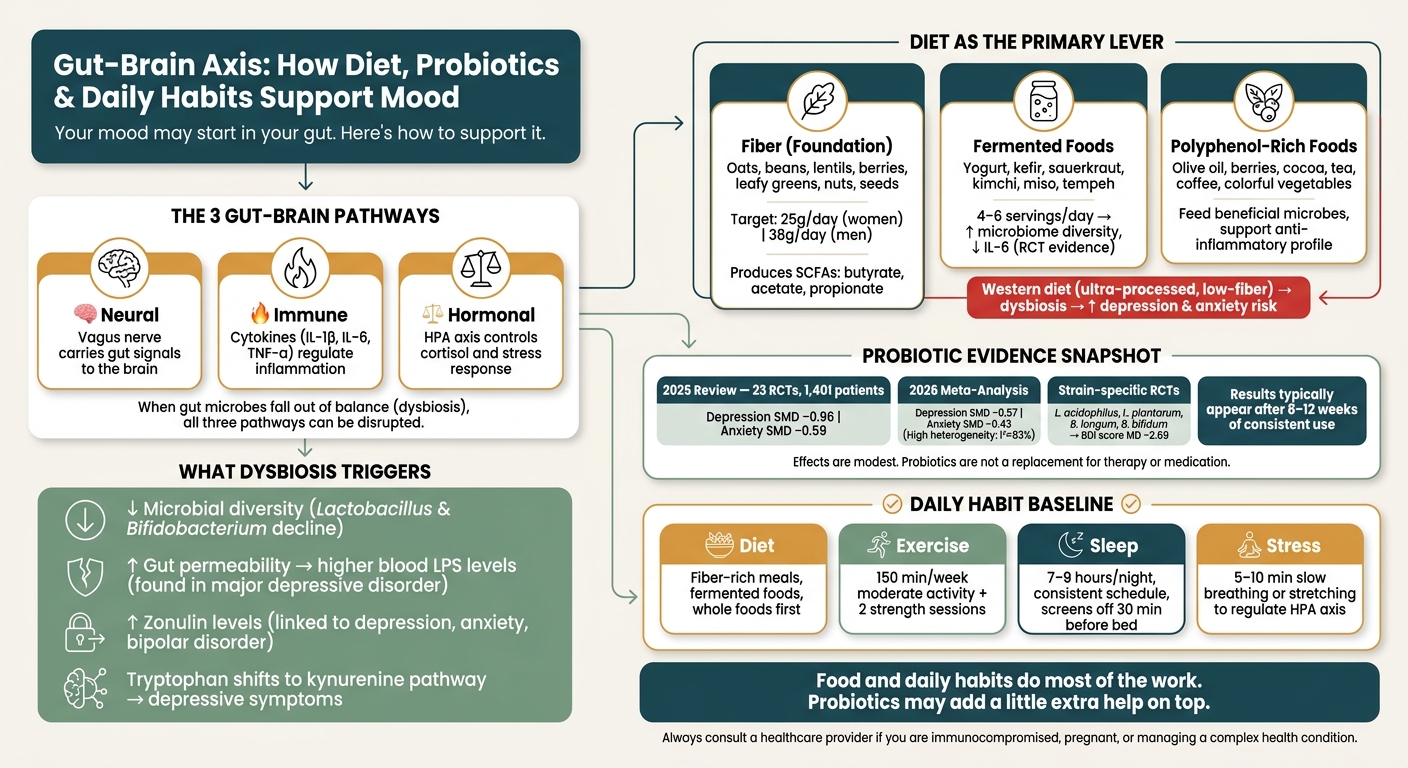
Gut-Brain Axis: How Diet, Probiotics & Daily Habits Support Mood
PROBIOTIC (HARVARD): The GUT-BRAIN Connection Unveiled #DigestiveHealth #Probiotics #MentalWellness
sbb-itb-1bbfe7f
How the Microbiome, Immune System, and Stress Response Work Together
Gut signals reach the brain through three main routes: neural, immune, and hormonal.
3 key pathways: neural, immune, and hormonal signaling
The vagus nerve is the neural route. It carries signals from the gut to the brain, including microbial and inflammatory cues that can shape mood and stress. Lower vagal activity is linked to more inflammation and a higher risk of depression.[1][2][5]
The immune pathway works through cytokines, which are proteins that signal inflammation. People with depression often show higher levels of pro-inflammatory cytokines such as IL-1β, IL-6, and TNF-α than healthy controls.[9] Gut microbes help regulate this system, in part through metabolites like short-chain fatty acids (SCFAs), which can calm inflammatory signaling.
The hormonal pathway runs through the hypothalamic-pituitary-adrenal (HPA) axis, the body’s main stress system. It controls cortisol output. When stress sticks around for too long, it can throw off HPA regulation, which may affect gut barrier function and microbial balance. And it doesn’t stop there. Gut microbes can also shape how strongly the HPA axis reacts to stress.[1][3][7] In short, the system works both ways.
What dysbiosis changes inside the body
When the microbiome drifts out of balance, several shifts can happen at the same time. Microbial diversity drops, and genera such as Lactobacillus and Bifidobacterium often decline.[4] With fewer microbes that make SCFAs, the gut lining gets less support against inflammation and less help maintaining its barrier.
That gut barrier matters more than it may seem. If it becomes less stable, compounds like lipopolysaccharide (LPS) - part of certain bacterial cell walls - can move into the bloodstream more easily. Clinical studies have found higher blood LPS levels in patients with major depressive disorder than in healthy controls.[8][10] Researchers have also found higher levels of zonulin, a protein involved in regulating tight junctions in the gut lining, in people with depression, anxiety, and bipolar disorder.[8]
Dysbiosis can also change how the body uses tryptophan, an amino acid tied to serotonin-related pathways. During inflammation, tryptophan metabolism tends to shift toward the kynurenine pathway instead. That shift has been linked with depressive symptoms.[4][6][7] The downstream effects can include brain fog, more stress sensitivity, poor sleep, and slower emotional recovery.
Because these pathways respond to microbial shifts, diet becomes the next lever.
How Diet Shapes Gut Microbes and Mood
Diet is one of the clearest ways to shape the gut microbiome. What you eat day after day affects which microbes stick around and what kinds of signals they send to the brain. If dysbiosis throws things off, food can help move the system back in the right direction. And since inflammation and stress signaling already affect mood, diet becomes the next big lever.
Foods that support the microbiome-mood connection
Fiber is the foundation. Gut microbes ferment fiber from oats, beans, lentils, berries, apples, leafy greens, nuts, and seeds into short-chain fatty acids, or SCFAs, especially butyrate, acetate, and propionate.[13][14][16] These SCFAs help strengthen the gut lining, lower inflammation throughout the body, and affect brain pathways tied to mood.[12][13] Put simply: fiber gives gut microbes the raw material they need to do some of their best work. It also has some of the strongest evidence for mood support.
Fermented foods add another layer. Foods like yogurt, kefir, sauerkraut, kimchi, miso, and tempeh provide live cultures and fermentation byproducts that may support microbial diversity and help cool inflammation. In one prospective randomized trial, people who ate about 4 to 6 servings of fermented foods per day saw measurable increases in microbiome diversity, along with drops in circulating IL-6.[16]
Polyphenol-rich foods help too. Olive oil, cocoa, tea, coffee, berries, grapes, and colorful vegetables can feed helpful microbes and support a healthier inflammatory profile. That means the benefits do not just come from fiber alone. Different food compounds seem to work together.
How a Western-style diet can work against gut and mood health
A Western diet - high in ultra-processed foods, sugar, refined grains, and saturated fat, and low in fiber - is linked to dysbiosis.[11][13][15] Ultra-processed foods can weaken the gut lining, reduce helpful species, and push the body toward inflammation.[11][17][21] Reviews and meta-analyses also connect higher ultra-processed food intake with more depression and anxiety symptoms, with gut microbiota disruption flagged as one key pathway.[18][19][20]
This does not mean you need a perfect diet. Far from it. The goal is a steady shift toward whole foods, fiber-rich meals, and fermented options that fit normal life.
A practical daily plate for gut-brain support
Here’s what a gut-brain-supportive day of eating can look like for a typical U.S. adult, using familiar foods you can find in most grocery stores:
| Meal | What's on the plate | Why it helps |
|---|---|---|
| Breakfast | Steel-cut oatmeal with blueberries, walnuts, and ground flaxseed; plain yogurt with live cultures; coffee or tea with minimal added sugar | Fiber, polyphenols, live cultures |
| Lunch | Black bean and brown rice bowl with mixed greens, tomatoes, avocado, olive oil drizzle, and a side of sauerkraut | SCFA support, healthy fats |
| Dinner | Baked salmon or tofu with roasted Brussels sprouts, carrots, and sweet potatoes; miso soup or kimchi; whole-grain bread | Protein, fiber, fermented foods |
| Snacks | Fresh fruit, a small handful of nuts, or plain kefir | Fiber, polyphenols, live cultures |
These shifts do not change things overnight. But they help set the stage that probiotics can build on. From there, probiotics and synbiotics can add more targeted support to this food-first base.
Probiotics, Psychobiotics, and Synbiotics: What the Evidence Shows
Diet comes first. Probiotics can then add more focused support.
Probiotics are live microbes that may help health. Prebiotics feed those microbes. Synbiotics bring both together in one product, with the goal of helping live strains survive and do well in the gut.
What clinical research says about mood support
The research points in a good direction, but the effects are modest.
A 2025 systematic review of 23 randomized controlled trials (RCTs) with 1,401 patients found that probiotics reduced depressive symptoms and anxiety symptoms, with pooled effect sizes of SMD −0.96 for depression and SMD −0.59 for anxiety.[25] A separate 2026 GRADE-assessed meta-analysis found lower depressive symptoms at SMD −0.57 and anxiety at SMD −0.43. That same review also reported high heterogeneity - I² = 83% for depression and I² = 80.5% for anxiety.[27]
So yes, the average result is positive. But there’s a catch: outcomes differ a lot from one study to the next, and from one product to another.
Across reviews, depression results usually line up more than anxiety results. Anxiety findings are more uneven. Some trials show a clear effect. Others find no difference from placebo, especially in people with mild symptoms or no clinical symptoms at all. Right now, probiotics have the strongest data for mood support. Synbiotics look promising. Prebiotics and postbiotics have less research behind them.
That’s why the word “probiotic” by itself doesn’t tell you much. The strain matters.
Why strain choice and formulation matter
Not all probiotics work the same way. That’s the whole point.
A 2024 strain-specific meta-analysis of 12 RCTs and 707 participants found that certain strains - including Lactobacillus acidophilus, L. plantarum, Bifidobacterium longum, and B. bifidum - were linked with lower depression scores on the Beck Depression Inventory (BDI), with a pooled mean difference of MD −2.69 (95% CI −4.22 to −1.16).[26]
These strains may help mood in a few ways:
- Lowering inflammation
- Strengthening the gut barrier
- Influencing vagus-nerve signaling
The effect may be stronger in people with dysbiosis or more pronounced mood symptoms. Trial length also seems to matter. Most studies with positive findings run for 8 to 12 weeks or longer and use multi-strain formulas with clearly listed CFU counts.
How Rebirth RE-1 fits into a gut-brain support plan
Rebirth RE-1 is a clinically backed 3-in-1 eubiotic synbiotic that combines prebiotics, probiotics, and postbiotics in one daily sachet.[22] It includes Human Origin Strains (HOSt™), 500 billion CFU per serving, and 4.5 g of prebiotic fiber from GOS and inulin.[22]
Many mood-focused trials run for 8 weeks or more, so the 4-week and 12-week reset options are the closest fit to the time frames used in research.[23][24] In practice, RE-1 makes the most sense as a structured way to add synbiotic support to a food-first plan. It’s not a standalone fix. It’s one part of the picture.
The rest still matters most: diet, sleep, stress control, and regular movement.
Daily Habits, Safety, and Key Takeaways
A simple daily routine for food, stress, sleep, and movement
Once diet and probiotics are in place, your day-to-day habits shape how much of that work actually reaches the gut-brain axis. The big levers are pretty simple: food, movement, stress, and sleep. What matters most is doing them again and again over time.
A good daily baseline looks like this: eat regular meals, add fiber slowly, include fermented foods if they sit well with you, and drink enough water. When increasing fiber, go up by about 3 to 5 grams every few days until you reach 25 grams per day for women and 38 grams for men. That slow build matters. If you rush it, your gut may push back with gas or bloating.
For exercise, the U.S. guidelines call for 150 minutes of moderate-intensity activity per week plus 2 days of strength training. That can be brisk walks, cycling, swimming, or whatever gets you moving at a steady effort. Sleep matters just as much. Aim for 7 to 9 hours per night and try to keep your bedtime and wake time steady. A short wind-down routine can help more than people think: turn screens off 30 minutes before bed, then spend 5 to 10 minutes on slow breathing or light stretching. That can help regulate the HPA axis and the autonomic nervous system, both of which affect gut function and tie into mood.[28][31]
These habits support the microbiome-mood link in direct ways. Fiber feeds microbes that produce SCFAs. Movement helps support microbial diversity. Sleep helps keep HPA regulation on steadier ground. Put another way: the basics do a lot of the heavy lifting. Use them to back up a 7-day, 4-week, or 12-week reset, but don’t treat the reset itself as the finish line.
Safety, evidence limits, and when to see a doctor
Before you start taking a probiotic or synbiotic on a regular basis, it’s smart to look at the safety limits first.
In healthy adults, probiotics and synbiotics are usually well tolerated. The most common side effects are mild and temporary, such as gas or changes in stool consistency. But some people need medical guidance before using them, especially those who are immunocompromised, critically ill, pregnant, or managing complex digestive conditions like SIBO or severe IBD. In those cases, safety depends on the person, the strain, and the dose. Rare but serious events, including bloodstream infections, have been reported in high-risk groups, especially in people with central venous catheters or structural heart disease.[30]
It’s also worth being clear about what this can and can’t do. Even with strong habits in place, mental health symptoms may still need clinical care. Microbiome-based steps do not replace therapy or medication. The effects seen in research are modest, many studies focus on people with mild or subclinical symptoms, and trial periods are often short. Psychotherapy and medication still remain first-line care. Diet, sleep, movement, and a synbiotic like Rebirth RE-1 can support that care in a meaningful way, but they are not substitutes for it.[29][31]
FAQs
How do I know if my gut is affecting my mood?
Possible signs show up when mood shifts seem to move along with gut symptoms like bloating or discomfort. You might also notice more stress or poorer sleep. Gut imbalance can affect neurotransmitters such as serotonin and GABA.
Another clue is gut inflammation or increased permeability. That can influence the brain through immune signaling and the vagus nerve. And if your stress, mood, and sleep improve when you support your gut microbiome, that can point to a gut-brain link.
What should I eat first to support the gut-brain axis?
Start with a Mediterranean-style diet built around fiber-rich whole foods and fermented foods. Think whole grains, legumes, vegetables, fruits, nuts, and seeds. These foods help feed the good bacteria in your gut.
It also helps to add fermented foods like yogurt, kefir, sauerkraut, kimchi, and miso. Try to eat meals at about the same time each day too, since consistency can help your gut settle into a better rhythm.
You may also consider Rebiirth RE-1 if you want extra support to help restore gut balance fast.
How long do probiotics usually take to affect mood?
With steady daily use, probiotics can start to support mood in as little as 2 weeks. In most cases, though, more noticeable changes show up in about 4 to 8 weeks. For many people, the strongest effects tend to build over 8 to 12 weeks of daily use.
Rebiirth RE-1 is built around that timeline, with 7-day, 4-week, and 12-week microbiome protocols aimed at helping balance the gut environment and support the gut-brain axis.