

Short answer: I can’t say synbiotics improve working memory based on the studies here. The human research is small, mixed, and often uses tests that measure other parts of cognition instead of working memory itself.
Here’s the plain-English takeaway:
- Working memory is a specific skill, not the same as memory in general or overall cognition.
- Only direct working-memory tests count for this question, such as backward digit span or the One Back task.
- In the cited human studies, the synbiotic arms did not show a clear working-memory gain.
- One 8-week trial in 118 adults found a small signal in a probiotic-only group, but not in the synbiotic group.
- Other studies reported changes in recall, MMSE, or Rey–Osterrieth scores, but those are not direct working-memory measures.
- Biology may support a gut-brain link, but that does not prove a working-memory effect in people.
- Results from one formula do not carry over to another. That includes Rebirth RE-1.
If you want the bottom line fast, it’s this: the current evidence points to promise, not proof, and there is no clear basis for a blanket claim that synbiotics help working memory.
| What I looked at | What the article shows |
|---|---|
| Direct working-memory tests | Very little human evidence |
| Synbiotic results | No clear working-memory gain |
| Other memory or cognition results | Mixed, but often not about working memory |
| Mechanism studies | Possible gut-brain pathways, not proof |
| Rebirth RE-1 | Not directly tested in the cited working-memory studies |
So if you’re asking, “Do synbiotics help working memory?” my answer is simple: not proven at this point.
How Researchers Measure Working Memory in Synbiotic Studies
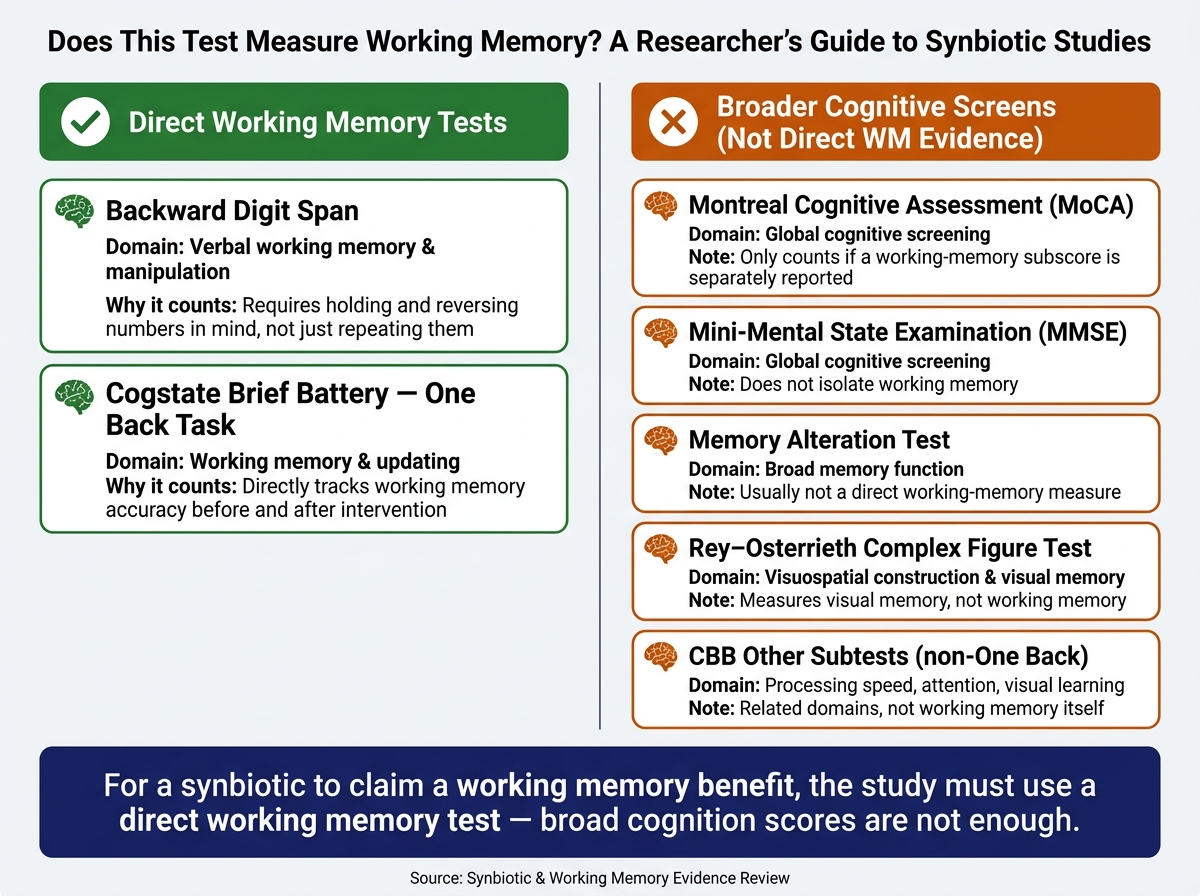
Synbiotics & Working Memory: Direct Evidence vs. Broad Cognitive Tests
If a study says a synbiotic helped working memory, it needs to use a test that measures working memory directly. A broad cognition score isn't enough. That's the line that matters here: direct working-memory tasks on one side, broad cognitive screens on the other.
Direct Working-Memory Tests and Stress-Sensitive Measures
The test a study uses can make or break a working-memory claim. Two common direct measures are backward digit span and the One Back task from the Cogstate Brief Battery (CBB).
Backward digit span is simple on the surface. A researcher reads out a string of numbers, and the participant repeats them in reverse order. The longer the correctly reversed sequence, the better the score. This is a direct verbal working-memory test because the person has to hold the numbers in mind and manipulate them, not just repeat what they heard.
The Cogstate Brief Battery (CBB) also includes a One Back working-memory task, along with other subtests that measure different domains.
In an 8-week randomized trial, researchers gave the CBB at baseline and again at week 8 so they could track change over time.[5] Timing also matters. In one multispecies probiotic trial, researchers tested backward digit span both before and within about 5 minutes after an acute stress task.[3] That setup pointed to a stress-buffering effect, not just a plain baseline lift , a phenomenon often explored in research on the gut-brain axis in anxiety, with a treatment interaction of F(1,56) = 4.48, p = 0.039, partial η² = 0.07.[3] A study that checks participants only at week 8, with no stress challenge, could easily miss that kind of result.
Other tests can still help round out the picture. But when the question is working memory, only direct working-memory tasks count as the main evidence.
Broader Cognitive Tests Reported Alongside Memory Outcomes
Other tools show up a lot in this research, including the Montreal Cognitive Assessment (MoCA), Mini-Mental State Examination (MMSE), Memory Alteration Test, and Rey–Osterrieth Complex Figure Test. These can tell you something about cognition or memory in a broad sense, but they do not isolate working memory.
The table below separates direct working-memory tests from broader cognitive screens.
| Test | Cognitive domain | Scoring direction | Typical timing | Direct working-memory evidence? |
|---|---|---|---|---|
| Backward digit span | Verbal working memory and manipulation | Higher span = better | Baseline and immediately post-stress | Yes |
| Cogstate Brief Battery - One Back | Working memory and updating | Higher accuracy generally = better | Baseline and post-intervention | Yes, for this subtest |
| Cogstate Brief Battery - other subtests | Processing speed, attention, visual learning | Accuracy higher = better; reaction time lower = better | Baseline and post-intervention | No - related domains |
| Montreal Cognitive Assessment | Global cognitive screening | Higher total = better | Baseline and post-intervention or follow-up | No, unless a working-memory subscore is reported |
| Mini-Mental State Examination | Global cognitive screening | Higher total = better | Baseline and post-intervention or follow-up | No |
| Memory Alteration Test | Broad memory function | Higher = better, depending on version | Baseline and post-intervention | Usually no |
| Rey–Osterrieth Complex Figure | Visuospatial construction and visual memory | Higher copy or recall = better | Baseline and follow-up | No |
Those differences shape which trial results can back up a working-memory claim.
sbb-itb-1bbfe7f
What Human Studies Show So Far
Human studies are still small, mixed, and rarely built around working memory as the main target.
Direct Working-Memory Results and Indirect Memory Signals
The closest randomized evidence comes from the 8-week "Gut Feelings" trial. It included 118 adults with low mood and room for diet improvement. Researchers used a 2 × 2 factorial design and assigned people to a probiotic supplement, a high-prebiotic diet, both together in the synbiotic arm, or control conditions. They measured cognition with the Cogstate Brief Battery, which covered processing speed, attention, visual learning, and working memory.[6]
The probiotic-only arm showed a small but uncertain working-memory signal: Cohen's d = −0.32, 95% CI (−0.67 to 0.03), with a posterior probability of benefit of 96%.[6] The synbiotic arm did not show a clear working-memory benefit.[6] That creates an obvious puzzle. If some studies hint at an effect, why do direct working-memory results keep coming back uneven?
There are a few other memory-related signals, but they don't give a direct answer. A 4-week synbiotic study reported better immediate and delayed recall. That's useful context, but recall is not the same thing as working memory.
A small crossover study in older adults with mild cognitive impairment also reported better MMSE and Rey–Osterrieth scores. Still, the sample was too small to support a firm read.[7]
Null Results, Inconsistent Findings, and Study-Quality Limits
| Population | Intervention | Comparator | Duration | Test Used | Main Result | Key Limitation |
|---|---|---|---|---|---|---|
| 118 adults with low mood and potential for dietary improvement | Probiotic supplement, high-prebiotic diet, or both | Placebo/usual-diet factorial controls | 8 weeks | Cogstate Brief Battery, including working memory | Probiotic arm: Cohen's d = −0.32, 95% CI (−0.67 to 0.03); synbiotic arm showed no clear working-memory benefit [6] | Confidence interval crossed zero; working memory was a secondary outcome; multiple endpoints |
| Adults in a 4-week synbiotic study | Synbiotic containing 5 g of prebiotic material | Comparator not fully specified in available result | 4 weeks | Immediate- and delayed-recall measures | Reported better scores on immediate and delayed recall; exact effect estimates not available | Short duration; unclear generalizability; recall is not a direct working-memory test |
| 19 adults aged 64–85 years with mild cognitive impairment | Synbiotic containing Enterococcus faecium | Isocaloric vehicle, crossover design | 8 weeks per treatment period with 3-week washout | MMSE and Rey–Osterrieth Complex Figure Test | Better scores from baseline on MMSE and Rey–Osterrieth memory; memory result reported at approximately p = 0.03 [7] | Very small sample; crossover and carryover concerns; neither test is a direct working-memory measure |
What do these studies show? More of a hint than a verdict.
Across the set, the same issues keep showing up: small samples, short study periods, and different ways of measuring cognition. Many trials treat cognition as a secondary or exploratory endpoint instead of building the whole study around it. And when working memory does get measured, researchers don't use one common test. Some use Cogstate tasks. Others use recall tests or the Rey–Osterrieth memory score. Those tools overlap, but they are not measuring the exact same thing.
Taken together, the human data do not support a universal working-memory claim for synbiotics. The pattern points to possible gut-brain effects, but not a steady working-memory result across populations. To see why the signal stays uneven, the next section looks at how prebiotics, probiotics, and postbiotics may interact in gut-brain pathways.
How Prebiotics, Probiotics, and Postbiotics May Work Together in Gut-Brain Pathways
Human findings are mixed. So the next step is to ask a simpler question: does the biology make sense at all?
Plausible Pathways Linking the Gut and Brain
At a basic level, yes - it does. Gut microbes ferment prebiotics into short-chain fatty acids, which may affect inflammation, gut barrier function, and brain signaling.[10][14] Probiotic strains may also shape microbial metabolites and neurotransmitter-related signals, but those effects depend on the strain. You can't assume one product will act like another.[9][12][16] Postbiotics add another layer by delivering microbial signals without using live organisms.[12][16]
That helps explain the logic behind combined formulas. The idea is that fermentable fibers, live microbes, and microbial signals may work together. But plausible doesn't mean proven. And it definitely doesn't mean the effects will stack neatly or boost each other every time.[12][16]
For working memory, the main pathways people look at are inflammation, barrier integrity, and neural signaling.[10][11][13][15] The catch is that support for these pathways is uneven. Some of it comes from cell work and animal research. Some comes from human association studies. And only a smaller share comes from controlled human trials.
Why Mechanism Studies Do Not Prove Working-Memory Benefits
This is where things often get blurry. A shift in the microbiome - or in metabolite levels - doesn't automatically mean working memory got better.
Cognitive test scores can move for all sorts of reasons, including:
- practice effects
- sleep quality
- mood
- stress
- caffeine
- baseline ability
A 2021 systematic review described evidence that some probiotics and prebiotics may influence cognitive function through SCFA production, neuroinflammation, and brain-derived neurotrophic factor-related pathways, but it did not establish a universal working-memory effect.[4]
The stronger studies don't just look at test scores. They pair cognitive testing with microbiome profiling, metabolite data, inflammatory markers, and checks on mood or sleep. Without those side-by-side measures, a better score on a memory task is hard to read. Was it the intervention? Better sleep the night before? Less stress? A bit more coffee?
That same biology is one reason multi-ingredient formulas keep showing up in research. Still, mechanism alone does not confirm any single product.
Where Rebirth RE-1 Fits Within This Evidence
Rebirth RE-1 is a 3-in-1 synbiotic with HOSt™ strains, GOS and inulin, and postbiotic components. Its formula lines up with the gut-brain hypothesis. But it is not the product tested in the working-memory studies cited here.
That matters. Results from other formulations can't be transferred straight to Rebirth RE-1, and formula similarity is not the same thing as trial evidence.
The practical takeaway is straightforward: there are believable gut-brain pathways, but the human clinical signal for working memory is still weak.
| Topic | Evidence rating | What it means in practice |
|---|---|---|
| Direct working memory | Very limited | Too few targeted, adequately powered human trials to support a general claim |
| Immediate or delayed recall | Mixed | Findings should not be generalized across products or populations |
| Global cognition | Mixed | Some positive findings exist, but interventions, populations, and tests vary substantially.[1][2][8] |
| Proposed gut–brain mechanisms | Plausible, not proven | Inflammation, barrier, and neural pathways are credible research targets, not proof of improved human working memory.[10][11][12][15] |
Conclusion: A Promising Research Area, Not a Universal Working-Memory Claim
Taken together, the trial results and mechanism data suggest promise, not proof. Research on synbiotics looks encouraging, but it still doesn't support a blanket claim that synbiotics improve working memory. The evidence is mixed, uneven, and still early.
Working memory is a specific function. Overall cognition is much broader. So when a study shows broader cognitive gains, that does not automatically mean working memory improved too. That gap matters, especially when a headline turns a general cognitive result into a memory claim.
Results also aren't interchangeable across formulas. Effects can shift based on the formula, dose, duration, and the test used.
The best estimate is still inconclusive.[6] Synbiotics vs. probiotics gut-brain pathways may make sense in theory, but plausibility alone isn't proof.
The same standard applies to any one product. For Rebirth RE-1, the formula is a product description, not proof of a working-memory benefit.[17] Synbiotics remain a promising research area, but they are not a proven universal fix for working memory.
FAQs
What counts as a true working memory test?
A true working memory test uses standardized, objective assessments to measure cognitive performance, including memory, mental flexibility, and language skills.
Researchers often use validated tools like the MMSE or MCA. They may also pair them with objective measures such as actigraphy, polysomnography, and neuroimaging to get a clearer, more reliable picture than subjective reports alone.
Why are synbiotic study results so inconsistent?
Results can look uneven for a few simple reasons.
First, many studies are small. And when a study includes only a limited number of people, the findings can be less reliable.
Another issue is what researchers test. A lot of studies look at single bacterial strains, not blends that may better match how the gut and brain interact in everyday life.
Study design also varies a lot. Treatment length isn't always the same, and some studies lean on subjective measures instead of objective ones. That makes side-by-side comparison tough.
On top of that, each person’s microbiome is different. So even when two studies test similar ideas, that built-in variation can lead to mixed results.
Can gut-brain mechanisms predict memory benefits?
Yes. Research suggests the gut-brain axis may help predict memory-related gains because it affects cognitive function through the vagus nerve, neuroactive compounds, inflammation, and neurotransmitter levels.
Clinical studies also show that targeted synbiotics may help improve memory, language, and visuospatial function. Rebiirth RE-1™ is built to support these pathways by combining prebiotics, probiotics, and postbiotics to help restore microbiome balance and support gut-brain communication.