

If you take levothyroxine, the safest takeaway is simple: keep probiotics in a separate part of your day. Human studies have not shown a meaningful short-term effect on TSH, free T4, or dose needs when probiotics are taken at least 2 hours apart from levothyroxine.
Here’s the short version:
- Levothyroxine absorption is sensitive to timing
- About 60% to 80% of an oral dose is absorbed in the first 3 hours
- Food, coffee, calcium, iron, antacids, and fiber can affect absorption
- Probiotics alone have not been proven to interfere
- A 2-hour gap is often used in practice
- A 4-hour gap may be used if a product also contains fiber, calcium, magnesium, or iron
- Many clinicians recheck TSH in 6 to 8 weeks after a new steady supplement routine starts
This means I would not treat probiotics as a known blocker of levothyroxine. But I would still keep the timing steady, because with thyroid medicine, even small shifts can matter.
A simple routine often works best: take levothyroxine first thing in the morning on an empty stomach, then take your probiotic with lunch or dinner. That keeps things easy and cuts down on timing mistakes.
What Is Already Known About Levothyroxine Timing
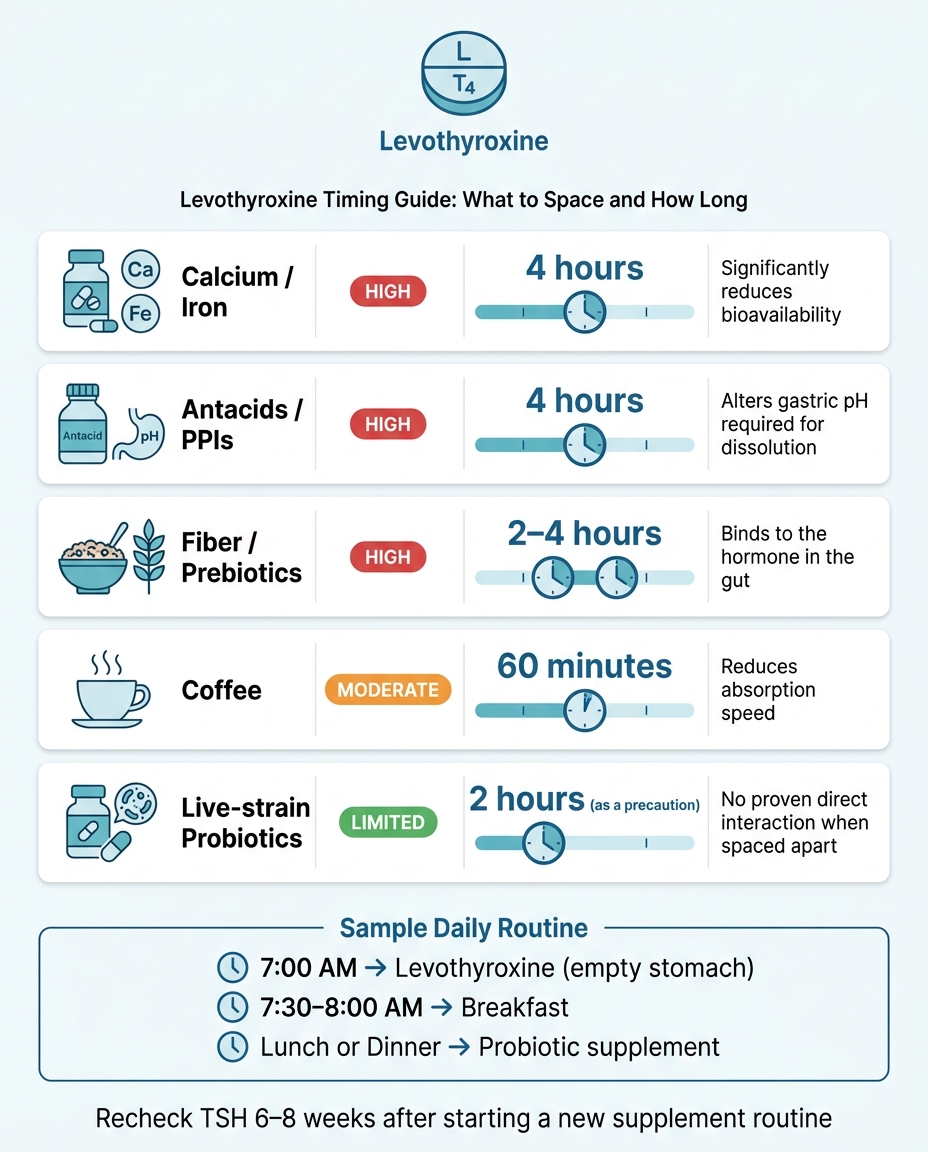
Levothyroxine Timing Guide: What to Space and How Long
Absorption Basics and Why an Empty Stomach Matters
Levothyroxine is absorbed mainly in the small intestine, so how and when you take it can make a big difference. The goal is simple: keep dosing as consistent as possible. If food or supplements are taken too close to your dose, absorption can drop.
A few common items can get in the way. Antacids and PPIs can lower absorption because they increase gastric pH. Coffee can slow absorption too. High-fiber foods and prebiotic fibers, including inulin, can also reduce how much levothyroxine gets absorbed. That's why probiotic products deserve a closer look, especially when they contain added fiber or minerals.
U.S. Clinical Timing Recommendations
Standard U.S. guidance is pretty clear: take levothyroxine with water either 30–60 minutes before breakfast or at bedtime, at least 3–4 hours after the last meal [2]. Then stick with the same timing every day, along with the same spacing from food, coffee, and supplements.
In day-to-day care, clinicians usually separate levothyroxine from common interacting items like this:
| Item | Evidence of Interaction | Suggested Spacing |
|---|---|---|
| Calcium / Iron | High - significantly reduces bioavailability | 4 hours |
| Antacids / PPIs | High - alters gastric pH required for dissolution | 4 hours |
| Fiber / Prebiotics | High - binds to the hormone in the gut | 2–4 hours |
| Coffee | Moderate - reduces absorption speed | 60 minutes |
| Live-strain probiotics | Limited evidence of direct interaction | 2 hours, as a precaution |
If a product includes calcium, magnesium, iron, or fiber, space it the same way you would space those ingredients [1].
With those timing rules in place, the next step is to look at whether probiotics on their own affect levothyroxine absorption.
sbb-itb-1bbfe7f
What Human Studies Show About Probiotics and Levothyroxine
Trial Data Using at Least a 2-Hour Separation
Published trials used separated dosing, not same-time use. That matters.
These studies were small, short-term, and mostly looked at people with stable hypothyroidism, often with Hashimoto's thyroiditis. Researchers followed key thyroid markers like TSH, free T4, and any changes in levothyroxine dose.
Across the short-term studies we have so far, keeping at least a 2-hour gap did not lead to a clinically meaningful change in TSH, free T4, or dose needs. Put simply, when people spaced probiotics and levothyroxine apart, the studies did not show a meaningful effect on thyroid control.
Those findings apply to separated dosing only.
How Clinicians and Patient Education Sources Read the Data
Clinicians and patient education sources tend to read the data in a pretty straightforward way: with a 2-hour gap, published trials found no meaningful change in TSH, free T4, or levothyroxine dose needs.
That doesn't mean probiotics and levothyroxine have been tested in every setup. It means the data we do have point to no meaningful short-term effect when the two are taken at least 2 hours apart.
What Microbiome Research Suggests but Has Not Proven
Microbiome research is interesting, but it hasn't answered the practical questions most patients care about.
Current studies do not tell us:
- whether effects differ by probiotic strain
- how dose changes the picture
- what happens with long-term use
- whether same-time dosing matters
- how probiotics affect people with malabsorption, active gastrointestinal disease, or unstable thyroid levels
So while the research hints at possible links between gut bacteria and thyroid medication handling, it has not proven how those factors play out in day-to-day levothyroxine use.
What Remains Unclear and How Clinicians Apply the Evidence
Open Questions: Strains, Long-Term Effects, and Special Populations
Because human data are still limited, clinicians tend to use this evidence with care. Most studies looked at specific probiotic strains and small groups of patients, so the results don't apply to every probiotic product on the shelf.
This matters even more for people who already have less predictable levothyroxine absorption. That includes those with celiac disease, a history of bariatric surgery, or chronic gastrointestinal disorders. In those cases, adding a probiotic brings in another moving part, and there still isn't enough research to support firm takeaways.
The long-term effects also haven't been studied. So, at this point, changing a levothyroxine dose just because someone started a probiotic isn't backed by the evidence. In practice, many clinicians recheck TSH 6 to 8 weeks after a patient begins a steady probiotic routine, especially when lab results have been unstable or the levothyroxine dose changed not long ago.
That's why routine care usually focuses on spacing and follow-up, not avoidance.
Timing Patterns Used in the United States
The goal is simple: keep levothyroxine absorption as steady as possible. That usually means taking it the same time, the same way, every day, while keeping probiotics separate from levothyroxine.
A common daily pattern looks like this:
| Time | Action |
|---|---|
| 7:00 a.m. | Levothyroxine on an empty stomach |
| 7:30–8:00 a.m. | Breakfast |
| Lunch or dinner | Probiotic supplement |
Many clinicians use a 2-hour gap. Some prefer 4 hours for higher-risk patients. The main idea isn't to cut probiotics out. It's to keep timing steady and give the two products some space.
That spacing plan is often the easiest way to fit microbiome support into a thyroid routine.
How Microbiome Support Can Fit Into a Thyroid Routine
Current data support spacing probiotics or synbiotics from levothyroxine. They do not show that you need to avoid them. So the main takeaway is pretty simple: keep microbiome support and levothyroxine in separate parts of your day.
That means timing is the big issue.
Placing Microbiome Support in a Separate Meal Window
For most people, a lunch or dinner dose solves the spacing problem. Take it with lunch or dinner, away from levothyroxine. Rebirth RE-1 - a 3-in-1 synbiotic combining prebiotics, probiotics, and postbiotics in a single daily sachet - fits neatly into that window as a once-daily microbiome support option.
If you’re starting a new supplement routine, regular TSH and free T4 checks still matter. It’s also smart to tell your prescribing clinician, especially if your levothyroxine dose was adjusted not long ago. And if you notice changes in energy, heart rate, weight, or temperature sensitivity, report them to your clinician.[3][4][5][6][7]
Conclusion: What the Data Supports Right Now
Human data is still limited, so the safest move is simple: keep your levothyroxine routine consistent and take microbiome support in a separate, steady daily time slot.
The long-term effect on levothyroxine dose needs is still unclear. Right now, the evidence points to spacing and consistency, not avoidance. That’s the most evidence-based answer to current patient questions about probiotics and levothyroxine.
FAQs
Can I take levothyroxine and probiotics together?
This is a common question. Clinical guidance often puts a lot of weight on timing because levothyroxine needs very specific absorption conditions, and probiotics are often taken on an empty stomach too.
If you take a product like Rebiirth RE-1 in the morning with water on an empty stomach, it’s smart to ask your healthcare provider how to time it with the rest of your medication routine.
How long should I wait between levothyroxine and a probiotic?
Levothyroxine timing matters because it affects how well your body absorbs the medication. That’s why it’s smart to ask your healthcare provider if you should wait between taking it and following your usual routine.
If you take Rebiirth RE-1, it’s often suggested on an empty stomach in the morning. If you’re adding any supplement while taking thyroid medication, check with your physician first about possible interactions.
Does it matter if my probiotic contains fiber or minerals?
Yes. If a probiotic includes prebiotic fibers like GOS or inulin, it acts as a synbiotic, which is generally good for gut health.
Those fibers do two helpful jobs. They can help shield the probiotics as they move through stomach acid, and they feed good bacteria so those microbes have a better shot at doing well in the intestines.
If you’re wondering how extra ingredients might fit into your daily routine, it’s smart to ask your healthcare provider.