

Herbs may ease symptoms after SIBO treatment, but they haven’t been shown to repair the gut barrier or prevent relapse. My starting point: eat foods you tolerate, keep meals regular, and track symptoms for 1–2 weeks before adding more products.
Here’s how I’d approach recovery:
- Put food first. Start with tolerated protein, starches, and cooked vegetables. Expand portions and variety slowly.
- Match herbs to symptoms - not repair claims. Ginger, chamomile, or peppermint may offer relief. Peppermint can worsen reflux.
- Check concentrated products first. Curcumin, licorice, and berberine need a medication and health review. Berberine isn’t routine recovery support.
- Test one change at a time. Probiotics, prebiotics, postbiotics, and synbiotics are optional, with limited or mixed research after SIBO.
<u>Feeling better doesn’t confirm that SIBO has cleared.</u> I wouldn’t assume worsening symptoms are “die-off.” Recurring symptoms or weight loss call for reassessment; severe pain, bleeding, persistent vomiting, or severe dehydration need urgent care.
Start With Foods You Tolerate
Build Meals With Protein and Cooked Foods
Before trying herbs, rebuild your intake with foods you already tolerate. Getting enough food matters more than following a perfect recovery diet. Steady intake reduces strain while your gut settles.
Build meals around tolerated protein - eggs, poultry, fish, firm tofu, or lactose-free yogurt - along with starches and cooked vegetables. Start with tender cooked carrots, zucchini, or small portions of oatmeal. Keep raw foods in your diet only if you tolerate them.
Broth adds fluid and sodium, but it doesn’t replace a meal. Drink regularly unless you have a fluid limit. Staying on a restricted diet can leave you short on the protein, calories, and nutrients needed for repair. If your portions keep shrinking or you’re losing weight, see a registered dietitian experienced in gastrointestinal disorders and ask about nutrient deficiencies.[7][10][11]
Try Food-Based Remedies in Small Portions
Once symptoms are stable, try one food at a time, such as culinary ginger, ginger tea, or berries you tolerate. For vegetables, start with about 1/4 cup of tender cooked carrots or zucchini. See how you feel before increasing the portion.
Don’t jump to large salads, bran, onions, garlic, or legumes if they trigger symptoms. These foods provide nutrients and variety, but your tolerance should guide the pace.
Track Symptoms as You Add Fiber
Keep the rest of your diet steady while testing one food or portion. Record the meal time, ingredients, amount, cooking method, stool frequency and form, bloating, and pain. Note symptoms before eating and again several hours later. A log can help you spot tolerance patterns, but symptoms alone can’t distinguish food intolerance from SIBO relapse.
Prebiotic fiber can worsen gas and bloating. Increase fiber slowly - by about 2 to 3 grams per day at most, or less if needed.[12][13] If symptoms remain mild enough to tolerate, try a larger serving next time. For structured FODMAP reintroduction, test one subgroup at a time and log symptoms.[8][9] If symptoms become troublesome, return to the last tolerated amount and seek guidance if they persist.
Use your notes to help expand your diet and decide when you tolerate a food well enough to move on. Don’t use the log to justify indefinite restriction or label worsening symptoms “die-off.”
sbb-itb-1bbfe7f
Choose Herbs by Use, Form, and Risk
Symptom relief, microbial control, and barrier repair are separate goals. Evidence for one doesn’t prove the others. Ginger, chamomile, and peppermint may help with symptoms. Use turmeric as a cooking spice, and review concentrated extracts with a clinician before taking them.
Once meals are stable, try just one low-risk herb at a time. Start with the mildest form that fits your symptoms, then watch for relief and side effects.
| Herb | Form | Role | Timing | Main caution | Symptom-relief evidence |
|---|---|---|---|---|---|
| Ginger | Food, tea, extract | Nausea, digestive discomfort | Around tolerated meals | Heartburn, diarrhea; review extracts with blood thinners or gallbladder disease | Limited-to-moderate for selected symptoms |
| Chamomile | Tea, extract | Digestive comfort | After meals or evenings | Ragweed-family allergy; drug interactions | Limited |
| Peppermint | Tea, enteric-coated oil | Cramping, IBS-type symptoms | Tea around meals; oil as directed | Reflux; tea and oil differ | Evidence for enteric-coated oil in IBS |
| Turmeric/curcumin | Spice, extract | Flavoring; proposed anti-inflammatory effects | Spice with meals; extracts after review | GI upset, drug interactions, gallbladder concerns, liver injury | Limited; condition-specific |
| Licorice | Glycyrrhizin-containing products, DGL | Upper-GI comfort | Clinician-guided | Blood pressure, low potassium, fluid retention, heart-rhythm risks | Limited; formulation-dependent |
| Berberine-containing herbs | Capsules, extracts | Supervised antimicrobial treatment | Defined plan with reassessment | GI effects, drug interactions; avoid in pregnancy or breastfeeding | Preliminary, product-specific SIBO evidence |
None of these herbs has direct evidence for post-SIBO barrier repair. There’s also no established evidence that they prevent recurrence.[15][16][17]
Ginger, Chamomile, and Peppermint for Symptom Relief
For mild relief, start with ginger tea or ginger in food, chamomile tea, or peppermint tea. If you’re allergic to ragweed, chrysanthemum, marigold, or related plants, don’t use chamomile without guidance.
Peppermint tea isn’t interchangeable with enteric-coated peppermint oil. The oil releases in the intestine and has been studied for IBS-type symptoms. Either form may worsen reflux. Check with a pharmacist before using concentrated ginger if you take anticoagulants or antiplatelets, or have gallbladder disease.[5][14]
Turmeric and Licorice: Match the Form to the Risk
Use culinary turmeric as a spice. Before taking curcumin extracts, get a review if you have reflux, gallbladder disease, or liver disease; are pregnant; or take anticoagulants. Extracts can cause GI upset, and high-absorption extracts have been linked to liver injury. Stop curcumin and seek care for jaundice, dark urine, unusual fatigue, or poor appetite.[4]
Licorice containing glycyrrhizin can increase blood pressure, lower potassium, and cause fluid retention or heart-rhythm problems. Avoid it if you have hypertension, heart disease, kidney disease, or low potassium, or take medicines that affect blood pressure, fluid balance, or heart rhythm.
DGL removes much of the glycyrrhizin, but that doesn’t prove it’s safe or helps repair the gut barrier. Both forms need clinician review, including during pregnancy or breastfeeding.
Keep concentrated herbs for supervised use, especially if symptoms are returning.
Berberine and Concentrated Herbs: Get Clinical Advice
Use berberine only within a supervised antimicrobial plan - not for routine symptom support or barrier repair. It can cause nausea, abdominal pain, constipation, diarrhea, vomiting, and drug interactions, including with cyclosporine.[6] Avoid it during pregnancy or breastfeeding unless a specialist specifically directs its use. Never give it to infants because of bilirubin-related risks.[1][14]
Its effects on the microbiome after treatment remain uncertain. If symptoms return, reassess the cause rather than repeating courses on your own.[15][17]
Before using concentrated herbs, get clinician review if you’re pregnant, breastfeeding, taking multiple medicines, or considering them for a child. The same applies if you have liver, kidney, gallbladder, heart, blood-pressure, reflux, or low-potassium issues. Persistent or unexplained GI symptoms and anticoagulant or antiplatelet use also call for review.
Make only one change at a time, including prebiotics, probiotics, and postbiotics. Keep a dated log of the product, form, meal timing, symptoms, and adverse effects. Choose products with clear ingredient labels and, when available, independent testing for identity or contaminants. Testing doesn’t prove effectiveness or rule out interactions. Agree on a review point instead of automatically extending a course, and stop if serious or disruptive adverse effects occur.[13]
Plan Microbiome Support and Recovery
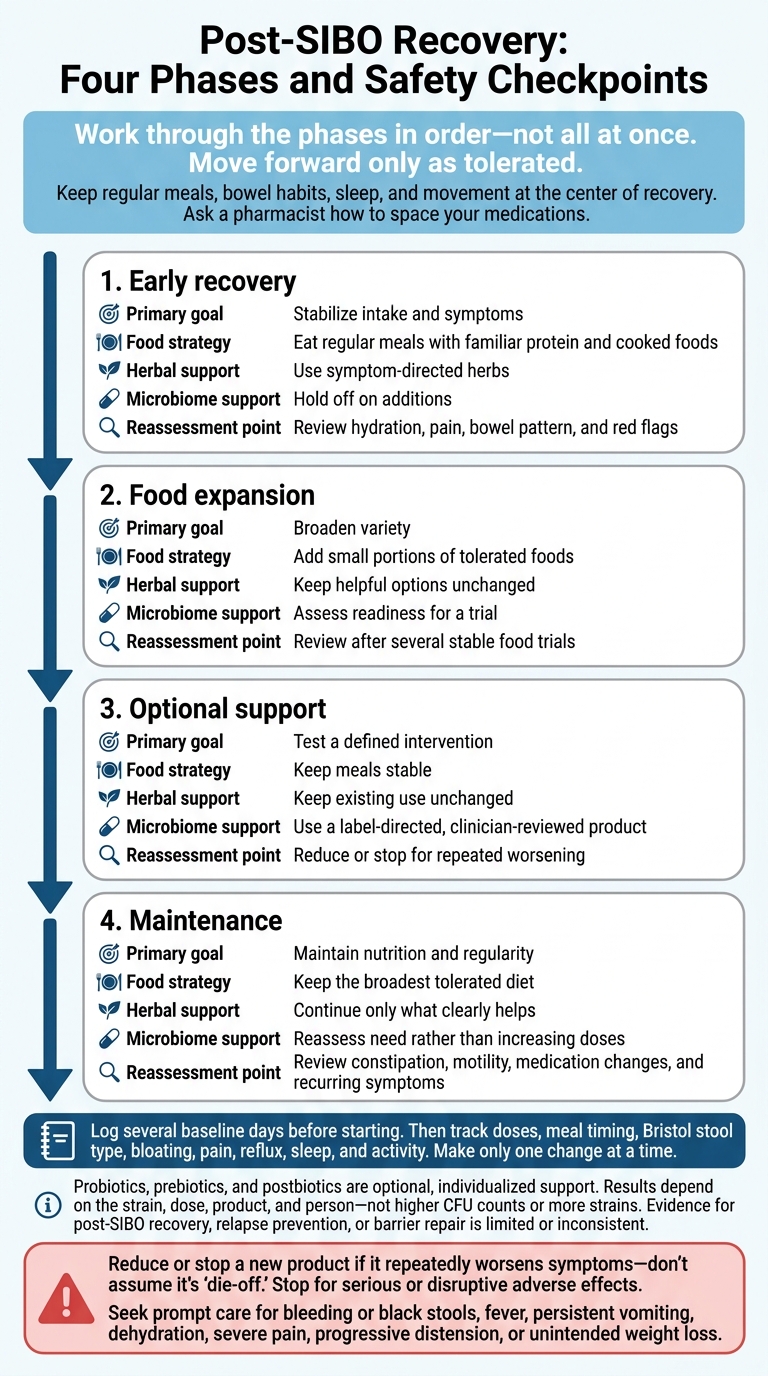
Post-SIBO Recovery: Four Phases and Safety Checkpoints
Prebiotics, Probiotics, Postbiotics, and Rebirth RE-1
After SIBO treatment, probiotics, prebiotics, and postbiotics should serve only as cautious, individualized support. Results depend on the strain, dose, product, and person - not higher CFU counts or more strains.
Wait until meals are stable, then introduce one microbiome product as a defined trial.
| Type | Action | Caution |
|---|---|---|
| Prebiotic | Support helpful microbes with tolerated fiber | Use only after food tolerance is stable |
| Probiotic | Consider a targeted trial | Evidence for post-SIBO recovery, relapse prevention, or barrier repair is inconsistent; avoid with immune compromise or serious illness |
| Postbiotic | Consider microbial components without live organisms | Post-SIBO evidence is limited; metabolites alone are not postbiotics, and inactivated products still need a safety review [18][20][22] |
If you try a commercial synbiotic, keep the rest of your plan unchanged so you can judge tolerance. Rebirth RE-1 is an optional commercial 3-in-1 synbiotic. Follow the label, and don't combine it with other high-dose probiotic or prebiotic products. Get clinician review if you're immunocompromised or seriously ill.[19][21]
A Recovery Schedule With Checkpoints
Move forward only as tolerated. Keep regular meals, bowel habits, sleep, and movement at the center of recovery. Ask a pharmacist how to space your medications.
Work through the table in order. These phases aren't goals to pursue all at once.
| Phase | Primary goal | Food strategy | Herbal support | Microbiome support | Reassessment point |
|---|---|---|---|---|---|
| Early recovery | Stabilize intake and symptoms | Eat regular meals with familiar protein and cooked foods | Use symptom-directed herbs | Hold off on additions | Review hydration, pain, bowel pattern, and red flags |
| Food expansion | Broaden variety | Add small portions of tolerated foods | Keep helpful options unchanged | Assess readiness for a trial | Review after several stable food trials |
| Optional support | Test a defined intervention | Keep meals stable | Keep existing use unchanged | Use a label-directed, clinician-reviewed product | Reduce or stop for repeated worsening |
| Maintenance | Maintain nutrition and regularity | Keep the broadest tolerated diet | Continue only what clearly helps | Reassess need rather than increasing doses | Review constipation, motility, medication changes, and recurring symptoms |
Log several baseline days before starting. Then track doses, meal timing, Bristol stool type, bloating, pain, reflux, sleep, and activity.
Reduce or stop a new product if it repeatedly worsens symptoms - don't assume it's “die-off.” Stop for serious or disruptive adverse effects. Seek prompt care for bleeding or black stools, fever, persistent vomiting, dehydration, severe pain, progressive distension, or unintended weight loss.
Conclusion and Clinician Checklist
Prioritize nutrition, gradual food expansion, and cautious herb use rather than assuming supplements repair the barrier. Bring your symptom log and complete product labels to your clinician. Before adding another product, review:
- Medicines: anticoagulants, antiplatelets, diabetes or thyroid drugs, antibiotics, and acid suppressants.
- Health factors: pregnancy or breastfeeding; allergies; reflux; and gallbladder, kidney, or liver disease.
- Higher-risk conditions: immune compromise, serious illness, or a central venous catheter.
- SIBO history and symptoms: bowel pattern, prior testing and treatment, and symptoms that need reassessment.
- Product details: dose, strains, fiber content, interactions, duration, and when to stop.
FAQs
How can I tell whether my gut barrier is healing?
Signs of improvement may include less bloating and abdominal discomfort, more regular digestion, fewer recurring issues or infections, and better energy and sleep [1][2].
Ask your clinician about biomarker testing. Falling I-FABP and zonulin levels may suggest less intestinal cell damage and better tight-junction integrity - the seals between intestinal cells. Lower LPS levels may suggest less bacterial translocation, or movement of bacteria or their components across the intestinal barrier. Improvements in mucus and tight-junction proteins, such as MUC2 and occludin, may also point to repair [3].
How long should I trial an herb before reassessing?
For mild symptoms, try herbs for gut barrier repair consistently for 4–6 weeks before reassessing [1]. Herbal antimicrobials used in broader treatment plans may take about 2 months to produce a clear improvement [2].
Check in with your healthcare provider every 4–6 weeks to track progress and adjust your plan, since responses vary [1][3]. Rebiirth RE-1, a 3-in-1 eubiotic synbiotic, may also help support microbiome balance during recovery [1][3].
How do I choose between herbs and microbiome support?
Your symptoms and recovery goals help guide the choice. Herbs like tulsi may help ease mild, stress-related gut imbalances and inflammation over 4 to 6 weeks. Synbiotics, such as Rebirth RE-1™, provide prebiotics, probiotics, and postbiotics and may help address persistent digestive symptoms or dysbiosis.
You can also combine these approaches, pairing herbs and a diet-first approach with structured microbiome support during recovery.