

If you want the short answer, here it is: people in rural areas often have more gut microbe diversity and more fiber-feeding bacteria, while people in cities more often show a Western-style gut pattern with lower diversity.
What matters most, though, is not your address. It’s the mix of things that come with daily life.
From the research, the main drivers are:
- Diet: more fiber vs. more ultra-processed food
- Outdoor exposure: more soil, plants, and animals vs. more indoor time
- Antibiotics: fewer courses vs. more frequent use
- Birth mode and infancy: vaginal birth and less antibiotic use in early life
- Daily routine: sleep, stress, movement, and time outside
Here’s the part I’d focus on if I lived in a city or suburb: you can shift many of these factors without moving. A higher-fiber diet, regular park time, steady sleep, more movement, and careful antibiotic use can help support gut function.
Studies also link urban living with about 50% lower gut microbiota than historical baselines. That sounds stark, but it does not mean every urban gut is in bad shape or every rural gut is healthy. It means the average pattern tends to differ.
Quick comparison
| Area | Rural | Urban |
|---|---|---|
| Gut diversity | Higher | Lower on average |
| Common gut pattern | More fiber-fermenting microbes | More Western-style profile |
| SCFA output | More butyrate and acetate | Lower on average |
| Outdoor microbe exposure | More soil, plants, animals | Less frequent |
| Usual diet pattern | More whole foods and legumes | More ultra-processed food |
| Early-life factors | Often fewer C-sections and fewer antibiotics | Often more C-sections and more antibiotics |
Bottom line: rural-vs.-urban gut health is mostly a story about food, exposure, and routine. Geography is just part of the picture.
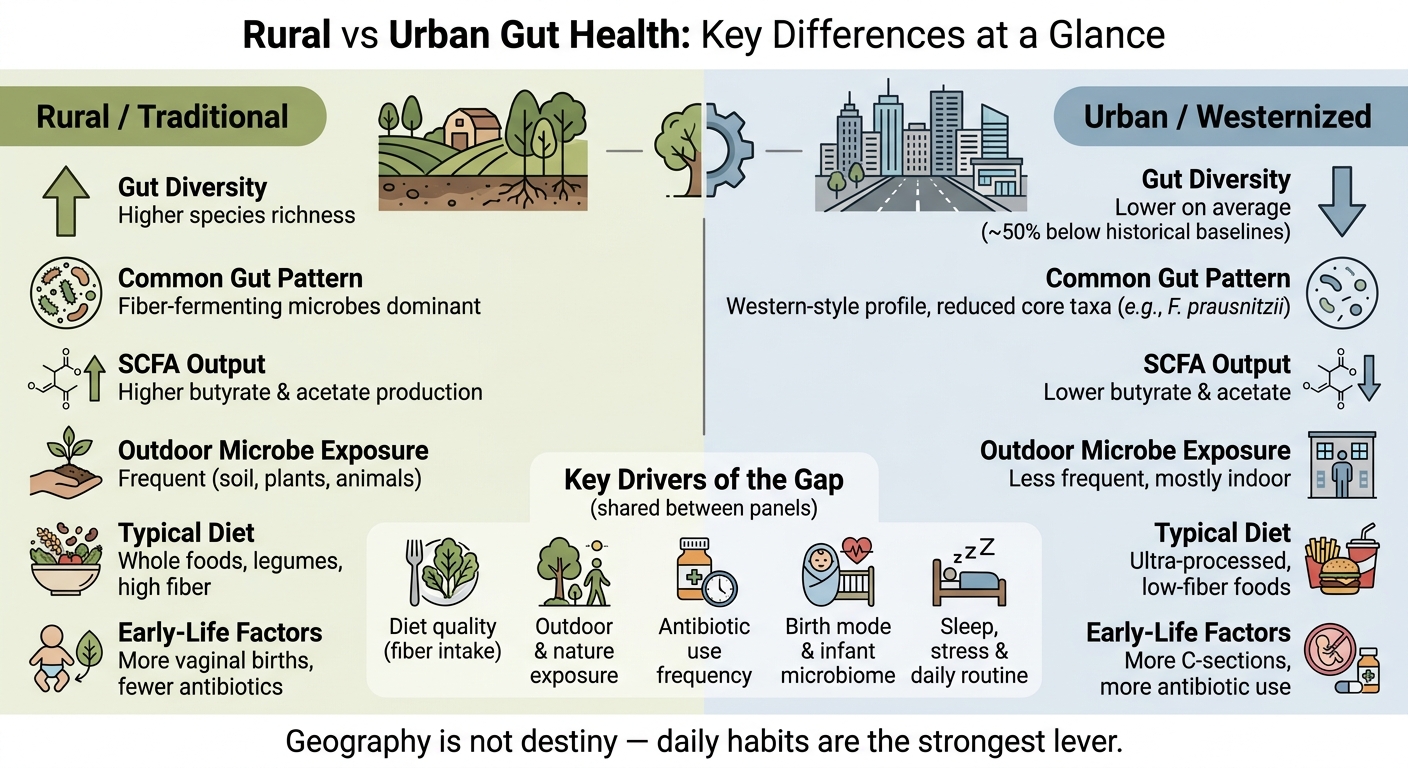
Rural vs Urban Gut Health: Key Differences at a Glance
Safarina Malik – Microbiome Gradient Across the Rural-to-Urban Transition in Indonesia | MVIF41 S05

sbb-itb-1bbfe7f
Rural vs. Urban Microbiomes: What the Studies Show
Studies across Europe, rural and urban Africa, Polynesia, and India point to the same broad split in gut microbiome profiles [2]. The biggest gaps show up in diversity, core taxa, and microbial output.
| Feature | Rural / Traditional | Urban / Westernized |
|---|---|---|
| Microbial Diversity | High species richness; wide range of ancestral strains | Lower diversity; reduced microbial complexity |
| Common Taxa Patterns | Enrichment of fiber-adapted, fermentation-capable bacteria | Loss of core members such as Faecalibacterium prausnitzii |
| SCFA Output | Higher SCFA production, especially butyrate and acetate | Lower SCFA output and different metabolic signaling profiles |
In rural settings, the pattern usually centers on fiber fermentation.
Higher Diversity and Fiber-Adapted Taxa in Rural Settings
Rural populations often show more bacteria that do well on complex plant fibers. These microbes break down dietary fiber into short-chain fatty acids, especially butyrate and acetate, which feed colon cells and help regulate immune responses [1]. That pattern lines up with diets based on whole foods and high fiber intake.
Lower Diversity and Westernized Patterns in Urban Settings
Urban microbiomes often have lower species richness and fewer core microbiota members. One example is Faecalibacterium prausnitzii, a major butyrate producer that is reduced in conditions like type 2 diabetes and IBD [1]. Loss of core taxa is also linked with obesity and metabolic syndrome [1]. These shifts tend to track with less outdoor time and less animal exposure, both of which are common in urban daily life.
Exceptions to the Rural-Urban Divide
This split is not fixed. It changes with diet and day-to-day exposure. When processed foods and farm chemical exposure become more common in rural areas, microbiome diversity can erode [3]. On the flip side, urban people who stick with high-fiber diets, spend time in natural spaces, and use antibiotics with care can partly hold on to the kind of microbial diversity more often seen in rural cohorts [1][3].
The main drivers behind these shifts are diet, green space, animal contact, antibiotics, and early-life exposures.
The next section looks at the exposures that shape those differences.
Why Microbiomes Differ: Diet, Environment, and Early-Life Exposures
The gap comes down to a few everyday exposures: diet, outdoor contact, antibiotics, and early-life biology. Once you look at those, the exceptions from the previous section start to make sense. On average, these factors help explain why rural and urban microbiomes drift apart. But they don't predict every single person.
| Factor | Urban Setting | Rural/Traditional Setting | Likely Microbiome Effect |
|---|---|---|---|
| Diet | Ultra-processed, low-fiber foods [3] | Whole foods, legumes, fiber [1] | Urban: reduced SCFAs and loss of beneficial taxa; Rural: higher diversity [1][3] |
| Green Space & Animal Contact | Little nature contact [3] | Outdoor, soil, and animal contact [2] | Urban: narrower microbial exposure; Rural: broader microbial exposure and immune training [2][3] |
| Antibiotics | More antibiotic exposure [3] | Less frequent use [1] | Urban: increased dysbiosis risk and altered microbial communities [1] |
| Birth Mode | More C-sections [3] | Higher likelihood of vaginal birth [3] | Urban: a different first wave of colonization at birth [3] |
Diet Quality: High-Fiber Eating vs. Processed-Food Patterns
Diet is one of the biggest forces in the research. Fiber feeds bacteria that make butyrate and acetate, short-chain fatty acids that support colon-cell health and help shape immune development [1]. When meals are low in fiber again and again, microbial diversity tends to shrink over time. Not all at once, but bit by bit [3].
That helps explain why many urban microbiomes look more fragile around processed-food patterns. If the diet leans hard on ultra-processed foods and skimps on fiber, the gut gets less of the fuel those bacteria need.
Green Space and Animal Contact: How the Outdoor Environment Shapes the Gut
Outdoor and animal exposure in early life can widen the range of microbes children meet [2][3]. Soil, plants, animals, and time outside all add more microbial input than a mostly indoor routine.
This seems to matter most in childhood, when the gut microbiome is still taking shape. You can think of it like building a playlist early on: the more varied the input, the more varied the mix may become.
Antibiotics, Cesarean Birth, and Infant Microbiome Development
For parents, some of the first microbiome differences begin at birth and with early antibiotic use. Cesarean birth can interrupt the first transfer of microbes from mother to baby [3]. Early and repeated antibiotic courses can also leave long-term shifts in microbial community structure [1].
Those early exposures help set the starting point. After that, daily routines still push the microbiome in one direction or another.
Urban Routines That Can Shift the Gut Microbiome
Daily habits keep shaping the gut microbiome long after infancy. For many city adults and parents, the biggest shifts don’t come from dramatic health choices. They come from everyday patterns: going to bed late, eating late, sitting for hours, and barely spending time outside.
Three habits stand out here: sleep, movement, and time outdoors.
Sleep, Stress, and Circadian Disruption
The gut microbiome runs on circadian rhythms, just like the rest of the body. When sleep is irregular, or when someone does shift work, or lives under chronic stress, gut microbial patterns tend to become less stable. That often comes with more metabolic strain.
Put simply, when the body is worn down by stress and too little sleep, the microbiome usually shows it too. And sleep isn’t the only piece of the puzzle. Movement and outdoor exposure affect the gut as well.
Sedentary Time, Low Nature Contact, and Indoor-Heavy Living
Long stretches of sitting, low physical activity, and mostly indoor routines can slow gut motility and cut down contact with microbes from the outside world. That matters more than it may seem at first glance.
Urban lifestyles are consistently linked to lower gut diversity than rural or historical patterns. Part of that pattern comes from low-nature, indoor-heavy living. More time indoors means fewer environmental microbes make their way to the gut.
What Urban Adults and Parents Can Change
The best changes are usually the ones people can repeat without turning life upside down.
| Common Urban Routine | Microbiome-Supportive Alternative |
|---|---|
| Indoor-heavy, sedentary living | Scheduled outdoor time in parks or gardens; regular physical activity |
| Processed, low-fiber diet | High-fiber eating with diverse plant foods and prebiotic fibers like GOS and inulin |
| Irregular sleep and late eating | Consistent bedtimes and regular meal timing to support circadian alignment |
| Overuse of antibiotics and sanitizers | Judicious antibiotic use; controlled exposure to natural environments where appropriate |
| Limited early-life microbial support | Avoid unnecessary antibiotics in infancy |
For adults, diet is usually the most direct place to start. Gradually adding more fiber and eating a broader mix of plant foods gives helpful bacteria more to feed on, no matter the zip code.
For parents, one of the clearest ways to protect the microbiome early in life is to avoid unnecessary antibiotic use.
Conclusion: What Urban Families Can Learn from Rural Gut Health Data
The pattern is pretty clear. The same few levers keep showing up: diet, time outdoors, sleep, and early microbial exposure. The big takeaway is this: urban living is linked to lower gut microbiome diversity, but the main drivers can be changed. In plain English, the rural-urban gap comes from exposure patterns, not from some fixed rule tied to where you live.
Urban populations show about 50% lower gut microbiota than historical baselines [3]. Researchers link that drop to processed diets, less contact with nature, and higher C-section rates. The most useful changes aren't complicated. Eat a wider mix of plant foods, protect children from antibiotic use that isn't needed, spend time outside on a regular basis, and keep sleep steady. Those day-to-day habits help support the gut functions that often weaken in urban settings.
The rural-urban gut health gap is real, but it isn't set in stone. Function matters more than geography, and the strongest levers come back to daily habits.
FAQs
Can city living permanently harm my gut microbiome?
Not always. Life in the city can mean more chronic stress, more exposure to toxins, more antibiotics, and more processed food. Over time, those things can throw your gut microbiome off balance. Research also suggests that many people living in urban areas may be low in Human Origin Strains (HOSt).
That said, a disrupted microbiome doesn’t automatically mean the situation is permanent. Rebiirth RE-1 is designed to help restore microbiome balance.
How long does it take to improve gut diversity?
It varies by person and by intervention, but noticeable microbiome shifts usually take steady, long-term habits.
Research-backed reset programs often use 7-day, 4-week, and 12-week timelines. Some targeted eubiotic treatments may ease symptoms like bloating within 7 days. But lasting gut diversity and resilience tend to depend on sticking with those habits over time.
What changes matter most for kids’ gut health?
For children, gut health starts taking shape early. Birth mode, infant feeding, and even contact with siblings can all play a part. Vaginal birth often leads to a richer mix of microbes than C-section delivery, and gut flora tends to settle over time as children move from milk to solid foods.
Day-to-day habits matter too. Steady routines and a nutrient-rich diet can help support long-term digestive stability. Rebiirth RE-1 is a medical-grade, 3-in-1 eubiotic synbiotic made to help restore balance and support immune health.