

Chronic stress can irritate your gut through five linked pathways: CRH signaling, cortisol changes, barrier damage, immune cell activity, and microbiome imbalance. If your symptoms flare when life stays tense, this is often why.
Here’s the short version:
- Stress hormones change gut function
- The gut lining can weaken
- Immune cells can stay switched on
- Microbes in the gut can shift out of balance
- Symptoms like bloating, pain, urgency, and food reactions can last longer
I’d sum it up like this: stress does not just affect how you feel mentally. It can change motility, increase gut permeability, and push inflammation higher at the same time. That helps explain why one single fix often does not do much.
A few points stand out from the article:
- Pathway 1: CRH signaling can disrupt motility and trigger mast cells
- Pathway 2: cortisol changes can throw off immune control
- Pathway 3: barrier damage can make the gut more “leaky”
- Pathway 4: immune activation can drive pain, bloating, and urgency
- Pathway 5: microbiome imbalance can keep the cycle going
Bottom line: if stress is part of the problem, gut repair usually needs more than symptom relief. I’d look at stress load, sleep, food quality, and gut support together, because these pathways feed into each other.
| Pathway | Main Effect | Common Symptom Pattern |
|---|---|---|
| CRH signaling | Motility changes, mast cell activity | Cramping, urgency |
| Cortisol shifts | Immune imbalance | Slower recovery |
| Barrier damage | Higher permeability | Food reactions, discomfort |
| Immune activation | More cytokine activity | Bloating, pain, fatigue |
| Microbiome imbalance | Lower diversity, dysbiosis | Irregularity, flare cycles |
So before getting into the details, the main point is simple: stress can keep the gut inflamed by hitting the brain-gut axis, the gut lining, the immune system, and the microbiome all at once.
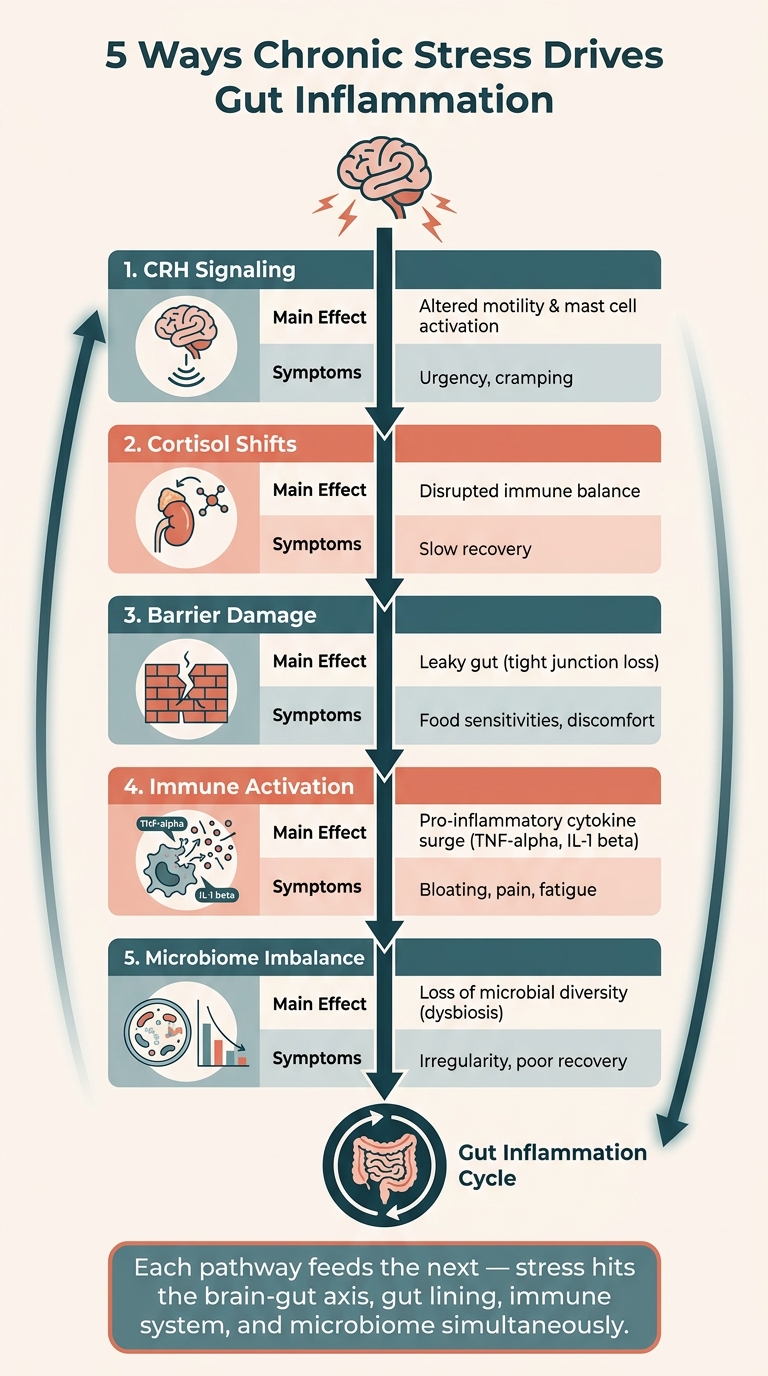
5 Ways Chronic Stress Drives Gut Inflammation
Pathways 1 and 2: CRH Signaling and Cortisol Shifts
How CRH Signaling Affects Motility, Mast Cells, and Gut Permeability
CRH signaling can throw off gut motility, set off mast cells, and weaken the epithelial barrier, which increases gut permeability [1].
CRH kicks off the stress response. Cortisol carries it forward when that signal stays high.
How Cortisol Shifts Disrupt Immune Balance in the Gut
Chronic stress can blunt or distort cortisol signaling, which shifts cytokines and weakens immune control in the gut [1]. This disruption often intersects with hydration and gut health factors. When stress signaling stays out of balance, inflammation can stick around and symptoms can get worse.
Taken together, these shifts increase the risk of barrier damage and immune activation. Next: how barrier damage and immune activation turn that stress response into ongoing inflammation.
sbb-itb-1bbfe7f
Pathways 3 and 4: Barrier Damage and Immune Cell Activation
How Intestinal Barrier Damage Creates a Leaky, Inflamed Gut
When stress signals keep firing, the tight junction proteins that hold gut cells together start to weaken. That makes the gut lining more permeable, so more irritants can slip through. For many people, that shows up as bloating, abdominal pain, and food sensitivities.
Some synbiotic strains may help support tight junction integrity and lower inflammatory signaling [1].
Once that barrier starts to open, the immune system has more to react to. And that’s when things can spiral.
How Immune Cell Activation Amplifies Pain, Urgency, and Inflammation
A leaky barrier keeps the immune system on alert. Mast cells, monocytes, and NK cells switch on and release TNF-alpha and IL-1 beta. That can lead to lingering pain, urgency, and inflammation.
Postbiotic support has been studied for its ability to help regulate immune signaling [1]. Prebiotic GOS has been shown to increase beneficial bacteria, boost NK activity, and reduce pro-inflammatory cytokines [1]. In plain terms, if immune overactivation is keeping symptoms switched on, restoring cytokine balance is a key reset target.
Pathway 5: Microbiome Imbalance That Sustains Inflammation
How Chronic Stress Shifts the Gut Microbiome
The fifth pathway is the one that keeps the cycle going: microbiome imbalance. Chronic stress can disrupt the gut in a deep way by reducing Human Origin Strains (HOSt®), the native microbes that help keep things in balance. As these protective strains drop, dysbiosis starts to take hold, and resident microbes are replaced by transient or opportunistic species [1].
That change can turn short-term stress into long-term gut inflammation. Put simply, the gut becomes less able to bounce back from everyday stressors [1].
And when those earlier stress responses keep happening, recovery gets harder here too. As diversity falls, the microbiome loses some of its ability to reset after new stress. That's a big deal, because a less diverse gut is often a less stable one.
The 5 Pathways at a Glance: Symptoms and Reset Focus
Here’s the full cycle in one view:
| Pathway Trigger | Main Gut Effect | Common Symptoms | Microbiome Reset Focus |
|---|---|---|---|
| CRH Signaling | Altered motility & mast cell activation | Urgency, cramping | L. helveticus |
| Cortisol Shifts | Disrupted immune balance | Slow recovery | L. paracasei |
| Barrier Damage | Leaky gut (tight junction loss) | Food sensitivities | B. breve |
| Immune Activation | Pro-inflammatory cytokine surge | Bloating, fatigue | GOS prebiotics |
| Microbiome Imbalance | Loss of diversity (dysbiosis) | Irregularity, poor recovery | HOSt® strains |
Each pathway feeds the next, so fixing the microbiome means dealing with the whole cycle, not just one piece of it. That’s why restoring microbial balance comes next.
Solutions and Conclusion: Microbiome Reset Options for Stress-Driven Dysbiosis
Why a 3-in-1 Synbiotic Approach Fits Stress-Related Gut Disruption
A practical way to respond is to support the gut from more than one angle. The five pathways don’t act alone. They feed into each other. So a 3-in-1 synbiotic makes more sense here than a product aimed at just one part of the problem.
Here’s the basic idea:
- Prebiotics feed helpful microbes
- Probiotics add live strains
- Postbiotics provide bioactive compounds that help support the gut barrier and immune response
That’s the thinking behind Rebiirth RE-1™. Rebiirth RE-1™ is a 3-in-1 synbiotic built around Human Origin Strains (HOSt™) for gut compatibility. It provides 500 billion CFU per serving along with 4.5 g of prebiotic fiber (GOS and inulin). Its Lyosublime™ delivery system is designed to help protect strain viability during storage and digestion.
In plain terms, Rebiirth RE-1™ is positioned to support barrier function, immune response, and microbiome recovery at the same time. It’s available in three reset formats: 7-day ($79), 4-week ($279), and 12-week ($749).
Key Takeaways on Stress, Inflammation, and Gut Recovery
Once gut support is in place across these pathways, daily habits help keep that reset going. A supplement alone usually isn’t the whole story. Recovery tends to work best when microbiome support is paired with better sleep, less ultra-processed food, and simple stress management habits.
When stress-driven dysbiosis is part of the picture, a well-built synbiotic plan can help support barrier repair, immune resilience, and microbial balance.[2][3]
Stress Is Damaging Your Gut Health. Here's How to Repair It.
FAQs
How do I know if stress is causing my gut symptoms?
Stress may be part of the reason your gut symptoms flare up, especially if digestive distress, fatigue, or mood changes tend to hit during high-pressure periods. That pattern can point to stress-related shifts along the gut-brain axis, plus a deeper imbalance in the microbiome.
Common signs include digestive issues, weaker immunity, poor sleep, anxiety, and increased gut permeability. Rebiirth RE-1™ is designed to help restore microbiome balance, strengthen the intestinal barrier, and support the gut-brain connection.
Can stress-related gut inflammation improve if my diet is already healthy?
Yes. Stress-related gut inflammation can stick around even if you eat well, because chronic stress can affect body systems that diet alone may not fully counter.
Stress hormones like cortisol can disrupt the gut-brain axis, weaken the intestinal barrier, and lower beneficial microbes that help regulate the immune system. Rebiirth RE-1 may help reset the microbiome, support the gut barrier, and restore balance.
How long does it take for the gut to recover from chronic stress?
Recovery time depends on how severe the gut imbalance is and which approach you use. The intestinal lining renews every 3 to 5 days, but stress-driven dysbiosis usually calls for a steady reset over several weeks.
Rebiirth RE-1 includes 7-day, 4-week, and 12-week protocols for different stages of recovery. Some biomarkers may improve in 2 to 3 weeks, while others can take 6 to 8 weeks.