

Most synbiotics appear low-risk for healthy adults, but they can still cause GI side effects - and some people should avoid live-microbe products.
If I boil the research down, here’s the short version:
- Most side effects are mild and gut-related: gas, bloating, cramping, and loose stools
- Prebiotic fiber is often the main cause of those symptoms
- Risk changes by strain, dose, and your health status
- High-risk groups include people with immune suppression, central lines, severe acute pancreatitis, critical illness, and preterm infants
- Long-term and very high-dose safety data are still limited
- Safety reporting is weak in many trials: 33% of 384 RCTs reported no harms data, and only 2% reported enough safety detail
If you’re healthy, the main issue is usually short-term stomach upset. If you’re medically fragile, the concern shifts to bloodstream infection risk from live microbes. That’s why I’d focus less on front-label claims and more on strain-level labeling, dose, and whether the product fits your health situation.
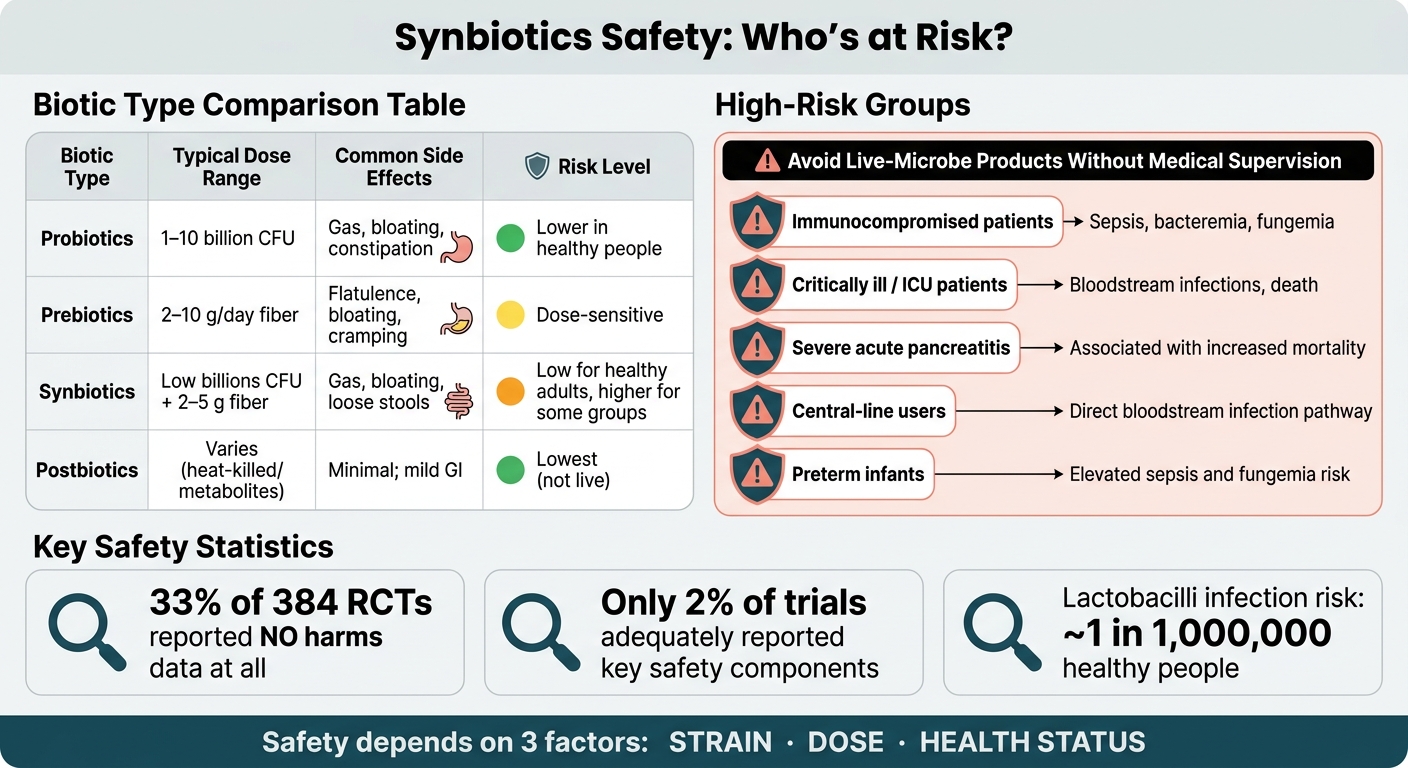
Synbiotics Safety: Side Effects & Risk by Group
Probiotic Side Effects & How to Fix Them
sbb-itb-1bbfe7f
Quick comparison
| Product type | Usual issue | Main risk level |
|---|---|---|
| Probiotics | Mild gas or bloating | Lower in healthy people |
| Prebiotics | Gas, bloating, cramping | Dose-sensitive |
| Synbiotics | GI upset from fiber + live microbes | Low for healthy adults, higher for some groups |
| Postbiotics | Mild GI issues, if any | Lower because they are not live |
In plain terms: healthy adults usually tolerate synbiotics fairly well, but “safe” is not the same for everyone.
What Studies Show About Common Side Effects
In healthy adults, reported side effects are usually mild and mostly digestive [5].
Typical Side Effects: Gas, Bloating, Loose Stools, and Cramping
Across trials, the main safety signal is short-term digestive upset, especially from the prebiotic part of a product. The most common issues are gas, bloating, loose stools, cramping, and, in some cases, constipation or thirst. These symptoms tend to show up soon after starting use and often ease within a few weeks [5].
Prebiotic fiber appears to drive most of this digestive upset, which is why symptoms are often dose-sensitive [5]. In plain English: the more fiber you start with, the rougher the adjustment can feel. Starting with a lower dose tends to help [5]. If your symptoms don't line up with the usual GI effects, it's smart to check the ingredient list [5].
### Prebiotics, Probiotics, Synbiotics, and Postbiotics Compared on Tolerability
Product type matters too. Synbiotics can lead to more GI symptoms than probiotics because they include fermentable fiber. Prebiotics are the most dose-sensitive, while postbiotics appear to be the easiest to tolerate in published human studies [5][1][2].
Published trials most often report temporary gas and bloating.
| Biotic Type | Typical Studied Dose Range | Common Adverse Events |
|---|---|---|
| Probiotics | 1–10 billion CFU | Gas, bloating, constipation |
| Prebiotics | 2–10 g/day (fiber) | Flatulence, bloating, cramping |
| Synbiotics | Low billions CFU + 2–5 g fiber | Gas, bloating, loose stools |
| Postbiotics | Varies (heat-killed/metabolites) | Minimal; mild GI |
If GI side effects last more than a few weeks, stop the supplement and talk with a healthcare provider [5]. For most healthy adults, these effects are brief and nonserious.
The next question is who should use these products with extra caution.
Dose Limits, High-CFU Use, and Human Origin Strains
What Research Shows About High-Dose Synbiotics
As CFU goes up, tolerability still comes down to the exact strain and the way the product is made. The catch is simple: once doses get higher, the safety data get thinner.
Most consumer synbiotics sit in the low billions up to about 50 billion to 80 billion CFU per serving. And even 50 billion to 80 billion CFU is tiny next to the gut microbiome, which already contains about 100 trillion microorganisms [3].
Research studies sometimes push far past that range. In some short-course interventions, doses move into the hundreds of billions, usually for 1 to 12 weeks.
| Population Studied | Dose | Duration | Adverse Events vs. Placebo |
|---|---|---|---|
| Healthy adults | Bacillus coagulans MTCC 5856 | 28 days | No significant adverse events; well tolerated [7] |
| Healthy adults | Standard probiotics up to 80B CFU | Variable | Occasional bloating and flatulence [3] |
One problem here is that safety reporting across trials is uneven. So while high-dose use does show up in published research, the picture isn't always clean or easy to compare across studies.
How Human Origin Strains Are Screened for Safety
Human origin strains are probiotic species first isolated from healthy human hosts and are generally considered nonpathogenic [2]. But that label alone doesn't tell the whole story. Human origin does not automatically equal safe.
A strain still needs strain-level identification, genomic screening for virulence factors, review of antibiotic resistance genes to lower the risk of horizontal gene transfer, and basic pathogenicity testing [2][7]. On top of that, manufacturer quality still matters for potency, purity, and identity [2].
This gets more concrete with histamine-related issues. Certain strains, including Lactobacillus helveticus and Streptococcus thermophilus, can produce histamine in the gut and may make symptoms worse in people with histamine intolerance [5]. That's why looking only at the genus name can lead you in the wrong direction. The strain is what counts.
Where Rebirth RE-1 Fits Within the Published Safety Landscape
Rebirth RE-1 is a 3-in-1 synbiotic with prebiotics, probiotics, and postbiotics. It uses Human Origin Strains (HOSt™) and delivers 500 billion CFU per serving. That puts it at the high end of published short-course use, so the usual high-dose safety questions still apply: strain-level identification, manufacturing quality, and screening for virulence factors and antibiotic resistance genes [2].
At that point, the key issue becomes less about the label on the front of the bottle and more about who should use extra caution.
Who Should Use Extra Caution With Synbiotics
Even when a synbiotic is well made, the person taking it still matters. Age, health status, immune function, and the condition of the gut barrier all shape risk.
Healthy Adults, Children, and Pregnancy: What the Data Shows
For most healthy adults, synbiotics are usually low risk. When side effects happen, they tend to be mild digestive issues like gas, bloating, or stomach discomfort.
In healthy children and infants, published safety data are generally reassuring too, though the research base is smaller than it is for adults. During pregnancy, published data are also generally reassuring. That said, people with obesity should get medical review before use, because some studies suggest a higher preeclampsia risk [6].
So the main issue for healthy groups is usually mild digestive upset. In medically fragile groups, the concern shifts. It becomes less about an upset stomach and more about the risk of invasive infection.
Premature Infants, Critical Illness, and Immunocompromised Patients
Risk climbs fast when the gut barrier is weakened or the immune system is impaired. The main concern is with the live probiotics inside synbiotics. In these cases, microbes may cross a weakened gut barrier and enter the bloodstream.
That risk is not just theoretical. In severe acute pancreatitis, probiotic use has been linked to higher mortality [5]. Central venous catheters add another layer of concern because they can provide a direct path to the bloodstream.
The highest-risk groups include:
- Immunocompromised patients - risk of sepsis, bacteremia, and fungemia
- Critically ill patients (ICU) - risk of bloodstream infections and death
- Severe acute pancreatitis - associated with increased mortality
- Central-line users - direct bloodstream access increases infection risk
- Preterm infants - elevated risk of sepsis and fungemia; use only clinically studied strains under medical supervision
For these groups, postbiotics may be easier to tolerate because they are not live microbes. That removes the infection risk tied to live organisms.
People in these categories need product-specific medical review before using live-microbe supplements. The next issue is regulation and study limits - and what those safety findings can, and can't, promise.
Regulatory Limits, Evidence Gaps, and Key Takeaways
What U.S. Regulation Does and Does Not Guarantee
In the U.S., synbiotics are sold as dietary supplements or foods, not as approved drugs. So the FDA does not check them for safety or effectiveness before they go on sale. Instead, manufacturers are supposed to make sure their products are safe and that the label is truthful. The FDA usually steps in only after a product is found to be unsafe or mislabeled [8].
Labels should list the full strain name and show potency through the expiration date, since synbiotic effects depend on the specific strain [2]. But even a correct label doesn't fix the bigger issue: most studies are still short, and many don't report enough detail.
Where the Research Is Still Thin
The safety record still has clear blind spots. A review of 384 randomized controlled trials on biotics found that 33% of trials reported no information on harms at all, and only 2% adequately reported key safety components [4]. That's a problem. If trials barely report safety issues, it's hard to judge what happens with long-term use.
The table below shows where the evidence stands on two major safety questions:
| Safety Question | Evidence Strength | Key Gap |
|---|---|---|
| Long-term Use | Limited | Most trials are short-term; long-term colonization effects are unclear [2][4] |
| Very High Dosage | Limited | Optimal doses are often unproven; safety of extremely high doses is not well-documented [1][2] |
Main Safety Signals Readers Should Remember
For most healthy adults, synbiotics are usually well tolerated. When side effects do show up, they're usually digestive, like gas, bloating, or stomach discomfort [5][3]. The infection risk from Lactobacilli is estimated at about 1 in 1,000,000 people, and it's even lower for yeast-based products at about 1 in 5,600,000 [5].
That said, the risk climbs fast in people who are more vulnerable, especially those with suppressed immune systems or severe disease [5][4]. In those cases, postbiotics - non-living microbial components or metabolites - may be a safer option because they remove the risk of live bacteria entering the bloodstream [6].
Across the board, the same pattern keeps showing up: we need better long-term safety research before anyone can speak with much confidence about use over years instead of just weeks or months [4].
At a practical level, the safety picture still comes down to the same three factors: strain, dose, and health status. For readers, the rule of thumb is pretty simple:
- Trust strain-level labeling
- Watch for GI upset
- Avoid live products if you're in a high-risk group
FAQs
How do I know if a synbiotic dose is too high for me?
A synbiotic dose may be too high if you keep having gas, bloating, constipation, or more thirst than usual. These issues can show up when you first start a supplement, but they often ease within a few weeks.
If the symptoms don’t let up, stop taking it and talk with a healthcare professional. Since people respond differently, many experts suggest starting with a low dose and increasing it slowly.
What should I check on a synbiotic label before buying?
Check the label for the exact genus, species, and strain of each microorganism. You’ll also want to see the CFU count and confirm whether potency is guaranteed through the expiration or use-by date, not just when the product was made.
It’s also smart to review the storage instructions. Some products need refrigeration, while others are shelf-stable. And if you have sensitivities, scan the label for allergens or prebiotic fibers, since those can lead to bloating or gas.
When should I avoid live-microbe synbiotics?
Avoid live-microbe synbiotics if you have a compromised immune system, recently had surgery, have acute pancreatitis, or have had a prolonged hospital stay.
Use extra caution if you have a venous catheter or impaired gut barrier function. Infants, young children, and people who are pregnant or breastfeeding should talk with a doctor before starting any new supplement.