

Your body does not digest food alone. I’d sum it up like this: human enzymes handle most carbs, protein, and fat in the upper gut, and gut microbes finish the job in the colon by fermenting fiber and resistant starch.
Here’s the plain-English version:
- Human enzymes work first in the mouth, stomach, and small intestine.
- Microbial enzymes work later in the colon.
- Fiber, inulin, GOS, and resistant starch often reach the colon mostly untouched by human enzymes.
- Gut microbes turn those leftovers into short-chain fatty acids (SCFAs) like acetate, propionate, and butyrate.
- Those compounds are linked to bowel regularity, gut lining support, satiety, and blood sugar control.
- When the microbiome is off balance, fiber breakdown can drop, and that may come with bloating, irregular stools, and weaker fermentation output.
- Reset plans usually combine probiotics, prebiotics, and postbiotics to help support that handoff between human digestion and microbial fermentation.
One point stands out: digestion is a two-step system. First, I break food down with my own enzymes. Then microbes process what I leave behind. If that second step works well, fiber does more than add bulk - it becomes fuel for useful metabolites.
Quick comparison:
| System | Where it works | What it acts on | Main result |
|---|---|---|---|
| Human enzymes | Mouth, stomach, small intestine | Starches, protein, fats | Nutrients broken into absorbable units |
| Microbial enzymes | Colon | Fiber, GOS, inulin, resistant starch | SCFAs and other microbial byproducts |
A few concrete details help make this clearer:
- 4.5 g of fiber from GOS + inulin is listed in the reset formula covered in the article.
- One strain example, B. breve M-16V, is tied to more acetate and lower fecal pH.
- Reset programs are often framed as 7-day, 4-week, or 12-week plans.
So if I want to understand why fiber tolerance, stool pattern, and gut comfort can change, I need to look at both halves of digestion - not just stomach acid or pancreatic enzymes, but also what my gut microbes do after food reaches the colon.
Human and Microbial Digestive Enzymes: How They Differ
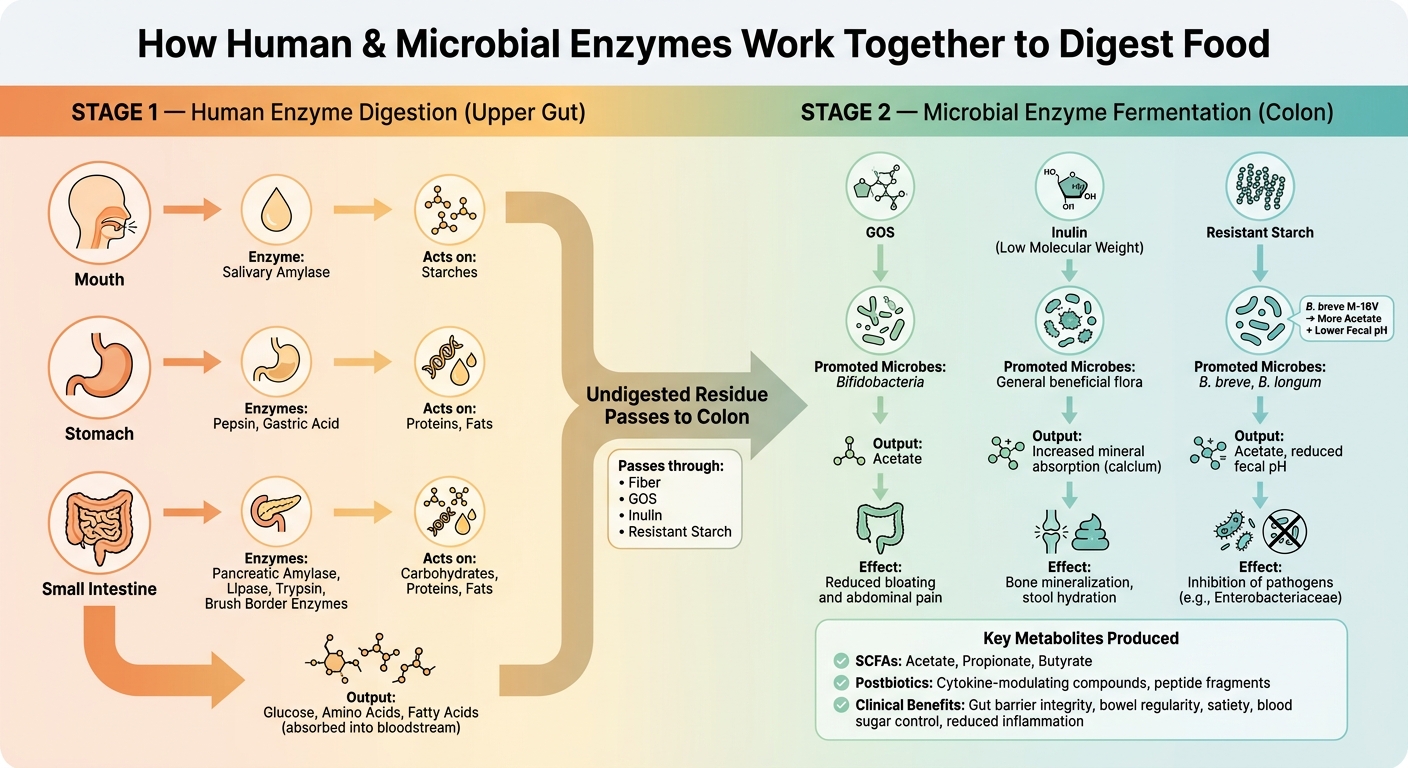
How Human & Microbial Enzymes Work Together to Digest Food
Human enzymes do the first round of digestion in the upper gut. Microbial enzymes pick up what is left in the colon. That split helps decide what gets absorbed in the small intestine and what gets fermented later in the colon.
Human Enzymes From Mouth to Small Intestine
Human digestion starts in the mouth and moves through the stomach and small intestine. Along the way, enzymes like amylase, proteases, lipase, trypsin, and brush border enzymes break digestible macronutrients into absorbable units.
By the time food reaches the end of the small intestine, most carbohydrates, proteins, and fats have been broken down into forms the body can absorb. What is left becomes the material microbes use to keep digestion going.
Microbial Enzymes in the Distal Gut
By the time material reaches the colon, it mostly consists of what human enzymes did not fully break down: fiber, resistant starches, and other fiber-rich compounds.
That is where microbial enzymes step in. Gut microbes make carbohydrate-active enzymes that break down complex fiber. In plain terms, microbes can handle parts of food that human enzymes cannot manage on their own.
Where Host Digestion Ends and Microbial Digestion Begins
Human enzymes act on digestible nutrients first. Then the undigested portion moves into microbial fermentation. Substrates such as inulin, galactooligosaccharides (GOS), and resistant starches pass into the colon, where microbes ferment them.
That fermentation produces short-chain fatty acids (SCFAs) and their link to inflammation, which help support gut health [1]. So the leftovers from upper-gut digestion do not just pass through. They become fuel for microbial fermentation and SCFA production.
| Human Digestive Enzymes | Microbial Digestive Enzymes | |
|---|---|---|
| Primary Location | Mouth, stomach, small intestine | Distal gut (colon) |
| Substrates | Proteins, fats, simple carbohydrates | Fiber (GOS, inulin), resistant starch, fiber-rich compounds |
| Enzyme Types | Amylase, proteases, lipase, trypsin, brush border enzymes | Carbohydrate-active enzymes that break down complex fiber |
| Primary Outcome | Absorption of amino acids, sugars, and fatty acids | Production of SCFAs, postbiotics, and other metabolites |
Together, these two systems shape how much nutrition gets absorbed early and how much is fermented later.
sbb-itb-1bbfe7f
Fiber Fermentation, SCFAs, and Postbiotic Production
Once digestion in the upper gut wraps up, the colon gets to work on the fiber that wasn't broken down earlier. There, microbes turn that leftover fiber into metabolites that can shift pH, change absorption, and influence host signaling.
Why Fiber Arrives in the Colon Undigested
Not all fibers ferment the same way. Each type tends to support a different microbial pattern.
GOS usually supports bifidobacteria. Low-molecular-weight inulin is linked to better mineral absorption. Resistant starches tend to support B. breve and B. longum.
How Fermentation Produces Acetate, Propionate, and Butyrate
When microbes ferment fiber, they produce prebiotics and short-chain fatty acids like acetate, propionate, and butyrate, along with other metabolites. One well-known example is Bifidobacterium breve M-16V fermentation. It increases acetate production, lowers fecal pH, and helps inhibit opportunistic pathogens such as Enterobacteriaceae.
| Fiber Type | Promoted Microbes | Key Outputs | Main Effects |
|---|---|---|---|
| Galactooligosaccharide (GOS) | Bifidobacteria | Acetate | Reduced bloating and abdominal pain |
| Inulin (Low Molecular Weight) | General beneficial flora | Increased mineral absorption (calcium) | Enhanced bone mineralization, improved stool hydration |
| Resistant Starch / Complex Fibers | B. breve, B. longum | Acetate, reduced fecal pH | Inhibition of pathogens |
SCFAs do most of the headline work here, but they aren't the only useful products that come out of microbial digestion.
Postbiotics as Functional Outputs of Microbial Digestion
Microbial digestion also makes postbiotics. These include cytokine-modulating compounds and peptide fragments that influence immune and metabolic signaling.
| Postbiotic Type | Origin | Targets | Documented Effects |
|---|---|---|---|
| Short-Chain Fatty Acids (Acetate) | B. breve M-16V fermentation | Colon environment | Lowers fecal pH; reduces Enterobacteriaceae |
| Immunogenic Postbiotic | L. paracasei BR-MCC1849 | Cytokines | Regulates inflammation; strengthens immune resilience |
That helps show why microbiome balance matters for nutrient handling, not just how fast food moves through the gut.
Microbiome Reset Strategies and Nutrient Handling
How Dysbiosis Alters Digestive Chemistry
When fermentation gets thrown off, digestion usually gets less efficient too. That can make nutrient handling worse.
With dysbiosis, fermentation quality can drop and the shared work between the body and the microbiome can weaken. One reason is that dysbiosis can reduce carbohydrate-active enzymes, which makes fiber breakdown less effective and affects what happens next with nutrient handling.
That is the gap reset strategies try to fix.
What a Microbiome Reset Is Designed to Do
A microbiome reset is a short, structured protocol meant to bring microbial balance back, improve fermentation quality, and rebuild host-microbiome digestion. The idea is pretty simple: restore helpful strains, feed them the right substrates, and give the gut ecosystem time to settle.
Reset plans are often offered in 7-day, 4-week, and 12-week formats.
A solid reset usually combines targeted probiotics, prebiotics, and postbiotics to help rebuild that balance.
Where Rebirth RE-1 Fits in This Discussion
Rebirth RE-1 combines probiotics, prebiotics, and postbiotics to support microbiome balance. It is designed as a combined probiotic, prebiotic, and postbiotic formula to address dysbiosis and support fermentation and nutrient handling [1].
Its prebiotic complex provides 4.5 g of fiber from GOS and inulin. That gives helpful flora the substrates they need and supports downstream fermentation [1]. Its postbiotic component, L. paracasei BR-MCC1849, helps regulate cytokine signaling and supports gut barrier integrity [1].
The table below shows how each reset element contributes to the gut ecosystem:
| Reset Strategy Element | Effect on Microbial Repertoire | Fermentation & Nutrient Outcomes |
|---|---|---|
| HOSt Probiotics | Repopulates human-origin strains (e.g., Bifidobacterium, Lactobacillus) to restore CAZyme diversity [1] | Supports SCFA production and fermentation balance; B. longum BB536 is linked to improved metabolic markers [1] |
| Prebiotic Complex (GOS + Inulin) | Provides targeted substrates to feed beneficial flora and enhance metabolite production [1] | Supports healthy fermentation and calcium absorption [1] |
| Postbiotic (L. paracasei BR-MCC1849) | Stimulates cytokine signaling to regulate inflammation and strengthen the gut barrier [1] | Supports gut barrier integrity and immune regulation relevant to nutrient handling [1] |
Clinical Takeaways: Digestion, Absorption, and Daily Nutrition
What Better Host-Microbiome Digestion Can Improve
When microbial balance improves, digestion tends to work better right where fermentation starts. Human enzymes do the first round of breakdown. Then microbial enzymes take over what’s left. When that handoff goes smoothly, people often feel the difference. Fiber-rich meals may feel easier to handle, bloating can ease, and bowel habits may become more regular.
Those day-to-day comfort changes point to something deeper. SCFAs also affect metabolism. They support satiety, blood sugar control, and gut barrier integrity as direct downstream products of microbial fermentation.
These effects may line up with lower systemic inflammation and better insulin sensitivity, tied more closely to the quality of fermentation than to digestion as a whole.
Key Points to Remember
Here’s the simplest way to connect each digestive step to its main outcome:
| Enzyme Process | Key Metabolites | Clinical Endpoints |
|---|---|---|
| Host enzyme digestion (amylase, pepsin, pancreatic enzymes, brush-border enzymes) | Glucose, amino acids, fatty acids | Macronutrient absorption, energy availability, reduced malabsorption |
| Microbial fiber fermentation (carbohydrate-active enzymes, glycosidases) | Acetate, propionate, butyrate (SCFAs) | Gut barrier integrity, bowel regularity, fiber-derived energy |
| Dysbiosis / reduced SCFA production | Ammonia, phenols, hydrogen sulfide | Increased permeability, inflammation, metabolic risk, GI symptoms |
Better digestion depends on both what you eat and how your gut handles it. When both systems are doing their job, daily gut function tends to improve.
FAQs
How do human enzymes and gut microbes share the work of digestion?
Human enzymes start breaking down food in the stomach and small intestine, which makes nutrients ready for absorption.
When non-digestible fibers move into the colon, helpful bacteria ferment them into short-chain fatty acids. These compounds help feed colon cells and support the intestinal barrier. Rebiirth RE-1™ supports this process with prebiotics and probiotics.
Why does fiber reach the colon instead of being digested earlier?
Fiber makes it to the colon because the body doesn’t digest it in the earlier parts of the digestive tract. Unlike other nutrients, it passes through the stomach and small intestine mostly unchanged.
Once it reaches the colon, helpful bacteria ferment that fiber and produce short-chain fatty acids that help support gut health. Rebiirth RE-1™ builds on that same process with 4.5 g of prebiotic fiber to feed the microbiome and support nutrient handling.
How can a microbiome reset support better digestion and nutrient handling?
A microbiome reset can help digestion and nutrient handling by bringing the gut back into balance. When your gut microbes are in better shape, your body can break down food more smoothly, absorb nutrients more efficiently, and support a stronger intestinal barrier.
Rebiirth RE-1™ supports this with a 3-in-1 eubiotic synbiotic that combines beneficial bacteria, prebiotic fiber, and postbiotics. Together, these help promote SCFA production, which supports colon cells, the protective mucus layer, and smoother digestive function.