

Here’s the short answer: biotics may help support mood, but they are not a main treatment for depression. The best human data so far point to small effects, mostly with specific probiotic strains used for about 6 to 12 weeks.
If I boil the article down, here’s what matters most:
- The gut and brain talk to each other through nerve, hormone, immune, and metabolic pathways.
- Prebiotics, probiotics, synbiotics, and postbiotics are being studied because they may affect inflammation, stress response, and short-chain fatty acids.
- The results are mixed and depend on the strain, dose, study group, and study length.
- Probiotics have the strongest human data of the four, but the effects are still modest.
- Diet still matters a lot: most U.S. adults get only 16–18 g of fiber per day, below the target of 25 g/day for women and 38 g/day for men.
- Reviews of supplements found small drops in depressive symptoms, with effect sizes around −0.34 to −0.57.
- A synbiotic plus fluoxetine did better than fluoxetine alone in one 6-week trial, but that does not mean synbiotics replace medical care.
In plain English: if you want to support the gut-brain axis, I’d look first at more fiber-rich foods, fermented foods, and then consider biotic supplements as an add-on, not a cure.
New Study Suggests Daily Probiotics Could Ease Depression and Anxiety Symptoms
sbb-itb-1bbfe7f
Quick Comparison
| Biotic type | What researchers mainly study | What the article suggests |
|---|---|---|
| Prebiotics | Fiber fermentation, immune markers, gut flora | Early evidence; more marker-based than mood-based |
| Probiotics | Mood, stress, sleep, IBS-related mental health | Best human data so far, but strain-specific |
| Synbiotics | Combined microbiome and gut-barrier support | Early human data; may work well as an add-on |
| Postbiotics | Immune signaling, mood under stress | Early-stage human research |
Bottom line: I’d read this topic as promising but still early, with the clearest takeaway being simple: support gut health, keep expectations realistic, and don’t treat biotics as a stand-alone fix for depression.
How Dietary Biotics May Affect Mood, Inflammation, and Stress
Building on those pathways, dietary biotics may affect mood mostly through changes in the immune system, stress response, and microbial metabolites. The effects tend to be modest, and they can vary a lot by strain.
Immune Activation and Inflammation
Prebiotics such as galactooligosaccharides (GOS) and inulin may increase helpful metabolites and IL-10 while lowering pro-inflammatory signaling [1]. That immune activity is one reason biotics are being studied for stress-linked mood effects.
Stress Response and the HPA Axis
In animal models, Lactobacillus helveticus BR-MCC1848 has been linked to fewer stress-related nervous-system gene changes [1]. A meta-analysis also found better sleep quality in adults with mild to moderate stress after daily Lactobacillus gasseri BR-LAC-343 [1]. Even so, these effects seem to depend on the specific strain.
Microbial Metabolites
Biotic intake can also shift short-chain fatty acids. For example, Bifidobacterium breve M-16V has been associated with higher fecal acetate [1]. Those metabolite changes help explain why biotics are still being studied for depression-related outcomes.
What Human and Animal Studies Show About Biotics and Depression
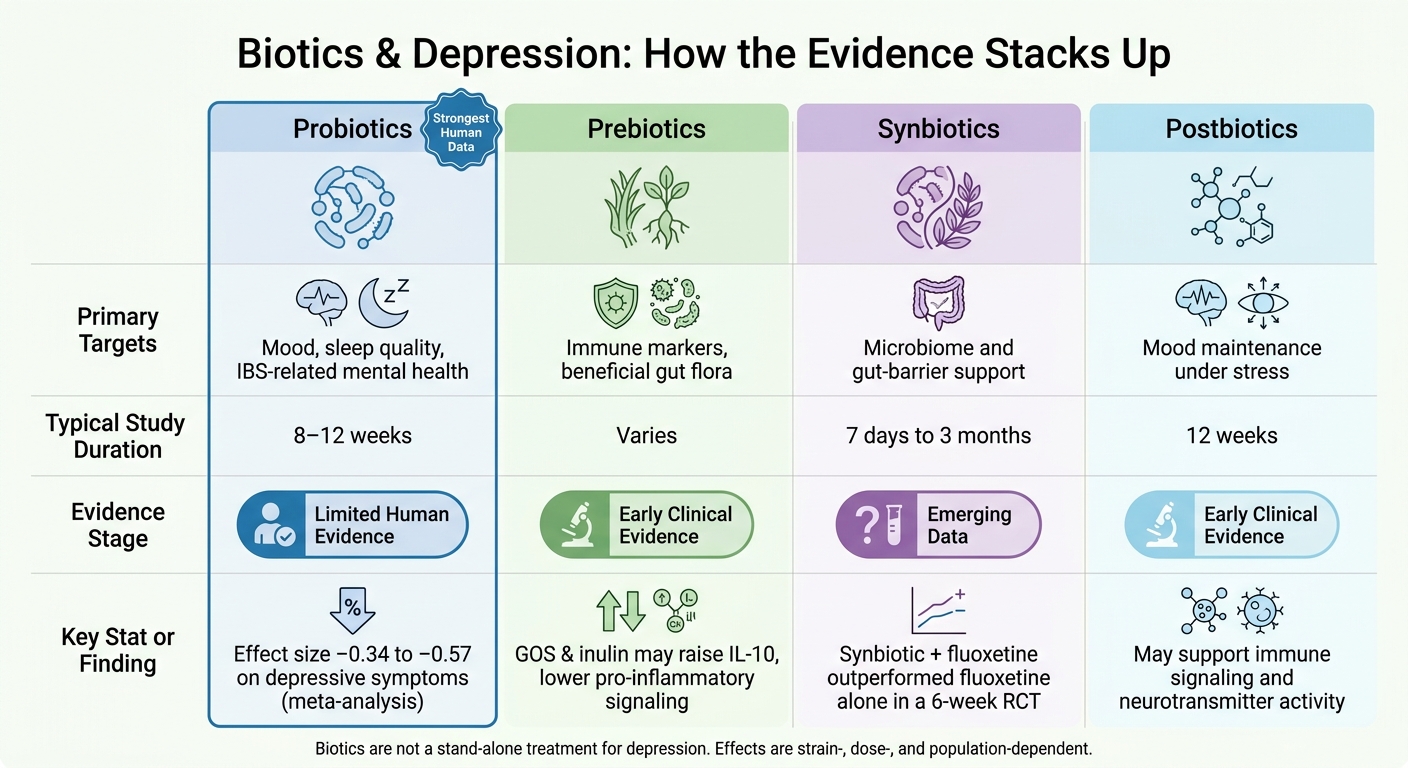
Biotics & Depression: Comparing Evidence, Targets & Study Duration
Researchers have mapped out a few likely pathways. These psychobiotics and the gut-brain axis connections are central to understanding mood regulation. Now the big job is clinical testing. Early animal and human studies give us a rough sense of where biotics may help most, especially around inflammation, stress signaling, and microbial metabolites - and whether those shifts show up as changes in mood. [1]
Probiotics and Synbiotics: Modest Changes in Depressive Symptoms
Animal research suggests that some probiotic strains may soften stress-linked brain changes in a depression-like stress model. But there’s a catch: the effects look strain-specific, not general across all probiotics. [1]
In humans, the clearest data so far are for selected probiotic strains. In people with stress-related IBS, B. infantis M-63 has been linked to better mental health scores, possibly because it helps restore the gut microbiome. [1]
Synbiotics are also under study because they may support both the microbiome and the gut barrier at the same time. That idea makes sense on paper, but human data are still limited. [1]
So at this stage, probiotics have the strongest human data among biotics, while the other categories are still earlier in the research cycle.
Prebiotics and Postbiotics: Early Evidence for Mood Support
Prebiotic research right now leans more toward immune markers than direct depression outcomes. [1] That means scientists are often measuring changes in inflammation or gut flora first, rather than asking whether depressive symptoms clearly improve.
Postbiotics are a bit different. Early clinical findings suggest some may help maintain mood during periods of stress. [1] That’s promising, but it’s still early days.
Study Design Factors Readers Should Know
This is one of those fields where the fine print matters a lot. Results can shift based on:
- the population being studied
- the strain or biotic type used
- the dose
- how long the study lasts
- the outcome being measured
Here’s where each biotic type stands right now:
| Biotic Type | Primary Targets | Typical Duration | Evidence Stage |
|---|---|---|---|
| Probiotics | Mood, sleep quality, IBS-related mental health | 8–12 weeks | Limited human evidence |
| Prebiotics | Immune markers, beneficial flora | Varies | Early clinical evidence |
| Postbiotics | Mood maintenance under stress | 12 weeks | Early clinical evidence |
| Synbiotics | Microbiome and gut-barrier support | 7 days to 3 months | Emerging data |
The bigger picture is pretty simple: depression research here is still strain-, dose-, and population-dependent, and no biotic type has shown steady, large-scale effects on clinical depression outcomes so far. [1]
What this does suggest, though, is a set of practical diet-related options worth watching - not a stand-alone treatment.
Dietary Biotics Strategies and the Microbiome Reset Concept
Food and Supplement Approaches That Support Microbial Balance
If these pathways matter, the next step is simple: how do you support them in everyday eating?
U.S. adults get about 16–18 g of fiber per day, which falls short of the recommended 25 g/day for women and 38 g/day for men[15]. That gap matters because fiber feeds microbial fermentation. In the gut, that process produces short-chain fatty acids like butyrate, propionate, and acetate, which help support gut barrier function and help regulate inflammatory activity tied to mood[5][7].
The good news? You don't need to flip your whole diet upside down. Small changes can go a long way. Think:
- oats or brown rice instead of lower-fiber grains
- beans or lentils a few times per week
- more fruit, vegetables, and fermented foods
Fermented foods add a second angle. In a 10-week randomized trial in healthy adults, a high-fermented-food diet increased microbial diversity and lowered several inflammatory markers compared with a high-fiber diet on its own[8].
Supplements have also been studied, especially for depressive symptoms. The main focus has been on **probiotic-containing and synbiotic formulas. Large reviews found modest drops in depressive symptoms, with standardized mean differences of about −0.34 to −0.57[12][13][14]. In most studies, these effects showed up after 6–12 weeks of steady use[3][4][6].
Prebiotics such as inulin and galactooligosaccharides (GOS) can support short-chain fatty acid production and help feed helpful microbes. Postbiotics may help shape immune activity and neurotransmitter signaling[2][5][7][10][11]. Put plainly, food lays the groundwork, and the supplement research builds on that base.
When food changes don't do enough on their own, synbiotic formulas become the next area to look at.
Where Rebirth RE-1 Fits Within Synbiotic and Eubiotic Research
One randomized controlled trial found that a 6-week synbiotic regimen added to fluoxetine led to bigger reductions in depression scores than the antidepressant alone[4]. A meta-analysis of 19 RCTs also found that synbiotics can improve standardized measures of depression and anxiety[9].
One example in this category is Rebirth RE-1. It is a 3-in-1 eubiotic synbiotic in sachet form that combines prebiotics, probiotics, and postbiotics for 7-day, 4-week, or 12-week use. Each serving includes 4.5 g of prebiotic fiber from GOS and inulin, Human Origin Strains (HOSt™), 500 billion CFU per serving, and a Lyosublime™ delivery system.
That said, it's best viewed as part of a broader gut-health plan, not as a stand-alone treatment for mood.
Conclusion: What the Evidence Supports Today
When you put the pathway data and early trials side by side, the picture is fairly clear: biotics may play a small but believable part in mood support.
Current research points to the gut-brain axis as one piece of depression-related processes for some people. That link seems to show up through microbial balance, inflammatory signaling and immune activity, and stress-response pathways. Probiotics may affect mood through the microbiota-gut-brain axis, but the results are not the same across studies. A lot depends on the strain, the dose, and how the study was set up.
Right now, the clearest use for biotics is as support, not as the main treatment. They make the most sense as add-ons to diet changes, therapy, or medical care, not as stand-alone depression treatments. Researchers still need standard strains, standard doses, and better ways to measure outcomes. At this stage, the evidence backs gut-health support as one part of a broader depression care plan.
FAQs
Can biotics treat depression?
Biotics may help support depression-related symptoms through the gut-brain axis. Some probiotics may help lower the risk of depression tied to stress, support serotonin and GABA activity, reduce inflammation, strengthen the gut barrier, and affect immune signaling and vagus nerve communication.
What does that mean in plain English? The gut and brain stay in close contact. When the gut is out of balance, that can ripple into mood, stress response, and inflammation. Certain biotics may help steady some of those pathways.
The current evidence suggests possible support and prevention benefits, especially for depression linked to chronic stress. But there’s a catch: these effects usually show up after steady use over several weeks, not overnight, and not as a standalone cure.
Which biotic type has the best evidence?
Probiotics have the strongest clinical backing right now, especially specific strains that researchers have studied for mood and stress-linked depression. Bifidobacterium often comes up for its link to lower anxiety and less inflammation. Some Lactobacillus strains, including L. helveticus, are also known for helping support neurotransmitter production.
At the same time, the research points to a broader synbiotic approach. In plain English, that means combining prebiotics, probiotics, and postbiotics instead of leaning on just one piece. The idea is simple: each plays a different role, and together they may give more complete support for microbiome balance and mental well-being.
How long do biotics take to affect mood?
Effects on mood and stress recovery often start to show up after 4 to 8 weeks of steady daily use. That timeline can feel a little slow, but it makes sense. Biotics don’t act like a light switch. They work over time by helping shape a healthier gut setting, which is tied to the steady production of mood-related neurotransmitters like serotonin and GABA.
Some people notice earlier shifts. For example, less bloating and better digestive comfort can show up within 7 days of starting a targeted eubiotic regimen.
The big thing here is consistency. Daily use tends to matter more than expecting instant results, especially when the goal is better mood support and stress recovery.