

If a biodegradable coating does not control moisture, oxygen, heat, and light, your synbiotic shelf life can fall apart long before expiration.
Here’s the short answer: biodegradable only tells me what may happen at end of life. It does not tell me whether a sachet can protect probiotics, prebiotics, and postbiotics during storage. For synbiotics, the main storage checks are CFU count, water activity, residual moisture, oxygen exposure, prebiotic stability, film thickness, and seal condition.
The article’s core point is simple:
- Moisture is often the first shelf-life problem
- Water activity matters as much as total moisture
-
Low
a_wmatters; in dried systems, development targets are often below about 0.25, while losses can get worse above about 0.33 - No single biodegradable film does every job well
- Multilayer films can cut oxygen and moisture transfer a lot, but only if they stay intact
- Heat swings, light, and oxygen work together
- Finished-sachet testing matters more than film-only testing
A few numbers make this clear. One cited example showed 0.2 log CFU/mL better survival after 60 days at 39.2°F (4°C) with a thicker chitosan coating. Another found multilayer film cut oxygen permeability about eightfold and water-vapor permeability about elevenfold versus a single-layer version. And one packaging case showed shelf life of up to 2 years at 39.2°F (4°C) versus only about 3 months at 86°F (30°C).
Quick comparison
| Factor | What I’d want to see | Warning sign |
|---|---|---|
| Moisture control | Low, steady a_w and residual moisture |
a_w drifts up, caking starts |
| Oxygen barrier | Low oxygen ingress through shelf life | Viability drops even when moisture looks fine |
| Heat handling | Stable after storage at 68–77°F (20–25°C) and stress at 104°F (40°C) | Big CFU loss after warm shipping or storage |
| Light protection | Opaque layer or outer pack when needed | Clear film with no light shield |
| Film build | Even thickness, no pinholes or cracks | Weak corners, thin spots, bad seals |
| Package test | Full sachet, full formula, full shelf-life study | Film data only |
If I were judging a coated synbiotic sachet, I would not stop at “biodegradable.” I’d ask one question: Does the full package keep the labeled dose and powder quality in spec through storage, shipping, and home use?
sbb-itb-1bbfe7f
Moisture and water activity: the main shelf-life problem
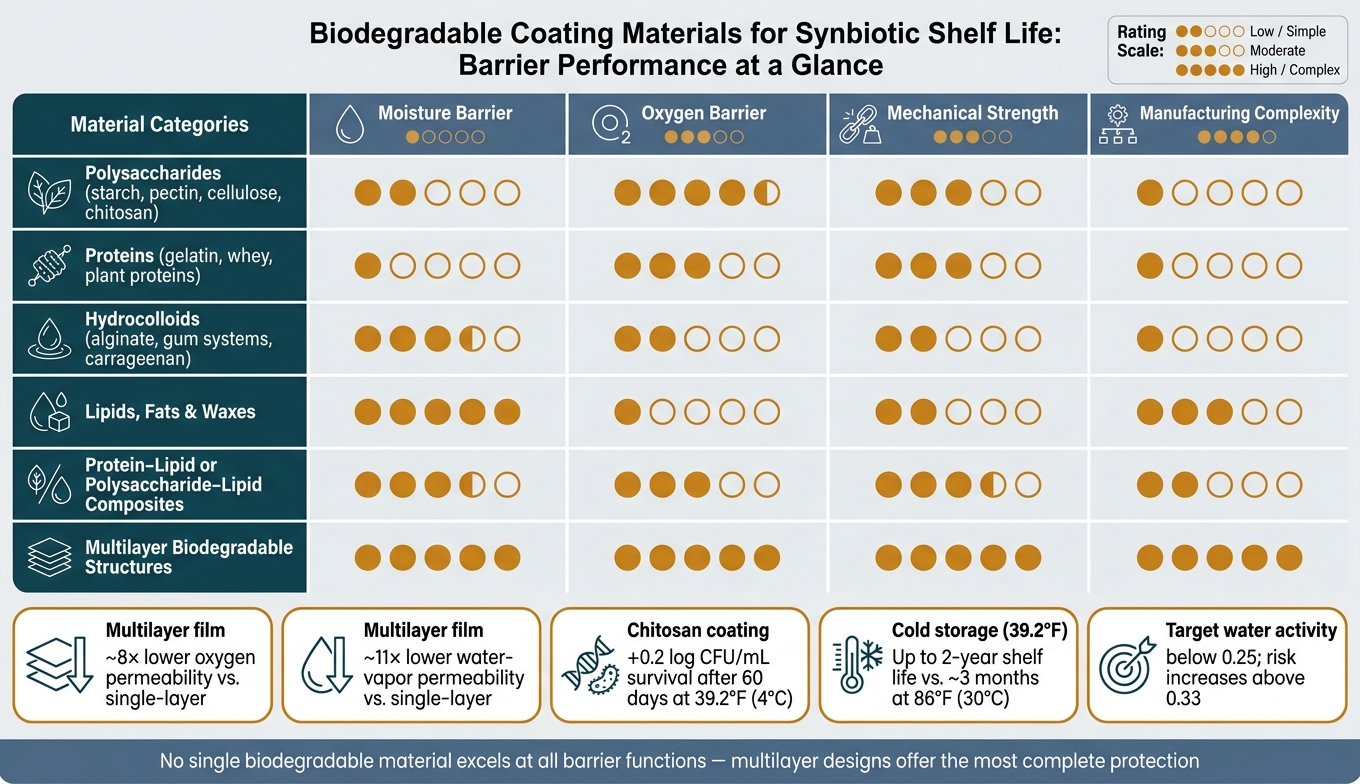
Biodegradable Coating Materials: Moisture & Oxygen Barrier Performance for Synbiotic Shelf Life
With biodegradable coatings, shelf life often comes down to one thing: moisture control.
That’s why water activity (a_w) is usually the first storage variable to check. Moisture content tells you how much water is in the product overall. Water activity tells you how much of that water is free and able to drive chemical change or microbial stress. Those two numbers are not the same. A powder can show only modest total moisture and still have enough mobile water to speed up probiotic viability loss.
So during storage, both need to be tracked separately.
For dried synbiotic powders, it helps to keep a_w low during development. A practical target is below about 0.25, while survival in some dried probiotic systems can fall off more sharply above about 0.33.[5] These are not universal release specs. The danger zone depends on the strain, excipients, packaging, and storage temperature. As a_w climbs, cells can partly rehydrate, become more metabolically active, and lose viability faster under oxygen and other storage stress. Moisture can also make prebiotic ingredients like GOS and inulin tacky, increase particle sticking, and lead to caking that hurts powder flow and uniformity.
How coating materials affect moisture protection
Hydrophilic polysaccharide and protein films usually do a poor job blocking water vapor because they absorb water, even though they can still provide gas-barrier help under moderate humidity.[1][2] Lipids, fats, and waxes resist moisture better, but there’s often a tradeoff in gas barrier, strength, or film quality.[1][3] In plain terms, no single biodegradable material gives you the best moisture resistance, oxygen protection, strength, and ease of manufacturing all at once. That’s why composite and multilayer designs show up so often.[1][2]
Still, none of that matters if the coating cracks, separates, or loses continuity during storage.
| Material Category | Moisture-Barrier Strength | Common Limitation | Likely Effect on Synbiotic Storage |
|---|---|---|---|
| Polysaccharides, such as starch, pectin, cellulose derivatives, or chitosan | Low to moderate; often moisture-permeable because of hydrophilic groups | Moisture uptake, swelling, and loss of mechanical performance at high humidity | May protect against some gases but can allow a_w and powder moisture to rise[1][2] |
| Proteins, such as gelatin, whey, or plant proteins | Low to moderate; commonly sensitive to water | Water-vapor permeability and humidity-related softening | Can support film strength and oxygen protection but may need a hydrophobic modifier[1][4] |
| Hydrocolloids, such as alginate, gum systems, or carrageenan | Variable; dependent on formulation and cross-linking | Swelling, tackiness, and moisture sensitivity | May improve coating uniformity but will not necessarily prevent moisture ingress[1][2] |
| Lipids, fats, and waxes | High; hydrophobic materials are among the most effective moisture barriers | Brittle or weak films, poor gas barrier, and possible processing limitations | Can slow moisture uptake and help preserve probiotic viability and powder flow[1][3] |
| Protein–lipid or polysaccharide–lipid composites | Moderate to high when well formulated; lipid content can reduce water-vapor permeability | Phase separation, defects, variable adhesion, and more complex manufacturing | Can balance moisture protection, mechanical strength, and gas-barrier performance[2][6] |
| Multilayer biodegradable structures | Potentially high because each layer serves a different function | Greater process complexity and risk of interlayer defects, pinholes, cracking, and delamination | Can provide a more reliable barrier when layer continuity and seal integrity are controlled[1][2] |
What moisture control means for probiotics and prebiotics
For prebiotic ingredients such as GOS and inulin, low a_w helps keep the dry matrix physically stable. It also lowers the chance of migration, redistribution, or local hydration that causes caking. When low a_w is maintained across the full formula, powder flow and serving uniformity are more likely to hold up, which affects product consistency when the user actually takes it.
A solid moisture-protection claim should cover more than one data point. It should include:
- a_w at release and through storage
- Moisture content, with the analytical method named
- Water-vapor transmission rate (WVTR) or water-vapor permeability (WVP) of the coating or package
- CFU per serving over time
- Prebiotic recovery
- Physical stability markers such as caking and powder flow
Moisture resistance alone doesn’t prove much unless release and storage data back it up.
Once moisture is under control, the next storage threats are heat, oxygen, and light.
Heat, oxygen, and light: storage stresses coatings must manage
Heat, oxygen, and light drive the next set of failure modes for coated synbiotics. Each one is among the factors affecting probiotic stability and causes damage in its own way. Put them together, and probiotic survival and prebiotic stability can drop much faster than they would from any one stress alone.
Heat exposure during processing, shipping, and storage
A short high-heat step during manufacturing is not the same as weeks of warm storage.
During processing, temperatures above about 113°F (45°C) can lower probiotic survival by damaging cell membranes and other sensitive cell structures.[13] In practice, that means adding live cultures after any high-heat step when the process allows it, and keeping hold times at high temperatures as short as possible.
Storage and shipping create a slower kind of damage, but it adds up. Repeated temperature swings - like the ones inside a warehouse or delivery truck in summer - can do more harm than a steady moderate temperature. Why? Because every swing puts stress on the coating, the seal, and the cells inside.
One microcapsule study on chitosan-coated probiotics makes that point clear. The study found that thicker coatings tracked with better stability, including 0.2 log CFU/mL higher viable count after 60 days at 39.2°F (4°C).[10] Thicker film isn't a cure-all, but it does show that coating design choices change the outcome in measurable ways.
A useful test plan should cover 68–77°F (20–25°C), 104°F (40°C), and 95–104°F (35–40°C).[7][11] Accelerated studies can help flag weak spots early, but they shouldn't stand in for real-time data at the labeled storage condition.
| Heat Scenario | Primary Risk | Coating or Packaging Response |
|---|---|---|
| Processing (brief, high-temp) | Cell membrane damage, protein denaturation, moisture migration | Add probiotics after high-heat steps when feasible; use protective encapsulation matrices |
| Storage at room temperature | Gradual viability loss, slow oxidation, moisture creep | Pair the coating with low-permeability sachet packaging; monitor water activity and CFU over time |
| Accelerated storage | Faster oxidation, increased gas permeability through some biodegradable films | Use as a supplemental test only; real-time data at the labeled condition is still required |
| Shipping and transport excursions | Temperature cycling stress, seal fatigue, coating delamination | Test the finished sachet under realistic distribution scenarios, not just static lab conditions |
Heat can also increase oxygen permeability in some biodegradable films. So even if the coating looks fine on paper, rising temperature may let more oxygen move through it.
Oxygen and light barriers for strain survival and ingredient stability
That same thermal stress can change how well a coating blocks oxygen and light.
Oxygen is a major issue for Bifidobacterium strains, which are usually more oxygen-sensitive than many Lactobacillus species.[9] When oxygen reaches those cells, oxidative damage can follow. It can also break down lipids, antioxidants, and other parts of the surrounding matrix. That matters because the matrix is part of what helps the coating protect the organisms in the first place.
Light adds a second hit. Photochemical reactions can create oxidative stress, and absorbed light can increase the local temperature inside a sachet at the same time.[8] So you can end up with heat, oxygen, and light all working together. A clear biodegradable film may help with product visibility, but without a light-blocking layer or opaque outer pack, the formula stays exposed.
| Approach | Advantages | Limitations | Likely Shelf-Life Impact |
|---|---|---|---|
| Transparent biodegradable coating | Enables visual inspection and consumer convenience | Limited light protection; barrier properties vary by polymer and humidity | Adequate only with low light exposure or protective outer packaging |
| Opaque biodegradable coating or outer layer | Reduces direct light exposure and photo-oxidation | Prevents visual inspection; pigments or fillers may affect processing | Better protection for light-sensitive strains and prebiotic matrices |
| Oxygen-barrier biodegradable layer | Reduces oxygen ingress and oxidative stress | Performance can decline with humidity; may need multilayer construction | Improved survival for oxygen-sensitive strains when seals are also intact |
| Multilayer biodegradable structure | Combines moisture, oxygen, heat, and light functions in one package | More complex to manufacture and validate | Often the strongest practical strategy when a single material cannot meet all requirements |
| Barrier film with oxygen removal | Removes much of the initial oxygen; ties barrier film performance to the coating system | Requires reliable seals; oxygen can still enter over time through coating defects | Strong option when the coating and packaging work together to limit oxygen ingress |
One example shows how these stresses interact. Aluminum-foil vacuum packaging at 39.2°F (4°C) supported up to 2 years of shelf life for a dry powder format, while storage at 86°F (30°C) cut that to about 3 months.[12] In that case, the packaging managed oxygen, moisture, and light at the same time. Nothing was handled on its own.
That's the main takeaway. Coatings don't work alone. A strong oxygen barrier can be undone by a weak seal. An opaque film may still fall short on moisture or gas barrier performance. And heat can increase gas permeability in some biodegradable polymers, letting more oxygen reach the probiotic even when the coating looked fine at room temperature.[8][9]
The smart move is to test the finished sachet as a full system - seal, headspace, and powder - under combined heat, oxygen, and light stress. That's the kind of data that shows whether film thickness or layer design needs to change.
Once these stresses are under control, film thickness and layer design determine how long that protection holds.
Film thickness and coating design: balancing protection, release, and usability
Once moisture, oxygen, heat, and light targets are set, thickness and layer design decide whether a coating can hit those targets in practice. And thicker isn't always better. The aim is simple: use the thinnest film that still protects storage stability. If a biodegradable film gets too thick, the sachet can become stiffer, dissolve more slowly, and use more material than needed.
Biodegradable film thickness is often discussed in the 50–200 micrometer range, but the right target depends on the material itself and has to be confirmed through testing.
How thickness, uniformity, and defects affect real performance
Average thickness doesn't tell the whole story. Just as important is whether the coating stays even across the full surface. Edge buildup, pinholes, and cracks create weak spots that can undo the barrier. For synbiotics, that matters a lot. A small pinhole in a sachet film can increase water activity, stress probiotic cells, or change powder behavior before the product ever reaches the consumer. Thickness should be measured at multiple points, with close attention to seal areas and corners, since handling stress can create leaks there even when the center of the film still looks fine.[17]
Finished sachets should be tested for:
- water-vapor transmission
- oxygen transmission
- tensile strength
- seal strength
- dissolution
- light transmission, when relevant
Single-layer versus multilayer biodegradable coatings
A single-layer coating is simpler to make and check, but one material usually can't do every job well at the same time. Hydrophilic materials such as starch, cellulose, and pectin can form strong oxygen barriers, yet they are weak against moisture.[14][15] Hydrophobic materials help resist water vapor, but they can reduce oxygen protection or slow dissolution. That's the trade-off with a single-layer design.
Multilayer designs deal with this by giving each layer a clear role: one handles moisture resistance, another blocks oxygen, and another adds mechanical support. That approach can deliver large gains. One study found that a three-layer film cut oxygen permeability by about eightfold and water-vapor permeability by about elevenfold compared with a single-layer version.[16] A 2024 study on a multilayer PLA coating made with cationic chitin nanofibers and anionic cellulose nanocrystals improved oxygen-barrier performance by 73%.[3]
| Design | Barrier performance | Release behavior | Mechanical strength | Sustainability trade-off |
|---|---|---|---|---|
| Thin single-layer | Lower material use; more vulnerable to pinholes and fast moisture or oxygen transmission | Usually dissolves faster | Flexible when plasticized; may tear under stress | Lowest material use; may need protective outer packaging |
| Thick single-layer | Better barrier when defect-free | May slow dissolution or moisture uptake | Less flexible; higher risk of stress cracking | Uses more material; may reduce process efficiency |
| Hydrophilic protein or polysaccharide layer | Strong oxygen barrier at low humidity; weakens in high humidity | Hydrates and dissolves fairly easily | Moisture can weaken structure | Renewable and biodegradable; humidity sensitivity may require a second layer |
| Multilayer film | Combines moisture resistance, oxygen protection, and mechanical support | Release can be tuned by layer order and thickness | Better; each layer does one job; interfaces can delaminate | More complex manufacturing; harder end-of-life handling |
| Defective or poorly sealed film | Thickness no longer protects; defects create direct transport paths | Irregular protection; possible premature moisture uptake | Higher risk of leakage or delamination | Wasted material and higher product-loss risk |
Of course, multilayer films bring a new problem: interfaces. Once more layers are added, the risk of delamination goes up under humidity and heat. A multilayer coating can look strong in a lab test and still fail in storage if the layers start to separate. Each interface needs to be tested under conditions that match shipping, storage, and day-to-day handling. On paper, the design may look great. In the field, the package still has to stay intact.
That point matters most at the finished sachet level, not just in a stand-alone lab film. For Rebiirth RE-1, which delivers 500 billion CFU per serving without refrigeration, the coating and sachet film need to work as one system. They have to protect the powder during shipping, storage, and household use, while still dissolving fast when mixed. For Rebiirth RE-1, the finished sachet should be validated for thickness, barrier values, seal performance, and dispersibility under real storage conditions.
Applying this framework to sachet-based synbiotics and key takeaways
What to verify for Rebiirth RE-1 during storage testing
When you apply this coating framework to a finished sachet, you need to test the entire package, not just the film by itself. In sachet form, Rebiirth RE-1 relies on coating integrity to protect 500 billion CFU per serving through shipping, retail storage, and use at home.
Start with water activity and residual moisture. These two need to stay low at the same time, because either one can hurt probiotic survival and make the powder flow worse. For RE-1, which includes 4.5 g of prebiotic fiber from GOS and inulin per serving, extra moisture can also lead to agglomeration and make the prebiotic portion harder to protect during storage.
After moisture is under control, the next pressure points are oxygen, light, and seal integrity. Check oxygen and light protection on the finished sachet itself, since seal failures are often what drive losses in day-to-day conditions. Testing should cover labeled storage conditions, 104°F (40°C) stress, shipping temperature swings, and light exposure. Measure CFU, water activity, residual moisture, prebiotic stability, oxygen transmission, and seal integrity.
For RE-1's Lyosublime™ delivery system, there's also a practical issue: the sachet still needs to open cleanly after storage. If the film holds up in storage but tears badly or opens poorly, that's still a failure from the user's point of view. The main question is simple: does each sachet still meet its labeled viable-count specification across the full shelf life?[18]
Prebiotic fiber can affect barrier behavior too, so it should be part of full-formula stability testing, not treated as a side issue.
Conclusion: the best biodegradable coating is the one that protects under real conditions
Moisture control is often the first thing that decides whether a powdered synbiotic makes it through storage. But it doesn't act alone. Heat, oxygen, light, film thickness, and coating defects all shape the end result.
After storage testing, the only verdict that matters is whether the sachet still meets its label claims. The lower-risk coating is the one that keeps labeled CFU, moisture limits, and package integrity in range under actual storage conditions.
| Evaluation factor | Lower-risk result | Warning sign |
|---|---|---|
| Probiotic viability | Counts stay within labeled specification through expiry | Rapid or strain-selective loss during humidity or heat testing |
| Water activity | Stable, low a_w with limited drift |
a_w rises as the package absorbs moisture |
| Residual moisture | Controlled and consistent across lots | Moisture increases, powder cakes, or flow changes |
| Oxygen barrier | Low oxygen ingress | Oxidative changes or declining viability despite low moisture |
| Prebiotic integrity | Fiber remains within identity and quality specifications | Hydrolysis, agglomeration, or compositional drift |
| Film thickness | Uniform coating without defects | Thin spots, pinholes, cracks, or variable seals |
| Sustainability claim | Biodegradability verified for the specific material and conditions | Claim lacks defined test conditions or conflicts with required barrier layers |
The best biodegradable coating is the one that still protects the synbiotic during storage, shipping, and use by the consumer.
FAQs
Why isn’t biodegradable enough?
Biodegradable materials on their own often aren't enough. They can be too porous, which means oxygen, moisture, and stomach acid can get in and lower probiotic viability.
They do offer basic structure. But they often don't give the exact level of protection needed during storage or while moving through the gastrointestinal tract. In Rebirth RE-1, the Lyosublime™ delivery system adds a stronger shield to support stability and targeted release without refrigeration.
What packaging tests matter most?
The most important packaging tests for synbiotic shelf life are stability and bioavailability.
In plain English, you need to know two things: the product stays potent over time, and the body can still use what’s inside.
Quality control should include particle size analysis and stability testing to confirm the product keeps its potency throughout shelf life.
Testing should also confirm that the packaging protects against heat, moisture, oxygen, and light. Those four factors can wear down probiotic viability and shorten the product’s usable life.
Room-temperature stability testing matters most for products meant to work without refrigeration. If a synbiotic is sold as shelf-stable, the packaging needs to back that up with test data.
How do heat and humidity reduce CFU?
Heat and humidity can cut CFU because they speed up the breakdown of probiotic cells. These cells are very sensitive to storage conditions. When temperatures climb, more of the good bacteria die off. Add moisture, and things get worse: stability drops and cell viability falls.
Research backs this up. Storage at 86°F (30°C) and 50% relative humidity leads to much poorer survival than storage at 68°F (20°C) and 20% relative humidity.
That’s why protection matters so much. Rebiirth RE-1 uses Lyosublime™ to help protect its 500 billion CFU potency.