

Here’s the short answer: in late pregnancy, moderate exercise is linked with steadier gut microbiome patterns and lower inflammatory markers, but the research does not prove cause and effect.
If you want the main takeaways fast, here they are:
- Women who were more active in the third trimester often had more stable microbial networks
- Simple diversity scores did not always change much
- Higher sedentary time was linked with less favorable inflammation markers like IL-6 and TNF-α
- Exercise programs of 12+ weeks, done 2–3 times per week, were linked with lower inflammation and higher IL-10
- Some data in women with gestational diabetes showed more butyrate-producing bacteria with about 200 minutes per week of exercise
- Most studies are small and results can shift based on diet, BMI, antibiotics, and study methods
In plain English: if you stay active late in pregnancy, your gut and immune markers may look more steady. But I’d treat this as an early signal, not proof.
| What the research looks at | What it seems to show |
|---|---|
| Activity level | Around 150 minutes per week is the common U.S. benchmark |
| Gut microbiome | More effect on composition and stability than on diversity alone |
| Inflammation | Lower IL-6 and TNF-α, higher IL-10 in some exercise studies |
| Limits | Small samples, mixed methods, and many confounders |
If you’re reading this for a quick bottom line, that’s it: moderate third-trimester exercise may support a steadier gut-immune pattern, but the evidence is still limited.
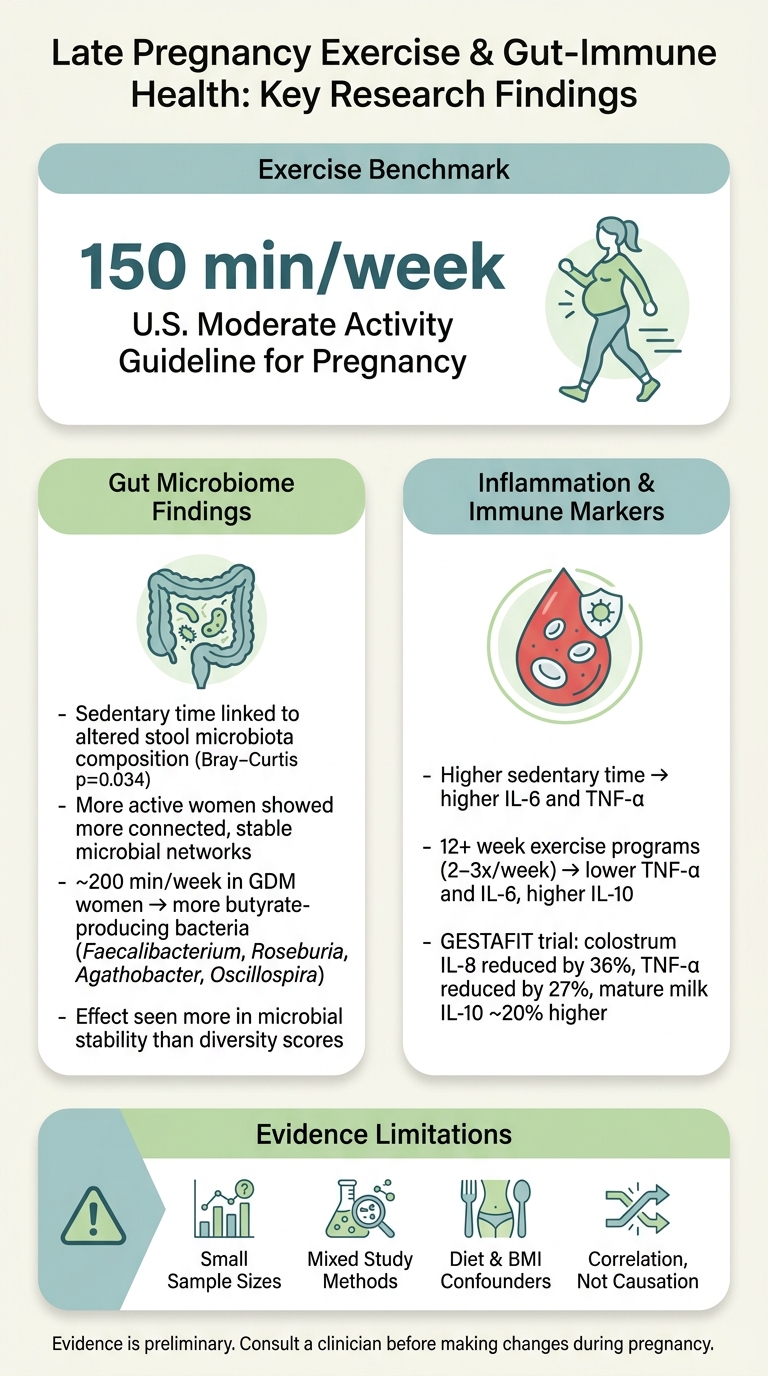
Late Pregnancy Exercise & Gut-Immune Health: Key Research Findings
Prenatal Fitness Research Review: Benefits Beyond Birth
sbb-itb-1bbfe7f
How Researchers Measure Exercise in Late Pregnancy
Before researchers can compare study results, they need a steady way to measure activity. In late pregnancy, most studies use either questionnaires or accelerometers. Exercise trials also try to keep day-to-day activity stable, so any shifts in the microbiome or immune system can be linked to the program itself. That choice matters a lot because the measurement method shapes how much confidence researchers can place in the microbiome findings.
Self-Report Questionnaires vs. Accelerometers
Questionnaires depend on memory. Accelerometers record movement more directly.
That’s the main tradeoff. Recall-based tools are easier to use in large studies, but they can bring in memory bias. Accelerometers cut down on that problem by tracking movement as it happens. When researchers want tight activity data to compare with stool samples and immune markers, accelerometers tend to be more useful.
How U.S. Research Defines Moderate Intensity
In U.S. pregnancy studies, moderate activity is usually defined as 150 minutes per week or a rating of 13–14 on the Borg Rating of Perceived Exertion scale. At that level, the effort feels moderately hard.
Researchers use this threshold as the standard benchmark when they sort participants and compare activity levels across studies.
Observational Cohorts vs. Exercise Intervention Trials
Observational cohorts track the activity patterns people already have. Exercise intervention trials do something different: they prescribe exercise and keep outside activity as steady as possible, so shifts in stool, inflammation, and metabolism can be tied to the program.
Each approach gives researchers something different. Cohorts reflect everyday habits, but they can’t fully control for confounders. Trials allow cleaner comparisons, but they may not mirror how people usually behave during pregnancy.
Those activity measures are then paired with stool and immune data in the next section.
What Researchers Measure in the Gut Microbiome and Immune System
Once activity levels are recorded, researchers match that data with stool and blood measurements to see whether late-pregnancy exercise is linked to changes in gut barrier function and immune balance. They then compare stool findings with blood markers to check whether microbiome shifts line up with immune changes.
Stool Sequencing, Diversity Scores, and Microbial Network Stability
In third-trimester studies, researchers usually track stool sequencing results, alpha and beta diversity, relative abundance, and microbial network stability. They pair those results with barrier markers such as fecal pH, acetate, and tight junction proteins. In exercise studies, this helps show whether moderate activity lines up with a steadier gut ecosystem.
Researchers usually read these gut measures alongside inflammation and immune markers, not on their own. That matters because a change in the microbiome means more when it matches changes seen in the blood.
Inflammatory and Metabolic Markers Tracked Alongside the Microbiome
Researchers also track blood-based markers that help connect stool findings to whole-body immune and metabolic responses. Common variables include IL-10, pro-inflammatory cytokines, triglycerides (TG), phagocytosis, and NK cell activity [5].
| Marker Category | Specific Variables Tracked | Purpose/Significance |
|---|---|---|
| Inflammatory | IL-10, pro-inflammatory cytokines | Measures the balance between systemic inflammation and immune regulation |
| Gut Health | Fecal pH, acetate (SCFA), tight junction (TJ) proteins | Indicates barrier integrity and gut acidity |
| Immune Function | Phagocytosis, NK cell activity | Evaluates innate immune activity |
The main question is pretty simple: do these patterns suggest a more balanced maternal immune response? IL-10 gets a lot of attention because it helps researchers judge whether exercise is linked to a better balance between anti-inflammatory and pro-inflammatory signals. Taken together, these markers show whether late-pregnancy activity tracks with lower inflammation, stronger barrier function, and steadier immune balance [5].
What Late-Pregnancy Exercise Studies Currently Show
Moderate Activity Is Linked to More Stable Microbiome Patterns
Late-pregnancy exercise seems to affect microbial makeup and network stability more than simple diversity scores.
One accelerometer-based study found that sedentary time during the second and third trimesters was tied to stool microbiota composition. The link was statistically significant in the third trimester (Bray–Curtis p=0.034, R²=0.025), even though richness and diversity scores did not change much. [2]
Another cohort reported that women who met or went beyond the U.S. guideline of 150 minutes per week of moderate-intensity aerobic activity had lower relative abundances of Bacteroidales, Bifidobacteriaceae, Lactobacillaceae, and Streptococcaceae than less active women (FDR-adjusted p<0.02). [1] In a late-pregnancy network analysis, more active women also had more connected and stable microbial networks. That points to better microbial resilience and stronger functional interaction. [8]
In women with GDM who exercised for about 200 minutes per week, researchers found more butyrate-producing genera, including Faecalibacterium, Agathobacter, Roseburia, and Oscillospira, along with higher microbial diversity. [4]
Those shifts stand out most when they move in step with immune markers.
Possible Links to Lower Inflammation and Better Immune Balance
Inflammation is where the clearest pattern shows up.
In one cohort, more moderate activity during the third trimester was linked to better IL-6 and leptin levels at delivery. On the flip side, higher sedentary time predicted higher IL-6 and TNF-α. [6]
Exercise programs lasting 12 weeks or more, done 2–3 times per week at moderate-to-vigorous intensity, have been linked to lower TNF-α and IL-6, higher IL-10, and better lipid and glucose markers. [9]
Some trials suggest the pattern may go beyond stool and show up in milk immune markers too. In GESTAFIT, exercise lowered colostrum IL-8 by 36% and TNF-α by 27%, while mature milk showed about 20% higher IL-10. [10][11] That fits with broader exercise–microbiome work showing that butyrate-producing microbes may help support anti-inflammatory signaling and gut barrier integrity.
Where the Evidence Falls Short
The early signal is encouraging, but the evidence still has clear limits. Many studies use small samples, different ways of measuring exercise, and different sequencing pipelines. Results can also be affected by diet, BMI, gestational diabetes, antibiotics, and medication use. Those gaps help explain why larger randomized trials with microbiome, immune, and metabolic endpoints are still needed. [1][3][7]
Conclusion: What These Findings Mean for Maternal Gut-Immune Support
Taken together, moderate activity during the third trimester seems linked to steadier microbial patterns and lower inflammatory signals. But it's important to be clear about what that means: these findings point to a possible gut-immune benefit, not cause and effect.
So the takeaway is modest, but encouraging. There may be a link worth paying attention to, especially for people thinking about gut and immune health during late pregnancy. Still, any plan for pregnancy or postpartum microbiome support should be talked through with a clinician.
Where Rebirth RE-1 Fits in This Topic
For readers looking for general microbiome support, Rebirth RE-1 is a 3-in-1 eubiotic synbiotic that combines prebiotics, probiotics, and postbiotics. It is not a pregnancy-specific treatment, and use during pregnancy or lactation should be discussed with a physician or obstetrician.
FAQs
What counts as moderate exercise in late pregnancy?
Moderate exercise in late pregnancy usually means 20 to 30 minutes of physical activity on most days. That can be as simple as walking, yoga, or cycling.
Doing this on a regular basis may help support gut-brain alignment and overall microbial health. Still, talk with your physician or obstetrician before starting any new exercise or health routine during pregnancy.
Why might exercise change the gut microbiome without changing diversity scores?
Exercise can change the gut microbiome even when overall diversity scores stay the same. In plain English, you may not see more kinds of bacteria across the board, but you can still see shifts in the bacteria that matter for health.
One example is an increase in certain functional bacterial species, including those that produce GABA.
So the main effect may not be “more bacteria.” It may be more of the right kinds. Physical activity appears to support specific populations linked to immune stability, metabolic health, gut-brain communication, and microbial metabolite production.
Can these findings guide safe exercise plans in the third trimester?
Research suggests that regular, moderate physical activity, such as walking, yoga, or cycling for 20 to 30 minutes on most days, may help support a healthy gut microbiome and overall well-being.
That said, this is guidance, not a one-size-fits-all rule. During the third trimester, it’s smart to check with your physician or obstetrician before you start a new exercise routine or make changes to supplements.