

After SIBO treatment, I’d focus on eating enough, correcting nutrient deficiencies, and tracking bowel habits - not chasing a “reset.” Start by testing one food at a time and keeping a stool diary for 1–2 weeks.
Here’s how I’d approach recovery with your clinician:
- Check persistent symptoms. Bloating alone does not prove SIBO has returned. Repeat breath testing only when the result would change your care, and review possible causes such as motility problems.
- Rebuild your diet. Ease out of short-term restrictions, add foods gradually, and use testing to guide nutrient replacement.
- Treat supplements as optional. Probiotics, prebiotics, and postbiotics are not proven to prevent recurrence. Human-origin labels and high CFU counts do not prove better results.
- Review RE-1 before trying it. Its listed 4.5 g of GOS and inulin fiber per serving may worsen symptoms. Its reset schedules are not validated post-SIBO protocols.
My bottom line: <u>judge recovery by food tolerance, nutrition, and bowel habits - not by finishing a supplement plan.</u> Seek urgent care for severe pain, black or bloody stool, repeated vomiting, or serious dehydration.
Rebuild Your Diet After Treatment
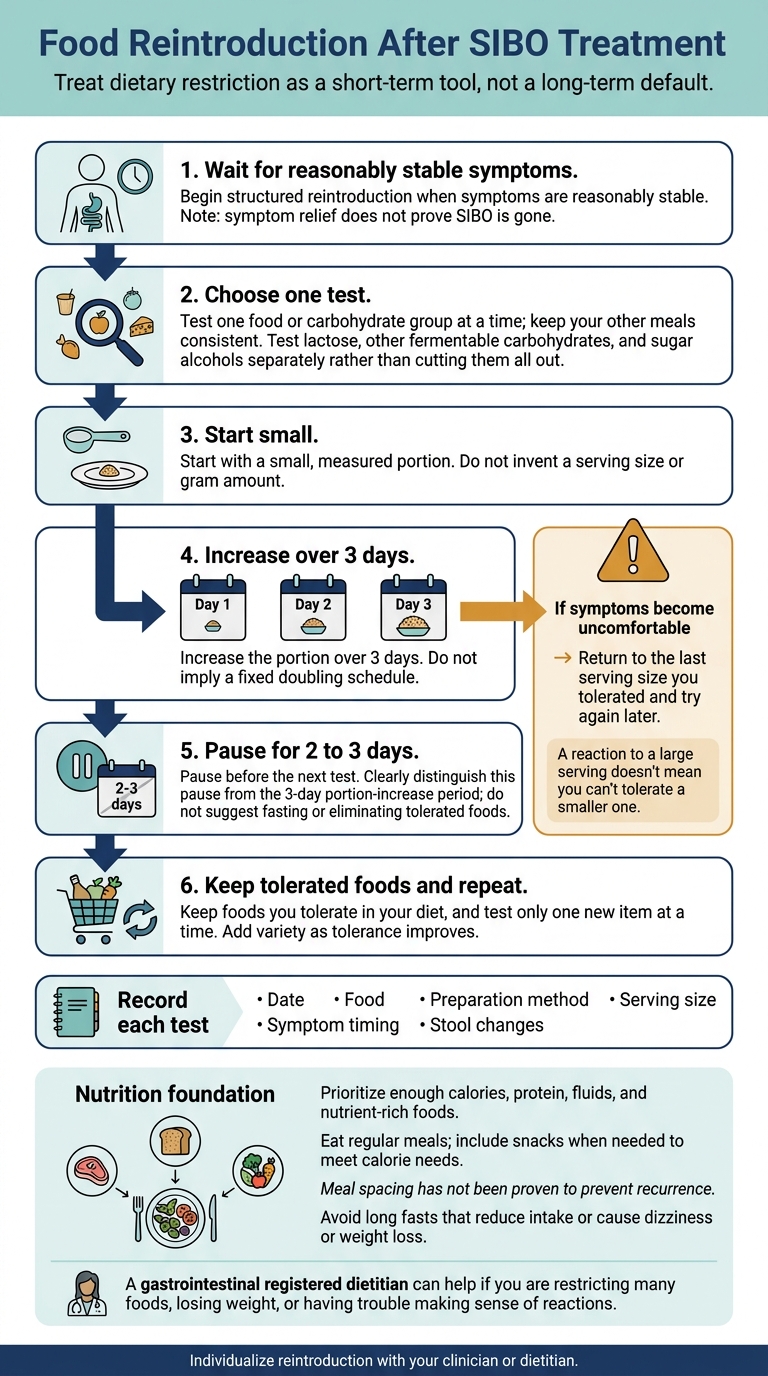
Food Reintroduction After SIBO Treatment
Treat dietary restriction as a short-term tool, not a long-term default. Low-FODMAP eating may ease symptoms, but symptom relief doesn't prove SIBO is gone. Keep the restriction phase short, then reintroduce foods to build a diet that works for you.[8][9][10] Once symptoms are stable, begin a structured reintroduction.
Reintroduce Foods Gradually
When symptoms are reasonably stable, test one food or carbohydrate group at a time and keep your other meals consistent. Start with a small, measured portion. Increase the portion over 3 days, then pause for 2 to 3 days before the next test.[4][5][7]
If symptoms become uncomfortable, return to the last serving size you tolerated and try again later. A reaction to a large serving doesn't mean you can't tolerate a smaller one.
Test lactose, other fermentable carbohydrates, and sugar alcohols separately rather than cutting them all out. Record the date, food, preparation method, serving size, symptom timing, and stool changes. Keep foods you tolerate in your diet, and test only one new item at a time.
Meet Nutrition Needs and Plan Meals
Focus on enough calories, protein, fluids, and nutrient-rich foods. Build each meal around a protein, carbohydrate, and fruit or vegetable you tolerate. Add variety as your tolerance improves rather than sticking to a small set of foods.
A registered dietitian with experience in gastrointestinal disorders can help if you're restricting many foods, losing weight, or having trouble making sense of reactions.[6]
As you add foods back, make getting enough nutrition your first priority. Meal spacing has not been proven to prevent recurrence. Eat regular meals, and include snacks when you need them to meet your calorie needs. Avoid long fasts that reduce your intake or cause dizziness or weight loss.
sbb-itb-1bbfe7f
Correct Nutrient Deficiencies and Track Stools
As you tolerate more foods, use lab results, weight, and stool patterns to check your recovery. Persistent bacterial overgrowth can interfere with nutrient absorption. Excess bacteria may consume vitamin B12, while poor fat absorption can limit absorption of fat-soluble vitamins. For consistent weight tracking, use the same scale, wear similar clothing, and weigh yourself at the same time of day.[11][12]
Check B12, Iron, and Other Nutrient Levels
Treating deficiencies helps recovery, but not everyone needs every nutrient test. Ask your clinician about targeted testing if you have unintentional weight loss, limited food intake, persistent diarrhea or steatorrhea (fatty stools), anemia, numbness, or a history of intestinal surgery or malabsorption. Tests may include a complete blood count, B12, iron studies - including ferritin and transferrin saturation - folate, or 25-hydroxyvitamin D. Your history and exam guide any additional testing.[11][13]
B12 can be low even when folate is normal or elevated because some intestinal bacteria produce folate. Borderline B12 results may need another test to confirm a deficiency. The replacement dose, treatment length, and delivery method depend on the nutrient deficiency, its severity, and how well you absorb treatment. B12, for example, may be given by mouth or injection.[14][15]
Don't start high-dose supplements without a confirmed deficiency, and follow your clinician’s retesting schedule. Treat B12 deficiency first: folate can mask it while nerve injury continues.[14][15]
Track Diarrhea, Constipation, and Stool Changes
Stool trends add context to your lab results and help you assess food tolerance as you rebuild your diet. Using a microbiome diet planner can help you organize these changes. Persistent greasy stools may need evaluation for malabsorption. If your bowel habits are still changing, record them the same way each day to track your gut reset progress and make patterns easier to spot.
Keep a stool diary for 1–2 weeks, or as directed. Note frequency, urgency, pain, nighttime episodes, blood or mucus, and any medication or supplement changes. Use the Bristol Stool Form Scale: Types 1–2 are hard or lumpy, Types 3–4 are formed or soft, and Types 5–7 are loose to watery.[18] Neither stool form nor frequency can confirm or rule out SIBO.[16][17]
| Pattern | Frequency | Consistency | Urgency | When evaluation is appropriate |
|---|---|---|---|---|
| Diarrhea-predominant, often with cramping or bloating | More frequent than usual | Types 5–7, especially watery stools | Sudden or difficult to delay | Persistent or worsening diarrhea, greasy stools, fever, nighttime episodes, or weight loss |
| Constipation-predominant, sometimes with bloating or reduced appetite | Less frequent than usual, or difficult passage | Usually Types 1–2 | Often straining or incomplete evacuation rather than urgency | Persistent constipation or worsening difficulty passing stool |
| Mixed, sometimes with cramping or incomplete evacuation | Alternates between difficult and loose stools | Shifts between Types 1–2 and 5–7 | Varies between urgency and difficult passage | Recurrent, disruptive changes, especially with anemia, fever, nighttime symptoms, or weight loss |
| Improving, with better intake, hydration, and comfort | Moves toward your usual pattern | More consistently formed, often Types 3–4 | Less urgency or leakage | Report relapse, persistent abnormal stools, or any warning sign even if some symptoms improve |
Compare changes with your usual bowel habits. Sudden shifts deserve review.
Seek urgent care for black or bloody stool, severe abdominal pain or swelling, repeated vomiting, fainting, confusion, serious dehydration, or inability to pass stool and gas. Contact your clinician promptly for worsening weakness, new numbness, or trouble walking. Don't dismiss these changes as normal recovery.
Add Microbiome Support With Care
Once your diet, stools, and nutrient deficiencies are stabilizing, you can consider targeted microbiome support.
Understand Microbiome Supplement Types
Supplements are optional, not a required recovery step. After diet changes and nutrient repair, some people try them for added support. But none is established as a way to prevent recurrence or permanently change the gut microbiome.
| Category | What it is | Potential role | Evidence limits | Cautious use |
|---|---|---|---|---|
| Prebiotic | Fiber or a compound used by microbes that support health | Feeds selected gut microbes | Not all fiber qualifies; benefits depend on dose | Start small; reduce or stop if symptoms worsen |
| Probiotic | A live microbe with a studied health effect | May help some GI symptoms | Effects depend on the exact strain; SIBO evidence is inconsistent | Check the studied dose, storage, and safety |
| Postbiotic | Nonliving microbial material with a studied health effect | Provides support without live organisms | Not every killed microbe or isolated metabolite qualifies | Check the exact preparation |
| Synbiotic | Live microbes plus a substrate | Combines microbes with targeted fuel | The combination does not prove benefit after SIBO | Review ingredients and total fiber dose |
| Human-derived strains | A label describing human origin, not a supplement class | Identifies the microbial source | Origin alone is not clinical evidence | Prioritize relevant human studies |
For products labeled as human-derived, look past the marketing terms and check the label details.
Assess the Evidence for Human Origin Strains
Human origin does not guarantee that a strain will work better or stay in your gut. Look for the exact strain, relevant human data, and the dose and duration studied. For live products, check storage instructions and viable counts through expiration. Colony-forming unit (CFU) count tells you about dosing - not whether the product works.
A pooled analysis found no clear reduction in SIBO with probiotics compared with placebo: risk ratio 0.63, 95% confidence interval 0.29–1.36. It does not show that probiotics prevent recurrence. The American College of Gastroenterology reports insufficient consistent evidence to recommend specific probiotics for SIBO.[19][20]
If you try microbiome support, start with the lowest exposure you can tolerate.
Increase Fermentable Fiber Slowly
Start with a small amount of one fiber food you tolerate or one selected supplement. Keep the dose steady for several days, and increase it only if you feel comfortable. Inulin and other highly fermentable ingredients can worsen bloating, pain, or stool changes.
Record the ingredient, dose, start date, and response. Use your stool log to check tolerance. Reduce or stop an addition that worsens symptoms rather than assuming those symptoms mean die-off.[1][3]
Get clinician guidance before experimenting if you have active or severe symptoms, major unintentional weight loss, marked immunosuppression, or methane-associated constipation - more accurately called intestinal methanogen overgrowth (IMO). People who are critically ill or have central venous catheters should not start live probiotics on their own because of rare bloodstream infections.[21][22]
With IMO, aim for fiber amounts you can tolerate, rather than sudden increases or long-term avoidance.[1][3] Track your response before increasing the amount again.
Consider Optional Rebirth RE-1 Support
With general microbiome support covered, the next step is to review this product’s ingredients, tolerance, and symptom tracking. Rebirth RE-1™ is optional post-treatment support - not a SIBO treatment. Discuss it with your clinician only after your diet, stool patterns, and nutrient deficiencies are stable. It does not replace diagnosis, prescribed antimicrobials, motility evaluation, or nutrient correction.
Review Ingredients and Fiber Tolerance
The manufacturer describes a 3-in-1 synbiotic with prebiotics, probiotics, and postbiotics. It lists seven live Human Origin Strains (HOSt™), one postbiotic Human Origin Strain, 500 billion CFU per serving, and 4.5 g of fiber from GOS and inulin.[23][24]
Review the current label with your clinician before trying it. GOS and inulin may worsen bloating, discomfort, or stool changes, especially if overgrowth or impaired motility persists.[2][25]
CFU counts, human-origin labeling, and Lyosublime™ claims do not prove better outcomes.
Compare Reset Schedules and Track Your Response
If you and your clinician decide to try RE-1, choose one schedule and track your response consistently. The manufacturer’s schedules are not validated post-SIBO protocols or tolerance tests. Finishing a schedule does not prove eradication, and longer use does not establish better results.[23][24]
| Duration | Manufacturer-listed schedule |
|---|---|
| 7-Day Reset | One sachet daily for 7 days |
| 4-Week Reset | One sachet daily for 4 weeks |
| 12-Week Reset | One sachet daily for 12 weeks |
Record your start date and dose. Then track discomfort, stool frequency and consistency, urgency, incomplete evacuation, food tolerance and variety, weight, and energy. Keep other new additions to a minimum so changes are easier to assess.
Pause the product if symptoms worsen and contact your clinician. Recheck abnormal nutrient labs only as directed.
Conclusion: Focus on Long-Term Recovery
Continue RE-1 only while symptoms, stools, and nutrition improve - and only if you tolerate it and your clinician considers its use appropriate.
FAQs
How can I tell food intolerance from SIBO recurrence?
Food intolerance and SIBO recurrence can both cause bloating, gas, and abdominal discomfort. Keep a detailed log of your bowel patterns, stool consistency, and symptom timing, including when symptoms occur in relation to meals and supplements.
If symptoms persist or worsen, consult a healthcare provider. They can review your log and use tools such as breath tests that measure hydrogen or methane to help tell dietary sensitivities apart from returning bacterial overgrowth.
What if I still can't expand my diet after treatment?
Your gut may need more time or targeted support. Keep a symptom journal to track how food, stress, and sleep affect your digestion.
If symptoms persist, consider clinically backed Rebiirth RE-1. Its prebiotics, probiotics, and Human Origin Strains may help fill nutritional gaps and restore balance when diet alone isn’t enough. Always consult a healthcare provider to rule out underlying issues and build a recovery plan that fits your needs.
How do I know if Rebirth RE-1 is helping me?
Keep a simple weekly note on your phone to track bowel regularity, bloating, abdominal discomfort, food tolerance, sleep quality, energy levels, and stress resilience.
Some users report improvements within the first week, but full microbiome recovery can take up to three months. Symptoms may ease before clinical markers return to normal. Pair your symptom log with professional guidance and diagnostic tests to check your progress.