

Here’s the short answer: gut microbiome tools may affect dopamine indirectly, but they do not replace dopamine and human proof is still limited.
If you want the article in one view, this is it:
- Prebiotics feed gut microbes and may shift SCFAs, inflammation, and amino acid supply.
- Probiotics add live strains, and the effects depend on the exact strain.
- Postbiotics deliver non-live microbial compounds, such as butyrate and other SCFAs.
- 3-in-1 synbiotics try to combine all three in one setup.
- The main human gap is still the same: few trials measure dopamine directly.
A few numbers show the current state of the field:
- One 2024 meta-analysis found prebiotics alone did not lower depression scores in a clear way (SMD -0.28; 95% CI -0.61 to 0.04).
- One 2025 human RCT reported that Lactiplantibacillus plantarum KBL396 increased serum dopamine after 8 weeks.
- In one Parkinson’s mouse model, sodium butyrate 165 mg/kg/day for 7 days was linked to worse motor outcomes and lower striatal dopamine.
- The synbiotic example in the article uses 4.5 g of GOS + low-molecular-weight inulin and 500 billion CFU per serving.
So the main point is simple: the idea is promising, but the data are uneven and highly dependent on the exact fiber, strain, compound, dose, and disease model.
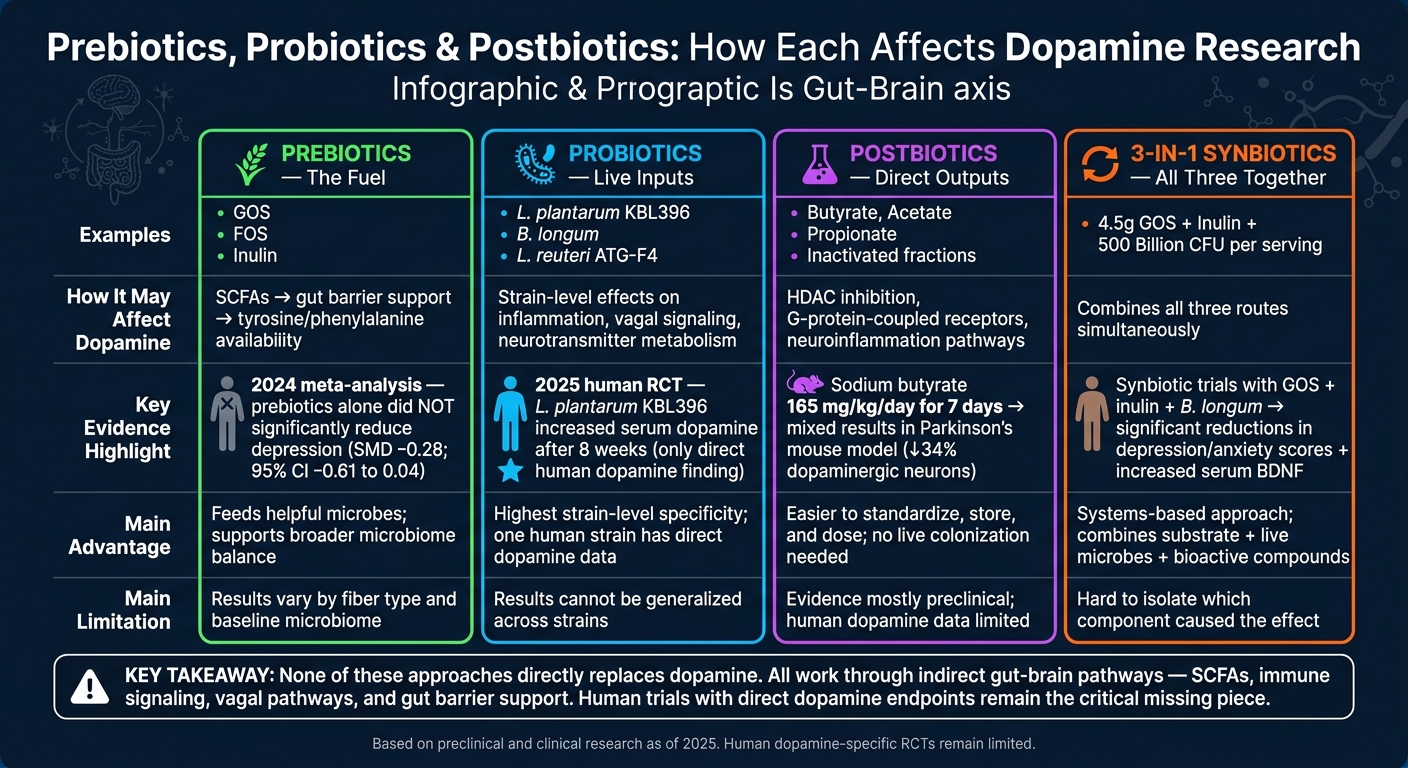
Prebiotics vs Probiotics vs Postbiotics: Dopamine Research Comparison
2-Minute Neuroscience: Gut-Brain Axis
sbb-itb-1bbfe7f
Quick Comparison
| Approach | How it may affect dopamine | What the evidence looks like | Main catch |
|---|---|---|---|
| Prebiotics | Through SCFAs, gut barrier support, and tyrosine/phenylalanine handling | Mostly preclinical; human dopamine endpoints are rare | Results vary by baseline microbiome and fiber type |
| Probiotics | Through strain-level effects on inflammation, stress pathways, vagal signaling, and metabolism | Some animal data and limited human data; one human strain has direct dopamine data | You can’t generalize from one strain to another |
| Postbiotics | Through SCFAs, immune signaling, HDAC-related effects, and barrier pathways | Mostly preclinical and mixed | Dose and disease context can change the direction of the effect |
| 3-in-1 synbiotics | Combine substrate, live strains, and microbial products in one protocol | Fits current gut-brain models | Hard to know which part caused the result |
What I take from the article is pretty clear: microbiome work in dopamine research is more about changing the setting around dopamine than changing dopamine itself. That means lower inflammation, better barrier function, and shifts in microbial metabolites may matter more than any claim about “boosting dopamine.”
If you’re reading this to compare options, the shortest way to think about it is:
- Prebiotics = fuel
- Probiotics = live inputs
- Postbiotics = direct microbial outputs
- Synbiotics = all three together
That frame makes the article easier to follow without repeating every study one by one.
1. Rebirth RE-1 3-in-1 Synbiotic Model
This model shows how the three microbiome classes can work together around one dopamine-related pathway.
Dopamine Mechanisms
Rebirth RE-1™ connects to dopamine research through indirect gut-brain pathways. Its 3-in-1 setup focuses on gut barrier integrity, neuroinflammation, and amino acid availability, including tyrosine and phenylalanine.
The prebiotic complex provides 4.5 g of galactooligosaccharides (GOS) and low-molecular-weight inulin per sachet. Those ingredients support short-chain fatty acid (SCFA) production and barrier function.[13]
That matters only if these mechanisms lead to measurable clinical or microbiome changes.
Evidence Outcomes
RE-1's reported outcomes focus on digestive function and microbiome composition. That matters because shifts in immune activity and inflammation can influence stress and dopaminergic signaling.
The HOSt™ probiotic blend includes seven strains:
- Bifidobacterium longum BR-BB536
- B. breve BR-M16V
- B. infantis BR-M63
- B. breve BR-B3
- Lactobacillus gasseri BR-LAC-343
- Bacillus coagulans BR-LACRIS-S
- Lactobacillus helveticus BR-MCC1848[13][12]
Several of these strain families show up in psychobiotics and the microbiota-gut-brain axis tied to stress, mood, and anxiety. Synbiotic trials using similar ingredients, including GOS, inulin, B. longum, and B. bifidum, have reported significant reductions in depression and anxiety scores and increased serum BDNF versus placebo.[14][16] Direct dopamine endpoints, though, are still a clear research gap.
That puts more weight on ingredient-level detail than on brand-level claims.
Specificity
The defined strain roster allows strain-level interpretation. In plain terms, it makes it easier to connect each strain to mechanistic literature tied to dopamine-related pathways.
The postbiotic component, Lactobacillus paracasei BR-MCC1849, delivers microbial material directly. That adds a non-live route for barrier integrity and immune signaling.[13]
Its role is not dopamine replacement. The point is to combine microbiome functions that may work together.
Synbiotic Fit
RE-1's 3-in-1 architecture lines up with the current direction of microbiome science. The three parts act on the same gut-brain pathways from different angles.
The Lyosublime™ delivery system is designed to support delivery through the digestive tract. That may help produce more consistent microbiome and metabolite changes tied to dopamine-linked research settings. With 500 billion CFU per serving and phased 7-day, 4-week, and 12-week protocols, the formulation is set up for measurable microbiome shifts that could be studied alongside dopamine-related outcomes.[11][13]
2. Prebiotics
Prebiotics are the least direct of the three classes. Even so, they can still affect dopamine-linked pathways by changing how gut microbes work.
Dopamine Mechanisms
Prebiotics like inulin, FOS, and GOS influence dopamine pathways indirectly by shifting the gut microbiome.[3][4][7] They can increase short-chain fatty acid, or SCFA, production by enriching taxa such as Bifidobacterium and certain Firmicutes. That matters because SCFAs help support gut barrier integrity and may reduce systemic and neuroinflammation.
They may also change tyrosine and phenylalanine availability through microbial amino acid metabolism and host absorption. In plain terms, they can affect how much raw material is available for dopamine production. SCFAs may also upregulate tyrosine hydroxylase and suppress dopamine-β-hydroxylase, which could tilt the system toward dopamine synthesis.[23]
Gut dopamine itself does not cross the blood-brain barrier. So when prebiotics affect brain dopamine, the route is thought to involve SCFA signaling, immune modulation, and precursor availability, not direct transfer of intestinal dopamine.[24][2][6]
Evidence Outcomes
The clearest mechanistic evidence comes from preclinical work. In a rat model fed a high-fat, high-sugar diet, FOS supplementation reduced preference for and consumption of palatable food. It also normalized molecular markers of dopamine signaling in the mesocorticolimbic (MCL) system.[21][9]
Human evidence is thinner. Most human trials do not measure dopamine directly, so researchers usually rely on mood and stress outcomes as stand-ins.[4][7] That makes the picture a bit less precise. A 2024 meta-analysis found that prebiotics alone did not significantly reduce depression (SMD −0.28; 95% CI −0.61 to 0.04).[22]
Specificity
Prebiotics are ecological modulators, not dopamine-specific drugs.[3] Their effects depend on a person's starting microbiome, diet, and genetics. So the same dose of GOS or inulin can lead to different microbial shifts and metabolite outputs from one person to the next.[3][4][17]
That's the catch: the mechanism makes sense, but the response is variable. And that makes dopamine-specific outcomes hard to predict at the individual level.
Synbiotic Fit
Prebiotics look most useful for dopamine-linked research when they are part of synbiotic systems. As substrates, they can support colonization and metabolic output from probiotic strains, which may increase the production of neuroactive molecules and neurotrophic factors beyond what prebiotics alone can do.[1][25][9][26]
In a 3-in-1 synbiotic design, this substrate layer helps drive probiotic activity and downstream postbiotic output. So in dopaminergic and immune signaling, prebiotics fit best as a support layer for immune health rather than a stand-alone dopamine intervention.
3. Probiotics
Probiotics add a live, strain-specific layer to dopamine-linked microbiome research. Compared with prebiotics, they work more directly because they introduce live strains with measurable effects at the strain level.
Dopamine Mechanisms
Some strains have been studied for gut-brain effects. Lactobacillus helveticus BR-MCC1848 has been shown to reduce stress-related gene-expression changes tied to signaling and nervous system development.[27] Bifidobacterium breve BR-B3 helps support barrier integrity by upregulating tight junction proteins that limit systemic immune activation.[27] Probiotics can also lower pro-inflammatory cytokines while increasing anti-inflammatory markers like interleukin-10 (IL-10).[27]
Put simply, the study connects selected strains to stress and mood pathways through the microbiota-gut-brain axis. The effects are still indirect, but this gets the research closer to defined strain-level mechanisms.
Evidence Outcomes
Mechanisms only matter if they show up in outcomes people can measure. And that’s where strain-specific findings start to stand out. Bifidobacterium infantis BR-M63 has been linked to better mental health in IBS, while Lactobacillus gasseri BR-LAC-343 has been studied for stress-related sleep quality.[27]
| Probiotic Strain | Primary Research Focus | Gut-Brain Relevance |
|---|---|---|
| Bifidobacterium infantis BR-M63 | Mental Health & IBS | Restoration of microbial balance and gut-brain axis [27] |
| Lactobacillus helveticus BR-MCC1848 | Anxiety & Depression | Reduces stress-related gene-expression changes linked to signaling [27] |
| Lactobacillus gasseri BR-LAC-343 | Quality of Sleep | Mediates gut-brain axis to improve sleep under stress [27] |
Specificity
HOSt™ strains are presented as human-derived strains meant to support eubiosis with more consistency than transient strains.[27]
Synbiotic Fit
In a prebiotic, probiotic, and synbiotic combination, probiotics use the prebiotic substrate and work alongside postbiotic signaling to strengthen microbiome effects. That makes strain metabolites the next layer to watch in dopamine-linked research. Postbiotics then carry those effects further by delivering microbial compounds without live organisms.
4. Postbiotics
If prebiotics feed the system and probiotics help shift it, postbiotics are the end products. They’re the non-live part of dopamine-linked microbiome research, and that matters. Because they aren’t live microbes, they may help the host without the colonization swings that often muddy probiotic research.[5][32][33]
Dopamine Mechanisms
One of the main proposed links between postbiotics and dopamine runs through SCFAs, especially butyrate, acetate, and propionate. These metabolites can change gene expression and epigenetic marks in dopaminergic circuits. Butyrate, in particular, has been tied to shifts in dopamine-related genes and receptors.[28][32][33][37]
Other postbiotic components matter too. Peptidoglycans, lipoteichoic acids, and exopolysaccharides can interact with pattern-recognition receptors on immune cells. That can shift cytokine profiles in ways that affect dopaminergic neuron survival.[5][32][33] Some postbiotic preparations may also contain neurotransmitters and SCFAs that bind to receptors in the brain.[5]
So the key issue isn’t just whether something is labeled a postbiotic. The actual compound mix matters.
Evidence Outcomes
The dopamine data are still mostly preclinical, and the results don’t line up neatly.
In a chronic mild stress rat model, a combined probiotics, postbiotics, and n-3 polyunsaturated fatty acids protocol improved depressive behaviors and increased SCFAs and dopamine in brain and gut tissue.[10]
But there’s a flip side. In a subacute MPTP Parkinson's disease mouse model, sodium butyrate at 165 mg/kg/day for 7 days aggravated motor dysfunction, decreased striatal dopamine and serotonin, reduced dopaminergic neurons by about 34%, and downregulated tyrosine hydroxylase by about 47%.[30][31]
That’s why this area can feel tricky. The same broad class of compounds may point in different directions depending on the model, dose, and disease setting. Human data are still limited, and systematic reviews continue to describe postbiotic evidence for dopamine-linked outcomes as inconclusive.[36]
Specificity
Postbiotics are not exclusive to dopamine, but butyrate stands out as the compound most closely tied to dopaminergic neuron survival, synaptic plasticity, and motor control in basal ganglia structures.[32][33][37][5]
Synbiotic Fit
In 3-in-1 models, postbiotics act as the immediate signaling layer. Prebiotics feed the ecosystem, probiotics help reshape it, and postbiotics deliver direct bioactive signals that can affect inflammation, barrier integrity, and metabolite availability. For dopamine-linked research, the main takeaway is pretty simple: lower inflammation and better barrier function may help support dopaminergic circuits.[29][34][35]
Mechanisms, Outcomes, and Evidence Limits Across All Three Classes
All three classes affect dopamine indirectly through the gut-brain axis. The main routes are SCFAs, immune signaling, vagal signaling, and gut barrier support. The table below pulls together the main mechanism, evidence, and specificity differences already covered.
| Class | Dopamine Mechanism | Evidence Outcomes | Specificity | Synbiotic Fit |
|---|---|---|---|---|
| Prebiotics (GOS, FOS, inulin) | Indirectly support dopaminergic balance through SCFAs, gut barrier support, and precursor availability such as tyrosine.[7][46][47] | Direct human dopamine endpoints are rare; studies more often report microbiome or metabolic shifts.[7][47] | Effects differ by substrate; inulin tends to increase butyrate and tyrosine, while GOS and FOS show stronger HPA-axis or barrier effects.[8][45][47] | Acts as the fuel layer that feeds helpful microbes and supports SCFA output.[1] |
| Probiotics (L. plantarum, L. reuteri, B. longum, B. breve) | May shift dopamine signaling through immune effects, vagal signaling, and neurotransmitter metabolism.[2][41][19][43] | Some preclinical and limited human data show dopamine-related biomarker changes; symptom outcomes are more common than direct dopamine assays.[41][42][43] | Highest strain specificity: Lactiplantibacillus plantarum KBL396 increased serum dopamine in an 8-week human RCT, and Bifidobacterium longum CECT 30763 normalized dopamine release, metabolism, and signaling in a mouse model.[42][41] | Provides the live microbial component with psychobiotic properties.[1] |
| Postbiotics (butyrate, mixed SCFAs, inactivated fractions) | Non-viable components can act through G-protein-coupled receptors, histone deacetylase inhibition, barrier integrity, and neuroinflammation pathways.[10][20] | Promising preclinical data; human dopamine-specific evidence remains limited.[10][44] | Mechanistically distinct: butyrate affects epigenetics and dopaminergic neuron survival, while mixed SCFAs and inactivated fractions work through immune and barrier pathways.[20][48] | Provides the signaling layer in a 3-in-1 model.[1] |
| 3-in-1 Synbiotic (e.g., Rebirth RE-1) | Combines prebiotic fiber, live probiotic strains, and postbiotic components in one protocol. | Fits current microbiome research, which emphasizes microbe cross-feeding and metabolite signaling.[1] | Integrates all three classes into a single coordinated protocol. | Built to combine ecological support with a live microbial or metabolite payload.[1] |
The clearest dopamine-specific findings still come from animal work. For example, L. reuteri ATG-F4 increased serum dopamine in mice after 4 weeks,[19] and sodium butyrate improved dopamine levels in a Drosophila Parkinson's model.[20] Human trials, by contrast, usually lean on proxy outcomes like mood, stress, and cognition instead of direct dopamine measures through PET or CSF.[15][38][39][40]
There is one standout human exception. A 2025 randomized, double-blind, placebo-controlled trial found that Lactiplantibacillus plantarum KBL396 increased serum dopamine after 8 weeks.[42] That kind of direct endpoint is rare, and it shows why strain-level specificity matters so much. Saying "probiotics help dopamine" is a bit like saying "plants grow food" - technically yes, but the details make all the difference.
Prebiotic and postbiotic effects also shift based on the compound, dose, and model. Inulin, GOS, and FOS are not interchangeable, and butyrate, mixed SCFAs, and inactivated microbial fractions each act on different targets, so treating them as one bucket would blur meaningful differences.[20][48] Those tradeoffs are exactly why the next section looks at practical pros and cons, not mechanism by itself.
Pros and Cons of Each Approach for Dopamine-Linked Research
Each class brings something useful to dopamine-linked research. But there’s a catch: none of them, by itself, proves a direct dopamine effect.
| Approach | Main Advantage | Main Limitation |
|---|---|---|
| Prebiotics (GOS, FOS, inulin-type fibers) | Feed helpful microbes and support broader microbiome balance | Results vary by fiber type and baseline microbiome; can cause gas or bloating |
| Probiotics (L. plantarum KBL396, B. longum CECT 30763, L. reuteri ATG-F4) | Highest strain-level specificity; L. plantarum KBL396 increased serum dopamine in a human RCT[49] | Results can’t be applied across strains; viability and shelf stability matter |
| Postbiotics (butyrate, SCFAs, inactivated fractions) | Non-living and easier to standardize, store, and dose; no colonization required | Evidence is mostly preclinical; direct dopamine outcomes remain limited |
| 3-in-1 Synbiotic | Broad systems-based approach; combines substrate, live microbes, and bioactive compounds in one formula | Hard to pin results on one component; direct dopamine effects remain unproven without dopamine-focused RCTs |
The tradeoff shows up most clearly in human trials. In many cases, symptom shifts move ahead of dopamine data. For example, a multi-strain probiotic trial improved mood and serotonin, but plasma dopamine did not change[18].
That makes direct dopamine measurement the main gap heading into the final synthesis.
Conclusion
Put it all together, and one pattern keeps showing up: across prebiotics, probiotics, and postbiotics, microbiome research suggests indirect effects on dopamine pathways. But the human evidence is still uneven.
Prebiotics mostly support the gut ecosystem. Probiotics add live, strain-specific effects. Postbiotics deliver more defined downstream signals. Each may shape dopamine-linked pathways, but none is a direct dopamine therapy.
They all work through indirect routes, including SCFAs, immune signaling, vagal pathways, and barrier support. In plain terms, none acts on dopamine the way a drug does.
That’s the idea behind a 3-in-1 synbiotic model. It lines up with this biology by combining substrate, live microbes, and bioactive products in one protocol. Rebirth RE-1 fits that setup with GOS and inulin prebiotics, HOSt™ probiotics, and postbiotic components, though direct human data tied to dopamine is still limited.
The biggest gap hasn’t changed: large, controlled human trials with direct dopamine endpoints. Until those trials exist, the field is mechanistically strong but still incomplete in the clinic. The science looks promising, but dopamine-specific clinical proof is still the missing piece.
FAQs
Can microbiome supplements really increase dopamine?
Certain probiotic strains, often called psychobiotics, may affect the gut-brain axis and help support neurotransmitter production, including dopamine.
Research suggests these strains send signals to the brain through the vagus nerve and other pathways tied to mood and central nervous system function. Rebiirth RE-1™ follows this idea with a 3-in-1 synbiotic that combines prebiotics, probiotics, and postbiotics to support gut balance.
Why do strain, fiber, and dose matter so much?
In dopamine and broader gut-brain research, precision in strains, fiber, and dose matters because each one shapes how dependably an intervention works.
Specific Human Origin Strains (HOSt™) are adapted to the human gut. Prebiotic fibers, such as 4.5 grams of galactooligosaccharides and inulin, help feed helpful microbes. And a high-potency dose, such as 500 billion CFU, helps deliver a large microbial population.
Are synbiotics better than using one approach alone?
Yes. Research suggests synbiotics may work better than using just one approach because they combine prebiotics and probiotics. That combo can strengthen the effects of each one and may lead to steadier gut and stress-related results.
Adding postbiotics may help even more by lowering inflammation and supporting the gut barrier. This 3-in-1 approach, used in formulas like Rebiirth RE-1, may offer more dependable support than taking each part on its own.