

If you have a weakened immune system, probiotics are not a simple yes-or-no choice. Based on the article, they look lower-risk in some stable adults - such as certain people with controlled HIV - but the risk goes up in people who are critically ill, have central lines, gut injury, or very severe immune suppression.
Here’s the short version I’d want you to know first:
- Stable outpatient groups looked safer in studies.
- A 2015 review of 57 studies found no serious product-related harms, but many studies were small and short.
- In ICU patients, the picture changed. In the PROSPECT trial (about 2,653 ventilated patients), probiotics did not lower pneumonia or death, and L. rhamnosus was found in sterile sites in about 1.1% of patients who got LGG.
- Rare but serious bloodstream infections have been reported, most often with Lactobacillus or Saccharomyces strains.
- A 1980–2023 review found 23 cases where strain testing matched the infection to the probiotic taken.
- Risk is highest with ICU care, chemotherapy-related neutropenia, early transplant care, advanced HIV/AIDS, severe gut injury and dysbiosis, short bowel syndrome, and central venous catheters.
Bottom line: I’d read the article as saying probiotics may fit selected, stable immune-compromised adults, but they should not be used casually in high-risk settings. The product, the dose, and the person’s current health status all matter.
A few practical takeaways stand out:
- Do not assume one study applies to every immune-compromised person.
- Do not focus only on CFU count. Strain and patient condition matter just as much.
- Get clinician review first if there is ICU illness, a central line, transplant care, severe neutropenia, very low CD4 count, or gut barrier damage.
- If a probiotic is used, document the exact strain, dose, route, start date, and planned duration.
This article, in short, says: some stable patients may use certain studied probiotics with caution, but the sickest patients need specialist review or should avoid them.
Risks of using probiotics, medical expert explains
sbb-itb-1bbfe7f
What Clinical Studies Show About Probiotic Safety
Clinical safety changes a lot based on the setting. Stable outpatients tend to look safer than ICU patients. A 2015 systematic review that covered 57 clinical studies in immune-compromised adults found no serious product-related adverse events. In many of those studies, adverse event rates were actually lower in probiotic or synbiotic groups than in control groups.[5]
That sounds reassuring, but there’s a catch. Adverse-event reporting was uneven, and many trials were small and short. So while those studies did not show major safety problems, they also were not built to pick up rare harms.
In practice, safety seems to depend less on the word probiotic on the label and more on the patient’s condition. Clinical stability, gut integrity, and device burden matter a lot. The clearest safety signals come from stable outpatient groups, especially HIV studies.
Findings in Stable HIV and Moderately Immune-Compromised Adults
In adults with stable HIV, short-term probiotic use has generally looked safe. One placebo-controlled crossover trial in HIV-positive adults on antiretroviral therapy tested Lactobacillus rhamnosus GG (LGG) at about 1–5 × 10¹⁰ CFU twice daily for 2 weeks. Researchers reported no adverse events, no clinical infections, and no meaningful changes in HIV RNA or CD4 counts. A six-month follow-up also found no probiotic-related harms.[11]
Other small trials looked at L. rhamnosus GR-1 and RC-14 at around 2 × 10⁹ CFU per day in moderately immune-compromised HIV patients. Those studies also reported no safety concerns, no changes in hepatic or renal function, and no serious probiotic-attributable events, even with longer-term use.[14]
Still, it’s worth keeping the limits in view. These trials were small and short, which means they cannot rule out rare invasive infections. And once patients move from stable outpatient care into critical illness, the risk picture changes.
Findings in Critically Ill, Hospitalized, and ICU Patients
In ICU settings, the stakes go up fast. Mechanical ventilation, catheters, and severe illness can change the equation. Evidence here is less reassuring. Some reviews suggest fewer infectious complications, but the large PROSPECT trial did not confirm that benefit.[6][7]
That trial enrolled about 2,653 mechanically ventilated ICU patients. It found no significant reduction in ventilator-associated pneumonia (VAP) or mortality. It also detected L. rhamnosus in sterile sites in about 1.1% of patients in the LGG arm.[8][10]
That doesn’t mean probiotics are broadly unsafe in every hospitalized patient. But in a high-risk ICU population, this is a measurable signal, and it can’t be brushed aside.
That shift is what drives the risk discussion in the next section.
Documented Risks and High-Risk Clinical Situations
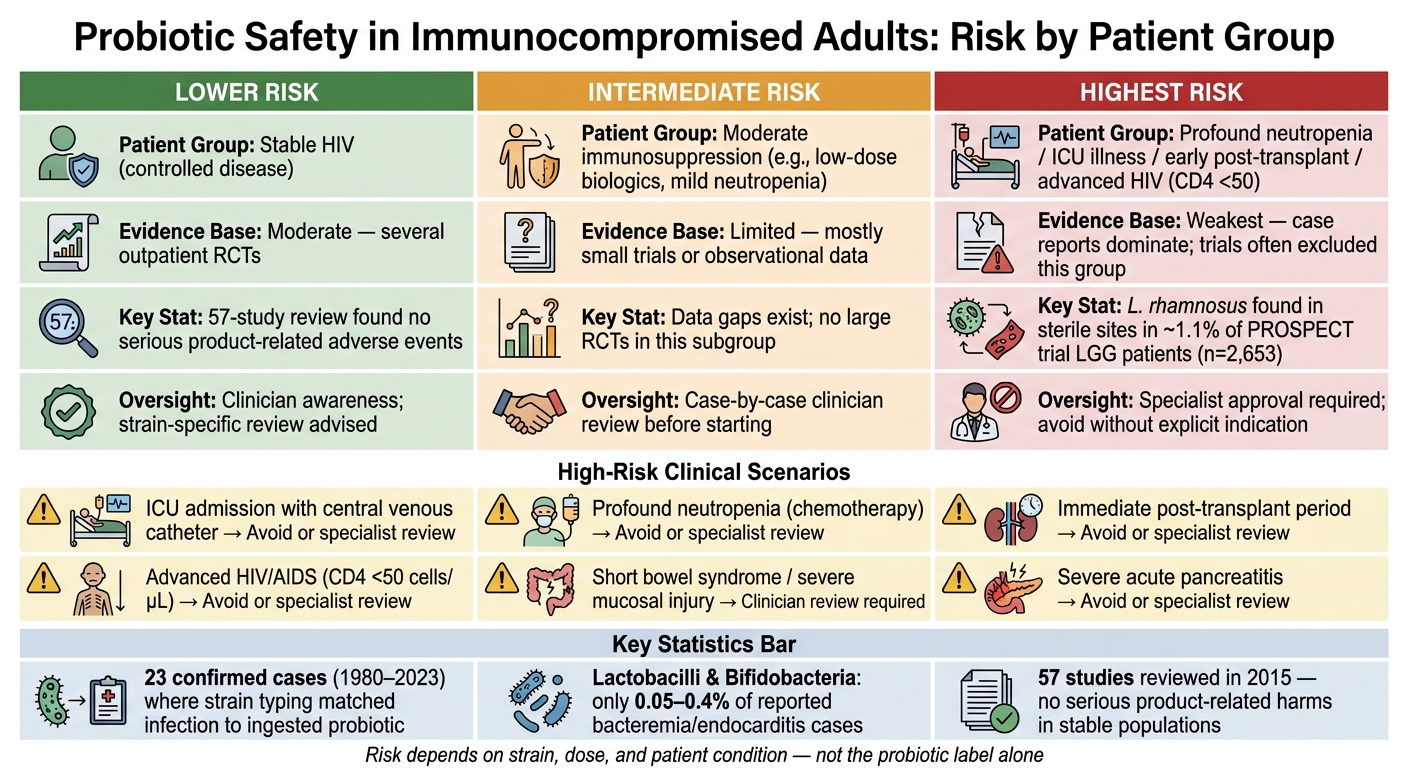
Probiotic Safety in Immunocompromised Adults: Risk by Patient Group
Lower risk doesn't mean no risk. Serious probiotic infections are uncommon, but they have been documented. The main concern is rare bloodstream infection in patients with barrier injury, central lines, or deep immunosuppression. In plain terms, safety depends a lot on the patient's condition, not just the strain name. Lactobacilli and bifidobacteria account for only 0.05%–0.4% of reported infective endocarditis and bacteremia cases.[18]
Bacteremia, Fungemia, and How These Events Can Occur
The organisms most often linked to probiotic-associated invasive infections are Lactobacillus species - especially L. rhamnosus GG (LGG) - and Saccharomyces species, especially S. boulardii. A literature review covering 1980–2023 found 23 cases in which strain typing matched the infecting organism to the ingested strain, which confirmed the source link.[19]
How does this happen? Usually in one of two ways. The first is gut translocation, where organisms cross into the bloodstream after the intestinal barrier has been damaged. The second is catheter contamination during handling. In high-risk patients, either route can lead to bloodstream infection. That's why traceability matters when an unexpected infection shows up.[11]
Which Patients Face the Greatest Risk
Serious infections are rare, but they do occur in patients with severe immune suppression, mucosal injury, or central lines. A hospital surveillance study from 2016–2019 found 26 bloodstream infection episodes involving typical probiotic organisms. Of those, 16 (62%) were classified as true infections, and 6 patients (38%) had documented probiotic exposure in the prior month.[17]
Risk goes up when immune suppression and barrier damage happen at the same time. In those settings, routine use should be avoided, or at minimum reviewed by a specialist. The main high-risk patterns are listed below.[15][16][19][20]
| Clinical Scenario | Main Risk Factors | Action |
|---|---|---|
| ICU admission with central venous catheter | Mechanical ventilation, broad-spectrum antibiotics, invasive lines | Avoid or specialist review |
| Profound neutropenia (chemotherapy) | Severe host immunosuppression, mucosal injury | Avoid or specialist review |
| Immediate post-transplant period | High-level immunosuppression, mucosal injury | Avoid or specialist review |
| Advanced HIV/AIDS (CD4 <50 cells/µL) | Markedly reduced immune surveillance | Avoid or specialist review |
| Short bowel syndrome / severe mucosal injury | Disrupted gut barrier, high intestinal permeability | Clinician review required |
| Severe acute pancreatitis | Gut ischemia, impaired barrier function | Avoid or specialist review |
Risk can stack fast. A neutropenic oncology patient with a central line and severe mucosal injury sits right where the main danger pathways meet. That's why the case reports are most concerning in that group.
Strain Selection, Dose Ranges, and When to Involve a Clinician
There isn't a single CFU cutoff that works for everyone. Safety depends on the strain, the dose, and the person taking it.[1][12] A dose used in a stable HIV study doesn't automatically make sense for someone in the ICU or in the first days after a transplant.
Strains and Dose Ranges Studied in Immunocompromised Adults
In adult studies involving immunocompromised patients, researchers have mostly used Lactobacillus, Bifidobacterium, or multispecies synbiotics in the range of 10⁹ to 10¹¹ CFU/day. But that doesn't mean the risk is low across the board. Serious adverse events have been reported in high-risk patients.[1][12]
| Strain or Combination | Typical Trial Dose (CFU/day) | Population Studied | Serious Adverse Events Attributed to the Probiotic | Key Safety Comment |
|---|---|---|---|---|
| L. rhamnosus GG (LGG) | 2–10 × 10¹⁰ | Stable HIV with chronic diarrhea | None reported in the trial | Invasive infections have been reported in vulnerable hosts outside trial conditions.[5][21][13][1] |
| L. rhamnosus GR-1 + L. reuteri RC-14 | 2 × 10⁹ | Adults with HIV and moderate immune compromise | None reported | Evidence is limited to a small outpatient population.[9][26][24] |
| Multispecies (7 strains, incl. Lactobacillus and Bifidobacterium) | 2 × 10⁹ | HIV patients | None reported | Short-term data only.[23][27] |
| Probiotic mix studied for febrile neutropenia prophylaxis | 6 × 10⁹ | Cancer patients at risk for febrile neutropenia | None attributed to the probiotic | Evidence remains limited and mixed.[22][25] |
Those dose ranges only mean something inside the exact groups that were studied. Move outside those settings, and the risk can change fast.
When Clinician Review Is Needed Before Starting a Probiotic or Synbiotic
Dose by itself doesn't settle the safety question. A clinician should review probiotic or synbiotic use before starting it in patients with advanced HIV, profound neutropenia, immediate post-transplant care, ICU-level illness, central lines, or active mucosal injury.[12][29][30]
The point is simple: match the patient's current condition to the actual evidence before use starts. That's where things often get missed.
Monitoring and Documentation If Probiotic Use Is Approved
If a probiotic is approved, good recordkeeping matters. The product should be documented in a way that makes later tracing possible if something goes wrong.[12][28]
That record should include:
- The exact strain name
- The CFU dose
- The route of administration
- The start date
- The planned duration
- Whether it's a single-strain, multi-strain, or synbiotic product
After starting use, watch closely for fever, low blood pressure, or worsening sepsis-like symptoms in any high-risk patient. If blood cultures grow the same species found in the product, that's a major warning sign and needs immediate clinical review.[12][2][31]
| Patient Group | Relative Risk | Evidence Base | Oversight Needed |
|---|---|---|---|
| Stable HIV (controlled disease) | Lower | Moderate; several outpatient RCTs | Clinician awareness; strain-specific review advised |
| Moderate immunosuppression (e.g., low-dose biologics, mild neutropenia) | Intermediate | Limited; mostly small trials or observational data | Case-by-case clinician review before starting |
| Profound neutropenia / ICU illness | Highest | Weakest; case reports dominate; trials often excluded this group | Specialist approval required; avoid without explicit indication |
Conclusion: What the Evidence Supports and Where Gaps Remain
The evidence supports probiotic use only in selected, stable immunocompromised adults. One review covering 57 studies in immunocompromised adults found no serious adverse events linked to the probiotic or synbiotic products that were studied.[3][39]
That sounds reassuring, but there's an important catch. Those studies mostly enrolled the kinds of patients who were already fairly stable: adults with controlled HIV, for example, or people with moderate immune suppression rather than the sickest cases. In plain terms, the data reflect the patients who were actually included. Once host defenses are weaker, the gut barrier is damaged, or vascular access is in play, the risk goes up.
Rare cases of bacteremia and fungemia tend to cluster in higher-risk settings, including:
- ICU patients
- Central-line users
- Adults with mucosal injury
- People with profound immunosuppression[32][33][4][34][35][36][37]
And rare doesn't mean harmless. In a very sick patient, even a small absolute risk can matter. That's why strain and dose still matter, but only when the host setting makes sense.
There are also clear gaps in the safety data. Long-term safety data for high-dose, multi-strain synbiotic formulations in immunocompromised adults are still very limited.[3][37][38] Most trial data come from one strain, or a small number of strains, used at studied doses for short periods.[13][3] High-dose, multi-strain synbiotics that combine prebiotics and postbiotics have not been systematically studied in severely immunocompromised groups such as ICU patients, adults in the early post-transplant period, or those with very low CD4 counts.[3][37][38] So for these high-risk groups, direct safety data are still missing.
Safety reporting has the same problem. Across probiotic trials, adverse-event reporting is still inconsistent, and studies need standardized bloodstream-infection reporting plus strain matching.[3][35] Without that, it's hard to sort out lower-risk strains from higher-risk use.[3][35][37][38]
The bottom line is pretty simple: current evidence supports cautious probiotic use in selected, stable immunocompromised adults, especially when well-characterized bacterial strains are used at studied doses under medical supervision. For patients who are severely immunosuppressed, in the ICU, or early after transplant, specialist review is required.
FAQs
Are probiotics ever safe if I’m immunocompromised?
Probiotics are usually safe for most people. But if you’re immunocompromised, it’s smart to be more careful.
The risk of infection from common probiotic strains is low. Even so, that risk may be higher if you have weakened immunity, a venous catheter, recent surgery, or a long hospital stay.
Because rare complications can happen, consult a healthcare provider before starting probiotics. They can help you choose the right strain and dose. Self-prescribing isn’t recommended.
Which immunocompromised patients should avoid probiotics?
Immunocompromised patients should not self-prescribe probiotics. In higher-risk cases, they should use them only under medical supervision.
Higher-risk situations include chemotherapy, venous or central venous catheters, recent surgery, acute pancreatitis, long hospital stays, or other serious acute illness. These cases carry more concern about rare probiotic-related infections. If you’re immunocompromised, get a medical review before starting.
What should my doctor review before I take a probiotic?
Before starting a probiotic, talk to your healthcare provider. They should look over your medical history, especially if you have a weakened immune system, are going through chemotherapy, have long-term digestive issues, or take several medications.
They can also help you pick the right strain and dose, since different microbes do different jobs. In some cases, they may suggest a stool analysis or a nutrition assessment to help make sure the plan is safe and a good fit.