

My starting point after SIBO antibiotics: if symptoms persist or return, contact your clinician before trying a “reset.” In one study of 80 adults, SIBO returned in 43.7% within 9 months after breath tests normalized.[1] A microbiome reset is not a defined medical treatment or proof of recovery.
I’d compare the four options by what they address, the research behind them, relapse risk, tolerance, timing, and cost. <u>Checking for relapse comes before adding supplements.</u>
Quick Comparison
| Option | Main purpose | Research and limits | Timing and cost |
|---|---|---|---|
| Medical reassessment | Check for relapse, medication effects, or another cause | Symptoms alone cannot confirm SIBO; testing may guide care | First if symptoms persist or return; U.S. costs vary |
| Diet-based recovery | Rebuild food variety and support nutrition | SIBO-specific research is limited; avoid prolonged restriction | Reintroduce foods gradually as tolerated; food and dietitian costs vary |
| Tailored prebiotic, probiotic, or postbiotic support | Choose ingredients for a specific goal | Results depend on the formula, strain, and dose; fermentable fibers may worsen bloating | Consider with clinical guidance once symptoms settle; prices vary |
| Rebirth RE-1 | Combine all three types of support | No established SIBO recurrence benefit; contains 4.5 g of GOS/inulin per serving | Not for active SIBO or current bloating; listed plans cost $79–$749[5] |
I’d judge recovery by symptoms, bowel habits, food tolerance, and testing when needed - not a supplement schedule. None of these supplements replaces treatment for active SIBO.
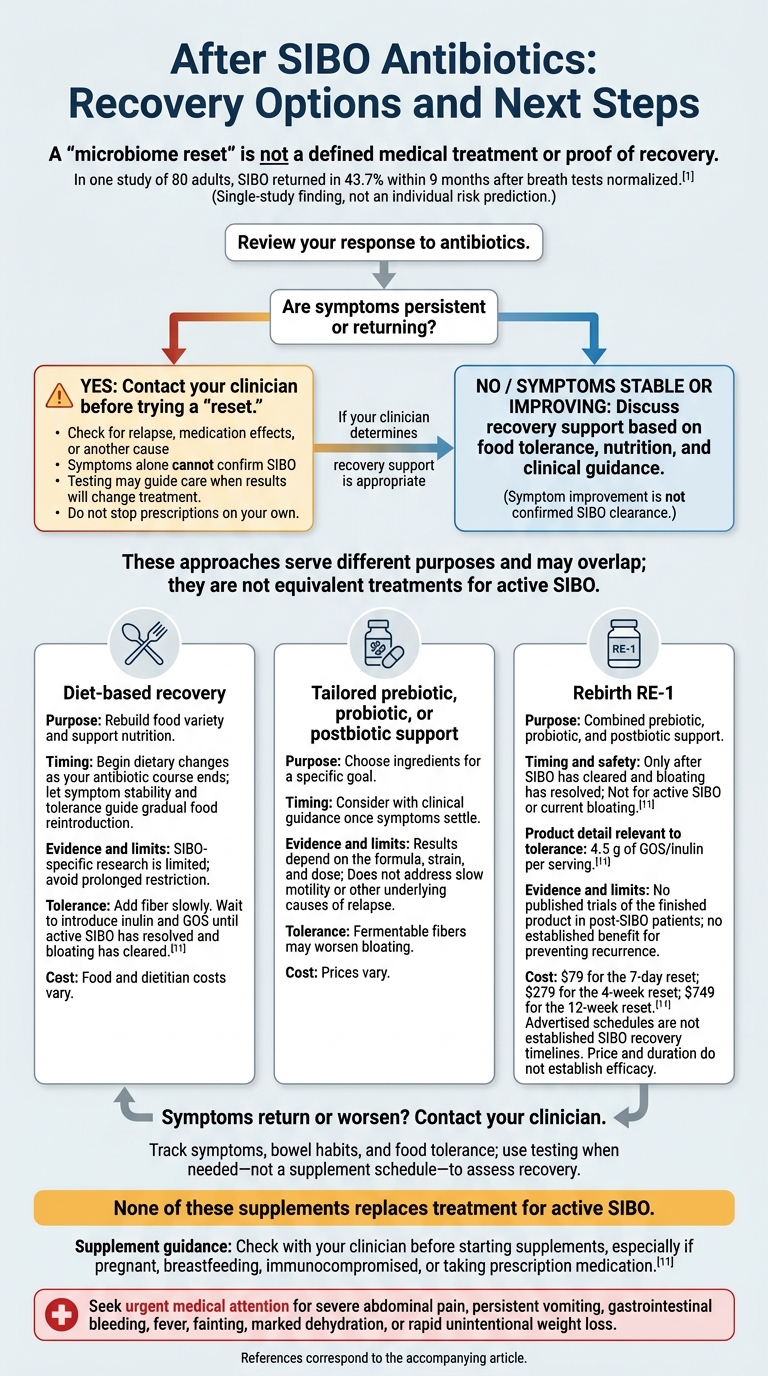
After SIBO Antibiotics: Recovery Options and Next Steps
Recovery Tips Post-Antibiotic Use
sbb-itb-1bbfe7f
1. Rebirth RE-1 Combined Microbiome Support
After antibiotics, RE-1 should be viewed as support - not proof that SIBO has resolved. Rebiirth RE-1 combines prebiotics, probiotics, and postbiotics in shelf-stable sachets. Each serving contains 500 billion CFU of Human Origin Strains and 4.5 g of GOS/inulin. Its Lyosublime™ delivery system is designed to protect strain viability.[5] These are product features, not proven SIBO outcomes.
Clinical Evidence
Data from adults taking broad-spectrum antibiotics showed higher microbial diversity and faster recovery of Bifidobacterium and Lactobacillus. Gut barrier integrity was also about 25% higher by Day 7 and 49% higher by Day 91 compared with placebo.[5]
The findings support microbiome recovery, but they do not establish SIBO-specific efficacy. No SIBO-specific recurrence data were available.
Recurrence and Underlying Causes
If bloating, pain, or bowel changes return, reassess the underlying cause rather than extending the reset cycle.
Symptom Tolerance and Safety
GOS and inulin are fermentable fibers, so they may worsen bloating. Company guidance states that RE-1 is not suitable during active SIBO or when bloating is already present. Talk with your clinician before use, especially if you are pregnant, breastfeeding, immunocompromised, or taking prescription medications.[5]
Timing and Cost
Current U.S. prices are $79 for the 7-day reset, $279 for the 4-week reset, and $749 for the 12-week reset.[5] These advertised schedules are not established SIBO recovery timelines.
During a clinician-approved trial, track bloating, pain, and bowel habits. Check in with your clinician if symptoms worsen.
2. Medical Reassessment
Medical reassessment helps keep recovery after antibiotics focused on the right problem. If symptoms return, the next step is to check whether SIBO has returned, another condition is responsible, or a medication is causing problems.
Clinical Evidence
SIBO can return after antibiotics, but symptoms alone don’t confirm a relapse. Order glucose or lactulose breath testing only when the results will change treatment. Common thresholds are a hydrogen increase of at least 20 ppm within 90 minutes or methane of at least 10 ppm at any point.[4]
Recent antibiotics, diet, laxatives, and medications can affect results, so follow the testing center’s instructions. Clarifying the cause helps determine whether more treatment, further testing, or recovery support without antibiotics makes sense.
Recurrence and Underlying Causes
Persistent symptoms often reflect the underlying cause of SIBO rather than failed recovery. Reassessment may identify slow transit linked to constipation, diabetes, or hypothyroidism. Prior surgery or structural problems, such as strictures, adhesions, or diverticula, may also play a role.[4]
If symptoms have changed, check for celiac disease, IBS, inflammatory bowel disease, carbohydrate intolerance, pancreatic or bile-acid disorders, and medication effects. Weight loss, major food restriction, or suspected malabsorption calls for a CBC plus iron, B12, and folate testing.[6]
Symptom Tolerance and Safety
Ask whether proton-pump inhibitors, opioids, or anticholinergic drugs could contribute to symptoms. Do not stop prescriptions on your own. Before taking more antibiotics, review past reactions, allergies, drug interactions, kidney or liver disease, pregnancy, immunocompromise, and any history of C. difficile.
Severe abdominal pain, persistent vomiting, gastrointestinal bleeding, fever, fainting, marked dehydration, or rapid unintentional weight loss requires urgent medical attention.
Timing and Cost
A targeted evaluation comes before any reset strategy. Start with a focused review of symptoms and medications, followed by labs, breath testing, imaging, or a GI referral when indicated. Testing should be ordered only when the result will change the next steps.
U.S. costs vary by insurance, network, deductible, and site of care. Ask for separate estimates for the visit and tests, and check whether prior authorization is required. Do not delay urgent evaluation to compare prices.
3. Diet-Based Recovery Support
If testing doesn’t point to relapse, the next step is to use diet to manage symptoms and improve food tolerance and long-term gut health.
Recurrence and Underlying Causes
Diet-based support mainly helps ease symptoms as you bring more variety back into your meals. Start when symptoms are stable, and focus on gradually reintroducing foods, rather than adding more restrictions. If symptoms return during reintroduction, seek reassessment.
Symptom Tolerance and Safety
Reintroduce restricted foods and add fiber slowly, with guidance from your practitioner. Wait to introduce inulin and GOS until active SIBO has resolved and bloating has cleared. Starting them too early can worsen bloating.[5]
Timing
Begin dietary changes as your antibiotic course ends. Let your tolerance guide the pace of food reintroduction.
4. Tailored Prebiotic, Probiotic, or Postbiotic Support
Clinical Evidence
If symptoms are improving but you still need support, choose the next step based on tolerance and relapse risk. After antibiotics, these options may help restore microbiome balance, but they do not treat active SIBO. Following a checklist for restoring gut health can help organize these steps.[5]
Recurrence and Underlying Causes
Microbiome support does not address slow motility or other underlying causes of relapse.[5]
Symptom Tolerance and Safety
Let your current symptoms guide your choice, especially if you're still bloated. Wait until bloating has settled before trying GOS- or inulin-heavy formulas.[5] Check with your clinician before starting any supplement if you're pregnant, breastfeeding, immunocompromised, or taking prescription medication.[5]
Timing and Cost
Synbiotic support may be started after antibiotics to help maintain a stable microbiome following treatment.[5] Compare this option with those below based on timing and what you can tolerate.
Comparing the Recovery Options
Each option serves a different purpose. Medical reassessment checks for relapse, diet supports symptom recovery, and tailored support or RE-1 offers microbiome support.
If symptoms return, seek reassessment first. If symptoms are stable, focus on long-term recovery support. Medical reassessment is the only option here that can confirm relapse or identify another cause.
| Pathway | Best use | Main limit | Timing |
|---|---|---|---|
| Medical reassessment | Identifying relapse or another cause of symptoms | May require testing or referral | First when symptoms persist or return |
| Diet-based recovery | Supporting food tolerance and nutrition | Does not address underlying causes of relapse; SIBO-specific dietary evidence is limited | Alongside care, based on symptom stability |
| Tailored support | Choosing prebiotic, probiotic, or postbiotic support for a defined goal | Benefits and tolerance depend on the preparation, strain, and dose | Once symptoms settle, with a review date |
| Rebirth RE-1 | A combined prebiotic, probiotic, and postbiotic formula with set trial durations [5] | No published trials of the finished product in post-SIBO patients; no established benefit for preventing recurrence | After SIBO has cleared and bloating has settled [5] |
Avoid concentrated prebiotic fiber while bloating is active. [5]
For tailored support, assess fiber tolerance with prebiotics, strain-specific evidence with probiotics, and preparation-specific evidence with postbiotics. Costs vary by pathway. RE-1 offers set-duration plans, but price and duration do not establish efficacy.
The next section looks at the practical advantages and limits of each path.
Advantages, Limits, and When to Use Each Option
Use this comparison to match each option to the main concern: relapse, food tolerance, or post-antibiotic support. The order does not indicate a preference.
| Factor | Rebirth RE-1 | Medical reassessment | Diet-based recovery | Tailored microbiome support |
|---|---|---|---|---|
| Advantages | Easy to follow, portable, and shelf-stable | Can clarify the diagnosis and guide treatment | Builds everyday eating habits without specialized products | Offers more control over the ingredient, strain, and dose |
| Limits | Higher cost; 4.5 g of prebiotic fiber per serving; benefits after SIBO are unproven | Requires appointments, testing, wait times, and expense | Takes consistency; restriction can reduce food variety and compromise nutrition | Evidence and tolerance vary, so selection takes care |
| Clinician guidance | Review suitability with a clinician; not for active SIBO or current bloating | Clinician-led, with a gastroenterology referral when needed | Registered dietitian support can help when intake is restricted | A clinician or dietitian can help match support to the goal |
The choice depends on the diagnosis, what the patient tolerates, and how much structure they need.
Start by reviewing the response to antibiotics. No response suggests the original diagnosis needs another look; returning symptoms suggest recurrence. Symptoms alone cannot distinguish sensitivity from relapse. Discuss constipation or diarrhea, current medications, and nutrition during that review.
Do not use a packaged protocol while symptoms remain unresolved. A postbiotic may suit a sensitive gut, but tolerability still depends on the formula.
Add fiber back gradually rather than pushing toward a high-fiber target. If symptoms do not resolve, contact your clinician.
The conclusion turns these trade-offs into a staged recovery plan.
Conclusion: Build Recovery Support in Stages
No single diet, supplement, or reset works best for everyone after SIBO antibiotics. If bloating or irregular stools continue or come back, get reassessed before taking another course of antibiotics [5]. Once symptoms settle, add foods back gradually. Use microbiome supplements only with clinical guidance - not to meet a reset deadline.
Rebiirth RE-1 combines prebiotics, probiotics, and postbiotics for support only after SIBO is cleared and bloating has resolved [5]. It doesn’t replace reassessment or gradual food reintroduction.
FAQs
How can I tell food sensitivity from SIBO relapse?
Symptoms can overlap: bloating, abdominal discomfort, and irregular digestion can occur with either condition. They may also point to a microbiome imbalance or other health issues [1][2].
Track your symptoms daily, and note any reactions within 72 hours of eating a new food [2][3]. If symptoms return, persist, or worsen, see a healthcare professional to help identify the cause. The evaluation may include a SIBO breath test [1][2].
Which foods should I reintroduce first after SIBO treatment?
Start with foods that are easy to digest, such as well-cooked zucchini, spinach, carrots, or squash, plus lean proteins like chicken, turkey, or fish. Add one new food every 3–4 days, and log any symptoms in a journal for the next 72 hours.
Slowly work in fiber-rich foods and small servings of kefir, sauerkraut, or kimchi, as tolerated. As symptoms settle, aim for a mix of vegetables, healthy fats, and whole grains to help support long-term microbiome balance.
How do I know if microbiome support is helping?
Watch for less bloating and abdominal discomfort, more regular bowel movements, and better digestion. You might also notice fewer food sensitivities and more energy.
Keep a symptom journal to track stool consistency, gas, and discomfort alongside what you eat and drink. Review it weekly to spot patterns instead of focusing on day-to-day changes. Some people notice improvements within a week; others need more time.