

Here’s the short answer: B. longum 1714 may help some people feel like they sleep better, but the human data is still small and the effects look modest.
If I boil the research down, this is what matters most:
- There are only 2 sleep-focused human trials
- Both used 1 × 10⁹ CFU per day
- One trial had 89 adults with poor sleep
- The other had 20 male students under exam stress
- Subjective sleep measures improved more often than device-based measures
- Stress-related markers, like cortisol and anxiety during stress, also improved in some studies
- This does not look like proof of a direct sleep treatment
In plain English: I’d read this strain as a probiotic solution for stress-induced insomnia, not as a fix for insomnia.
A few points stand out right away:
- Best signal: sleep quality and next-day function
- Weaker signal: actigraphy and broad mood outcomes
- Timing: some effects showed up by Week 4
- Main limit: small studies, narrow groups, and short follow-up
| Study | Group | Size | Dose | Main sleep result |
|---|---|---|---|---|
| Adult poor-sleep RCT | Adults with poor sleep | 89 | 1 × 10⁹ CFU/day | Better subjective sleep quality and less daytime dysfunction; no clear actigraphy change |
| Exam-stress crossover | Male students | 20 | 1 × 10⁹ CFU/day | Better sleep quality and sleep duration during stress |
If you’re checking whether the data supports sleep claims, my take is simple: the case is still limited, strain-specific, and based more on self-reported sleep than on objective sleep data.
Clinical innovations in sleep, stress, and the gut-brain axis with Microbiome Labs & Fullscript
sbb-itb-1bbfe7f
Sleep Trials: Study Design, Sample Size, Endpoints, and Results
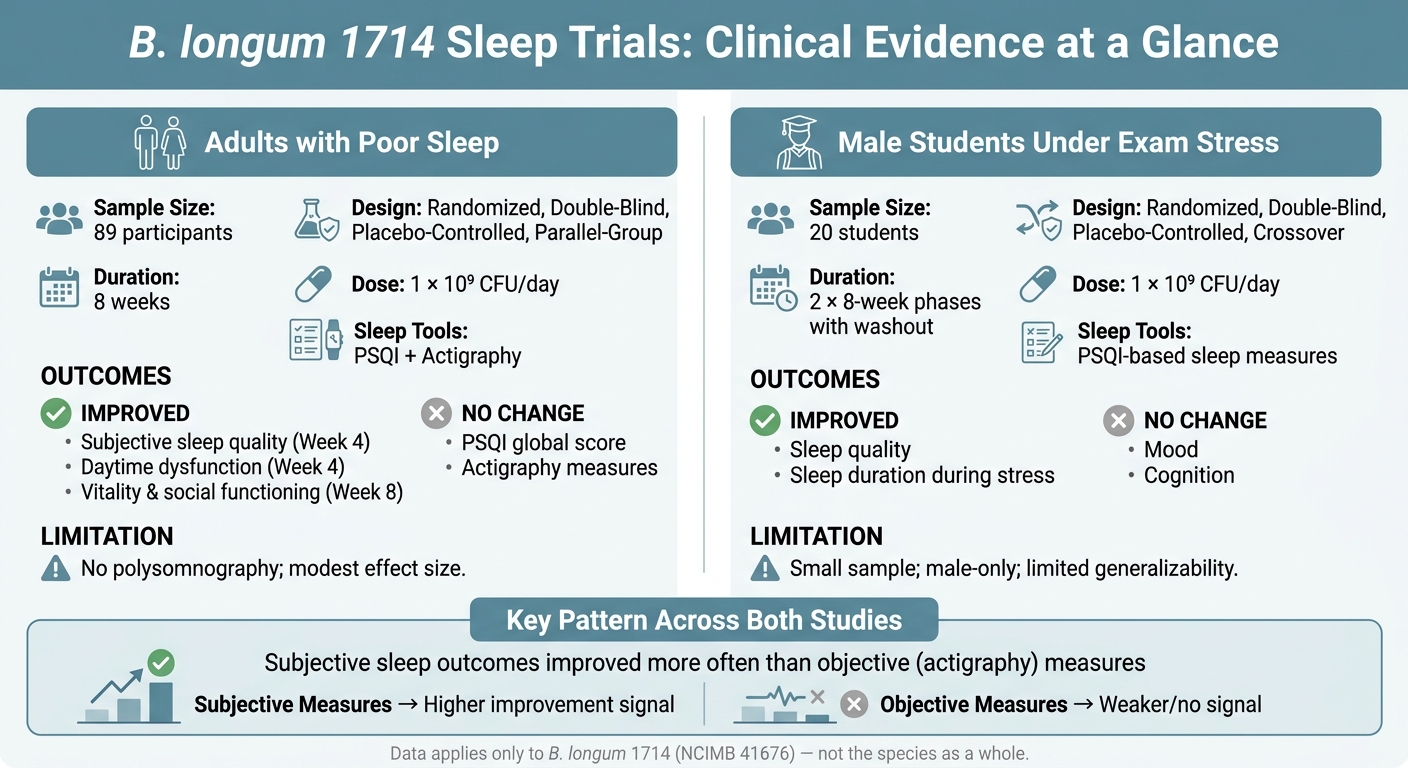
B. longum 1714 Sleep Trials: Side-by-Side Clinical Evidence
The sleep evidence for B. longum 1714 comes from two human trials. Both used the same daily dose: 1 × 10⁹ CFU/day.[16][10][15] Since stress can throw sleep off balance, these studies help answer a simple question: does B. longum 1714 affect sleep itself?
One trial followed adults for 8 weeks. The other looked at students during exam stress and used two 8-week phases with a washout period in between.[16][10][15]
Randomized Placebo-Controlled Trial in Adults With Poor Sleep
This was a randomized, double-blind, placebo-controlled parallel-group trial in 89 adults with poor sleep quality.[16][10] It was the first placebo-controlled study in this group to look at both self-reported sleep and actigraphy-based sleep outcomes.
Participants took B. longum 1714 or placebo once a day for 8 weeks. Researchers checked outcomes at Week 4 and Week 8 using the Pittsburgh Sleep Quality Index (PSQI) and actigraphy.[16][10]
By Week 4, the B. longum 1714 group showed a statistically significant improvement in subjective sleep quality and daytime dysfunction due to sleepiness compared with placebo.[16][10] By Week 8, vitality and social functioning had also improved.[16][10]
That said, not every sleep measure moved. The PSQI global score and actigraphy results showed no statistically significant difference versus placebo at either time point.[10][16]
Cross-Over Trial in Students Under Exam Stress
The second study looked at the same strain in a different setting: 20 male university students under exam stress.[1][15] It used a randomized, double-blind, placebo-controlled crossover design, so each student received both B. longum 1714 and placebo during separate 8-week phases.[1][15]
During the B. longum 1714 phase, sleep quality and sleep duration improved compared with placebo.[11][12][13] But mood and cognition did not change.[11][12] In plain English, the effect seemed tied to sleep, not to a broader shift in mental performance or emotional state.[11][12]
Sleep Outcomes Across Human Studies: Comparison Table
| Feature | Adult Poor-Sleep RCT | Exam-Stress Crossover Trial |
|---|---|---|
| Population | Adults with poor sleep quality | Male university students under exam stress |
| Sample size | 89 participants | 20 students |
| Design | Randomized, double-blind, placebo-controlled parallel-group | Randomized, double-blind, placebo-controlled crossover |
| Duration | 8 weeks | 2 × 8-week phases with washout |
| Daily dose | 1 × 10⁹ CFU/day of B. longum 1714 | 1 × 10⁹ CFU/day of B. longum 1714 |
| Sleep endpoints | PSQI global score, PSQI components, actigraphy measures | Overall sleep quality, sleep duration, PSQI-based sleep measures |
| Main findings | Improved subjective sleep quality and daytime dysfunction by Week 4; vitality and social functioning improved by Week 8; no significant change in PSQI global score or actigraphy | Improved sleep quality and sleep duration; no cognitive or mood benefit |
| Major limitations | No polysomnography; modest effect size | Small sample; male-only; limited generalizability |
Across both studies, subjective sleep outcomes improved more often than actigraphy measures or global PSQI scores.[16][10][11][12][13]
Stress and Mental Health Outcomes That May Help Explain Sleep Effects
Part of the answer may come from what B. longum 1714 seems to do to stress biology and mood-linked measures outside the bedroom.
Acute Stress Response and Daily Stress Markers
In a randomized, placebo-controlled trial of about 22 healthy adults, four weeks of B. longum 1714 at 1 × 10⁹ CFU/day significantly reduced cortisol output during the socially evaluated cold pressor test (SECPT), a standard acute stress challenge.[11][8] The rise in anxiety during the stressor was no longer significant after supplementation, which means the strain lowered both cortisol and perceived anxiety during stress.[11] Daily stress ratings also trended lower in the probiotic group, and the gap became marginally significant by Week 4.[6]
That matters because of how sleep affects gut-brain health in a pretty direct way. Lower cortisol and less pre-bed arousal could make it easier to fall asleep and stay asleep. And that lines up with the sleep RCT, where daytime dysfunction improved.[17]
A similar pattern also showed up in low-mood studies, where early quality-of-life shifts appeared before any broader change in symptoms.
Low Mood, PHQ-9, BDI-II, and Early Sleep Changes
A similar early signal appeared in adults with low mood. An 8-week exploratory RCT tested B. longum 1714 with PHQ-9, BDI-II, PSQI, and SF-36.[14][20] The clearest signal came at Week 4, when the probiotic group showed statistically significant gains over placebo in three SF-36 subscores: vitality (p = .038), mental health (p = .032), and social role functioning (p = .033).[14][18] By Week 8, the vitality edge remained (p = .042), but the mental health and social role functioning differences were no longer significant.[14]
BDI-II did not change, so the clearest pattern was the early SF-36 improvement, especially in vitality. Those shifts did not last, but they line up with the Week 4 sleep signal. PHQ-9 and BDI-II are broad mood measures, so the more relevant sign here was the early SF-36 change in vitality. Put together, these early shifts point more toward a stress-linked route than a direct effect on depression.[14][18]
How the Gut-Brain Axis May Link B. longum 1714 to Sleep
The Week 4 sleep signal probably isn't just random noise. A more likely idea is that changes in stress response and brain activity help explain it. The clearest leads point to the stress system.
HPA Axis, Cortisol, and Stress-Related Sleep Disruption
When bedtime cortisol runs high, people often take longer to fall asleep and sleep more lightly. In the SECPT trial, B. longum 1714 at 1 × 10⁹ CFU/day reduced cortisol response to acute stress, which could help explain the Week 4 gains in sleep quality.[7][21][3]
That matters because cortisol can shape both sleep onset and nighttime arousal. If stress stays high into the evening, the body doesn't always get the message that it's time to wind down. Bifidobacterium species may also affect GABA-producing microbes, which gives another plausible path for lowering pre-sleep arousal.[23][24]
Brain Activity, Inflammation, and Subjective Sleep Quality
Cortisol may be only part of the story. In the 2016 Allen et al. repeated-measures, placebo-controlled study in 20 healthy adult men, resting EEG after supplementation showed altered frontal theta activity compared with placebo.[7][3][4] A separate neuroimaging study found increased frontal and cingulate theta power and lower beta-3 power in hippocampal and temporal regions, changes linked to better vitality.[19]
Put simply, these brain-wave shifts may reflect changes in arousal and fatigue. That lines up with the reported sleep and vitality effects.[7][19][22]
These signals make sense, but they are still indirect.
Limits of the Evidence and How to Read the Data
The mechanistic signals above are interesting, but the clinical evidence is still in its early days. Most of what we have so far points to promise, not proof. The big issue is simple: how reliable are these effects, and do they last?
Strengths and Weaknesses of Current Clinical Studies
The better studies use randomized, double-blind, placebo-controlled designs and validated scales like PSQI, PHQ-9, and BDI-II. That matters because it helps cut expectancy bias. But it doesn't settle the case. Many trials are still underpowered, which means they can miss real effects or show results that happened by chance and may not hold up in later work.[5][14][25]
One pattern shows up again and again: subjective sleep measures tend to improve more often than objective ones.[5][25][26] In plain English, people may say they slept better, while actigraphy doesn't always show much change. A broader probiotic-sleep meta-analysis found the same split between what people feel and what devices record. That's one of the main trade-offs in the current data.
Follow-up time is also limited. Most studies run for 4 to 8 weeks. That's long enough to spot early shifts, but not long enough to say much about durability over months or years.
The table below gives a quick read on where the evidence is strongest and where it falls short.
| Evidence Strength | Supporting Details | Key Limitation |
|---|---|---|
| Randomized, double-blind, placebo-controlled designs | Multiple trials in impaired sleepers, exam-stress cohorts, and stress paradigms use rigorous randomized designs to reduce bias.[5][11][19] | Several are pilot or exploratory studies with modest sample sizes, limiting power and reproducibility.[5][14][25] |
| Subjective sleep improvements | Some trials show earlier improvement in perceived sleep quality and daytime dysfunction, and exam-stress studies report better sleep quality and duration during stress.[5][11][13] | Global PSQI can improve in both groups, and objective sleep metrics or cognition may show no significant benefit.[5][11][13][26] |
| Mechanistic signals via brain activity | Neuroimaging and social stress paradigms show modulation of brain responses after supplementation.[19] | Mechanistic changes do not always translate into large, consistent improvements in stress, mood, or cognition.[11][14][19] |
| Short- to medium-term tolerability | Daily supplementation over 4–8 weeks is generally well-tolerated in adult cohorts.[5][11][14] | There is little long-term follow-up, and data are limited in older adults and comorbid populations.[5][10][14] |
There’s also a population issue. Most studies focus on healthy adults, students, and volunteers with low mood. That’s a pretty narrow slice of people. It’s not the same as studying patients with diagnosed insomnia or other complex sleep disorders, where the clinical picture is often messier. This is particularly relevant when considering probiotics for stress-induced insomnia, where the interplay between anxiety and sleep is most pronounced.
Bottom Line: What the Evidence Supports and What It Does Not
Taken together, the pattern is pretty clear. Across this small set of clinical studies, the effects look modest, show up early, and are mostly based on how people say they feel. That points to an early, modest gain, not a big or lasting change in sleep. And the sleep signal seems tied more to shifts in stress and mood than to any broad sedative effect.
That leads to four practical takeaways.
Key Takeaways for Readers Reviewing the Research
These findings apply only to B. longum 1714 (NCIMB 41676), not to the species as a whole. If a product label says only "B. longum" and does not name the strain, you can't match it to this evidence.[7][5]
Self-reported sleep gains show up more often than device-recorded changes. So readers shouldn't treat actigraphy or other objective sleep metrics as confirmed backing for the strain's effects.[5][9][25]
Stress reduction likely explains much of the sleep signal. Lower cortisol and early mood shifts line up with the sleep findings, which helps explain why effects are easier to see in people under stress or those who already have sleep complaints.[2][11][14]
Bigger trials in broader groups are still needed. These narrow samples and short follow-up periods are enough to support a solid hypothesis, but not enough for broad claims.[5][11][14]
The same standard applies to product-level claims. For Rebirth RE-1, any sleep claim should be based on data from this exact strain.
FAQs
Can B. longum 1714 help with insomnia?
Clinical data suggests Bifidobacterium longum 1714 may help improve sleep quality, cut daytime dysfunction, and increase sleep duration in people under stress.
In a 2024 eight-week trial, participants reported better Pittsburgh Sleep Quality Index scores, along with more energy and stronger social engagement. That said, not every study found the same pattern. Some showed no major changes on actigraphy, which means the sleep benefits may show up more in how people feel than in device-based measurements.
How long does B. longum 1714 take to affect sleep?
Clinical data suggests B. longum 1714 may start to improve sleep after about 4 weeks of daily use. In healthy adults, studies reported better sleep quality and less daytime dysfunction around that point.
Other results, including longer sleep duration in stressed students, showed up over a similar multi-week stretch. Peak effects may take closer to 8 weeks with steady use.
Why did self-reported sleep improve more than device data?
Self-reported sleep gains with Bifidobacterium longum 1714 likely point to better perceived rest, more energy, and less daytime dysfunction - not big shifts in sleep architecture.
That gap can happen because actigraphy may miss the physiological or psychological factors that shape how people feel about their sleep. Without added objective measures like polysomnography, the exact link is still unclear.