

Here’s the short answer: prebiotics most often change the gut microbiome, and they sometimes help bowel habits too. The clearest pattern is an increase in Bifidobacterium across human trials, while stool changes show up more often in people with constipation, dysbiosis, or metabolic issues than in healthy adults with normal bowel habits.
If I boil the research down, this is what stands out:
- Microbiome changes are the most consistent finding.
- Stool benefits are more mixed, but tend to appear with 5 to 15 g/day over 8 to 12 weeks.
- Immune and inflammation results are less consistent than microbiome results.
- Starting gut makeup matters a lot. People with lower baseline levels of helpful bacteria often respond more.
A few numbers help make that plain:
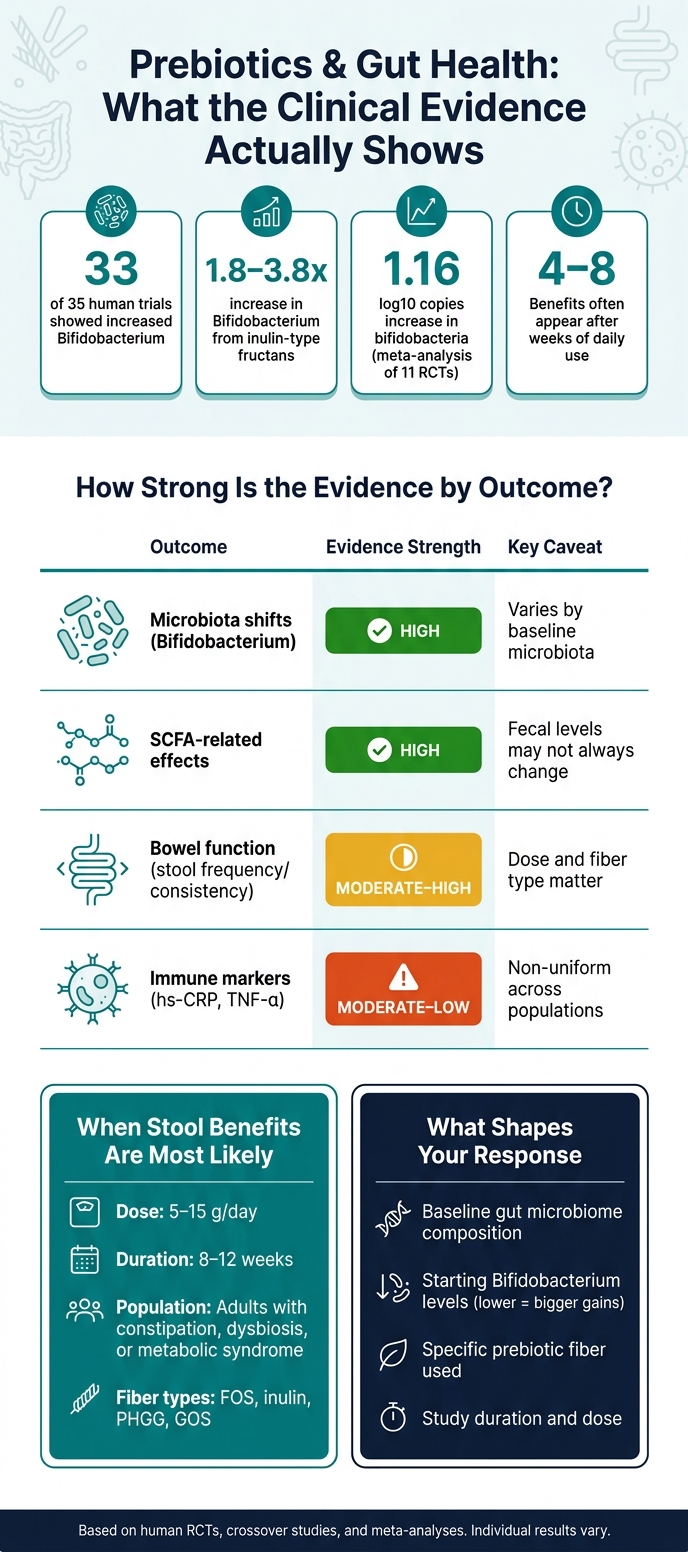
- Bifidobacterium went up in 33 of 35 human trials in one review.
- Inulin-type fructans often led to about a 1.8- to 3.8-fold increase in Bifidobacterium.
- A meta-analysis of 11 RCTs found an increase of 1.16 log10 copies in bifidobacteria.
- In some studies, effects showed up after 4 to 8 weeks of daily use.
So if you want the plain-English takeaway, it’s this: prebiotics are better supported for shifting gut bacteria than for producing clear day-to-day symptom changes in every person. And when you look at a product or formula, the details matter: the exact fiber, the dose, the study length, and the type of people studied.
That’s the lens I’d use to read the evidence below.
Prebiotics & Gut Health: Evidence Strength by Outcome
Study Designs, Populations, and Measured Outcomes
Randomized Trials, Crossover Studies, and Meta-Analyses Explained
Not all prebiotic studies should be treated the same. The design of a trial shapes how much confidence you can place in the results.
Randomized controlled trials (RCTs) are the strongest option for testing cause and effect. They compare a prebiotic group with a placebo group, which helps separate the effect of the intervention from everything else. Crossover studies work a bit differently: each participant gets both the prebiotic and the placebo in separate phases, with a washout period in between. That setup cuts down on person-to-person variation.
In one randomized, double-blind crossover trial of 20 healthy adults on a low-fiber diet, 12 g/day of a prebiotic fiber blend for 4 weeks increased Actinobacteria and Bifidobacterium versus placebo and raised plasma indolepropionate [9].
Meta-analyses combine data from many trials to show the bigger picture. A systematic review of 26 RCTs involving 831 participants found that prebiotic supplementation significantly reduced postprandial glucose (standardized mean difference -0.76) and insulin concentrations (-0.77) [8].
| Study Design | Primary Strength | What It Shows |
|---|---|---|
| Randomized Controlled Trial (RCT) | High internal validity | Direct causal link between prebiotic and health outcome |
| Crossover Study | Controls for individual baseline | How a specific person's microbiome responds to the intervention |
| Meta-Analysis | Statistical power | Generalizable patterns across different prebiotic types and doses |
Clinical Endpoints Commonly Measured in Gut Health Trials
Prebiotic trials usually track two kinds of outcomes. Some are mechanistic, like changes in Bifidobacterium, SCFA production, and barrier or immune markers. Others are more practical, like stool frequency, Bristol Stool Scale scores, and gastrointestinal quality-of-life measures.
For preventive care, that distinction matters. A shift in gut microbes is interesting, but the bigger issue is whether that shift leads to better stool function, stronger barrier support, and steadier immune balance.
In a 12-week randomized, double-blind, placebo-controlled trial of 53 prediabetic adults, 5 g/day of a fiber blend lowered HbA1c, fasting glucose, and lipopolysaccharide-binding protein [7].
The study population matters too. Most trials enroll healthy adults. Research in adults 60 and older tends to focus more on immune decline and lower Bifidobacterium levels [1][6]. Trials in overweight or obese groups often look more closely at glucose control and insulin sensitivity, so those findings do not always map neatly onto healthy, normal-weight adults [4].
These study designs lead straight into the next issue: which gut-health outcomes change most consistently?
sbb-itb-1bbfe7f
Microbiome and Stool Outcomes: The Most Consistent Findings
Bifidogenic Effects, SCFAs, and Microbiota Shifts
For preventive care, the main question is simple: are these microbiome changes steady enough to matter in practice?
Across human trials, Bifidobacterium stands out as the clearest signal. One review found higher Bifidobacterium in 33 of 35 human trials [2]. Review papers keep landing in the same place: this is the most reproducible prebiotic effect.
Inulin-type fructans (ITF) usually lead to about a 1.8- to 3.8-fold increase in Bifidobacterium populations [2]. And it doesn’t always take much. In healthy women, just 1.3 g to 2.0 g per day of galacto-oligosaccharides (GOS) led to a clear rise in Bifidobacterium within 3 weeks [3].
The effect isn’t limited to Bifidobacterium either. Prebiotics can also shift other helpful taxa, including Faecalibacterium, Bacteroides, and Akkermansia [10][5].
Those shifts can increase acetate and lactate, which help support butyrate production [1][2]. There’s also a pattern worth noting: people who start with lower baseline Bifidobacterium often see the biggest gains [3].
Stool Frequency, Consistency, and Constipation Scores
Stool outcomes are a bit less clear-cut. The biggest gains tend to show up when bowel function is already off to begin with.
In healthy adults with normal bowel habits, microbiome changes often show up without a statistically significant change in stool frequency or Bristol Stool Scale scores [9][3][10]. So the gut bugs may shift even when day-to-day bowel patterns look about the same.
There are still some signs of benefit in certain settings. In a 12-week decentralized trial of 60 participants with metabolic syndrome, 10 g/day of a mixed prebiotic formula that included FOS, inulin, and guar gum led to a clear increase in fecal Bifidobacterium and Parabacteroides and also reduced abdominal pain compared with the control group [11]. In a separate trial, daily partially hydrolyzed guar gum (PHGG) increased stool frequency in healthy volunteers from 1.13 ± 0.46 to 1.27 ± 0.47 bowel movements per day [10].
Taken together, the pattern is fairly plain:
- In healthy adults, prebiotics often shift the microbiome without changing stool measures.
- In constipation, dysbiosis, or metabolic syndrome, longer trials using 5 to 15 g/day more often improve stool frequency, consistency, or symptom scores.
- Stool outcomes appear more often in studies lasting 8 to 12 weeks.
These microbiome and stool findings set up the next issue: whether prebiotics also change immune and inflammation markers.
Immune Markers, Inflammation, and Dysbiosis Support
Mucosal and Systemic Immune Markers in Prebiotic Trials
Stool changes are one piece of the story. The next step is seeing whether prebiotics also affect immune markers and gut barrier function. In clinical trials, researchers look at mucosal and blood markers to see if shifts in the microbiome lead to better barrier support and changes in immune signaling. In healthy adults, blood markers like hs-CRP and TNF-α tend to move less often than mucosal markers [6][12].
In a randomized, double-blind, placebo-controlled trial of 55 healthy adults, 500 mg/day of chicory rhamnogalacturonan-I (chRG-I) for four weeks increased the anti-inflammatory cytokines IL-4 and IL-22 and lowered the pro-inflammatory markers IL-9 and IL-17A. The study also found higher HLA-DR expression on myeloid dendritic cells [12]. IL-22 stands out here because it helps maintain gut barrier integrity, which ties immune signaling directly to barrier support.
How Prebiotics May Help Prevent Dysbiosis
This link between immune activity and barrier support is part of why prebiotics are being studied for dysbiosis prevention. When these fibers are selectively fermented, SCFA production goes up. That, in turn, helps support barrier integrity and lowers colonic pH [1][2].
A 2012 study in 60 healthy volunteers found that a daily blend of 3 g inulin and 1 g XOS significantly reduced blood lipopolysaccharide (LPS) levels and attenuated LPS-induced pro-inflammatory gene expression of IL-1β [14]. Lower circulating LPS points to reduced metabolic endotoxemia [14].
In a separate RCT, an Opuntia ficus-indica extract at 300 mg/day for 8 weeks reduced the Firmicutes/Bacteroidetes ratio (p = 0.0012) and improved GIQLI scores in patients with dysbiosis [5].
Where Rebirth RE-1 Fits Within This Evidence Context
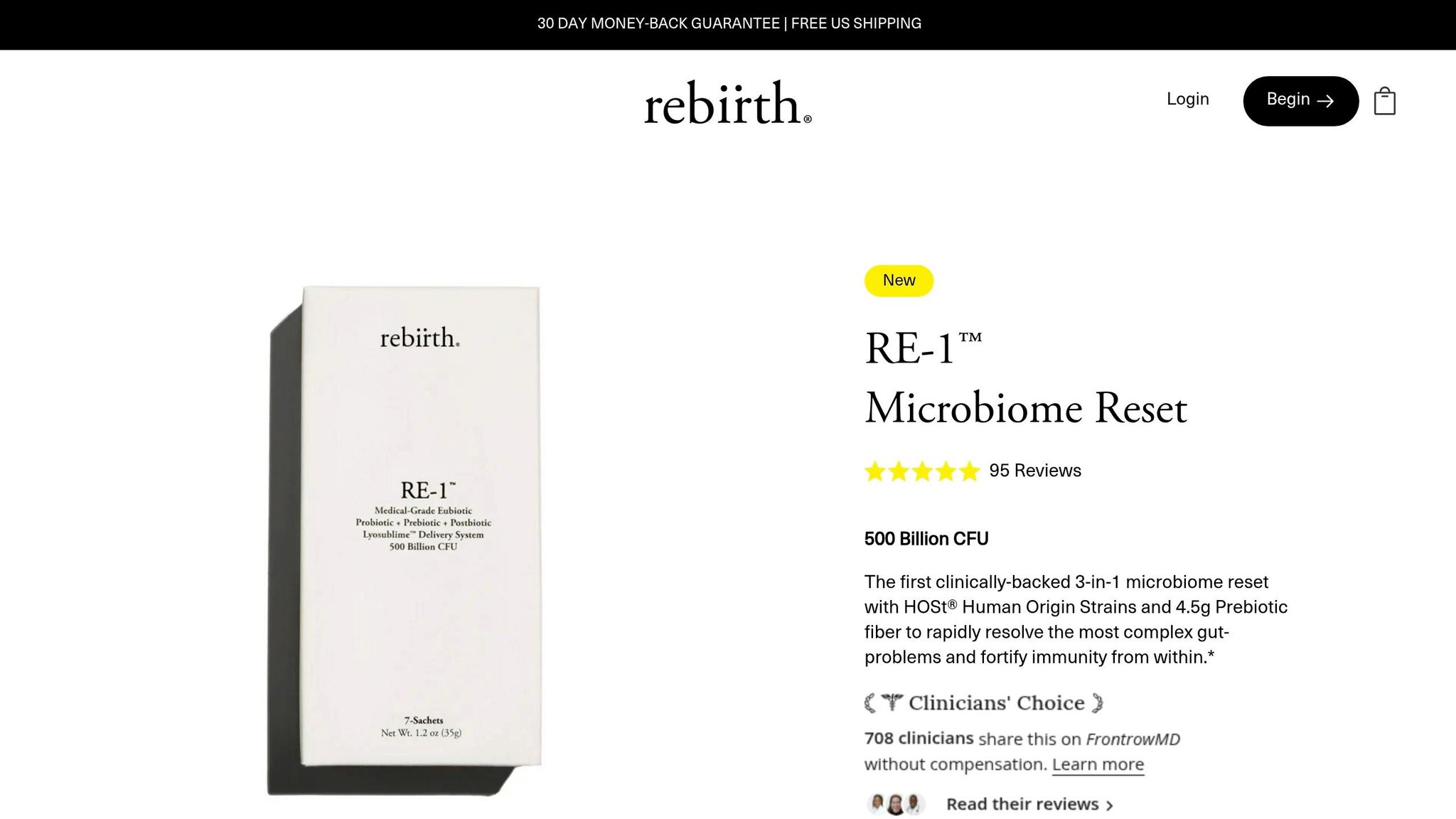
This is the clinical setting for synbiotic formulas that pair prebiotics with probiotic strains and postbiotics. Rebirth RE-1 combines all three. That approach lines up with clinical data showing that pairing prebiotic fibers with specific Lactobacillus and Bifidobacterium strains may increase microbial community richness and modulate immune markers such as fecal β-defensin2 and calprotectin [6].
Conclusion: What the Evidence Most Clearly Supports
Key Takeaways for Preventive Gut Health Decisions
Across the studies above, two findings show up most often: microbiota shifts and better bowel regularity. The strongest support is for those areas.
A meta-analysis of 11 RCTs found that prebiotic supplementation increased bifidobacteria levels by 1.16 log10 copies [15]. By contrast, findings on systemic inflammation and vaccine response are still mixed [13]. So broad immune claims deserve more scrutiny than claims tied to stool regularity or microbiota changes.
In plain English, the evidence stacks up like this:
| Outcome | Evidence Strength | Key Caveat |
|---|---|---|
| Microbiota shifts (Bifidobacterium) | High | Varies by baseline microbiota |
| SCFA-related effects | High | Fecal levels may not change |
| Bowel function | Moderate–High | Dose and fiber type matter |
| Immune markers | Moderate–Low | Non-uniform across populations |
One thing matters more than many people expect: baseline gut composition. Your starting point shapes how much you respond. And in most studies, benefits tend to show up after 4 to 8 weeks of daily use [9][5].
For now, the practical move is simple. Judge products by the exact prebiotic, dose, duration, outcomes, and population studied. Microbial shifts matter, but they don't automatically mean you'll feel or see a clear health effect. That's why product relevance comes down to matching the studied prebiotic, dose, and duration.
Future research should focus on personalized prebiotic strategies.
Episode 15: A primer on prebiotics
FAQs
How long should I take prebiotics before seeing results?
Clinical research suggests that prebiotics can start to show results within 3 to 8 weeks.
During that window, studies have found measurable shifts in the gut microbiota, including increases in beneficial bacteria, along with better digestive comfort.
Some people may notice effects by 3 weeks. Other changes, such as shifts in inflammatory markers or microbial diversity, may take up to 8 weeks.
That said, results don't look the same for everyone. Your response can vary based on your starting gut health, the dosage, and the type of prebiotic you use.
Which prebiotic types have the strongest clinical support?
Inulin, FOS, and GOS have the strongest clinical support for gut health.
They’re best known for helping increase helpful bacteria like Bifidobacteria and Lactobacillus. At the same time, they support short-chain fatty acid production, which helps maintain intestinal barrier function.
Resistant starch and 2'-fucosyllactose (2FL) have also shown benefits for immune health and stool consistency.
Why do some people notice benefits while others don’t?
People don't all respond to prebiotic supplements in the same way. Research points to a few main reasons: differences in baseline gut microbiota, usual fiber intake, and the type, dose, or length of time the prebiotic is used.
That makes sense. Each person's gut ecosystem is a little different, so results won't look the same across groups. Rebiirth RE-1™ is designed as a 3-in-1 eubiotic synbiotic to support a more rapid microbiome reset.