

Does city water harm your gut? Current research has not established that everyday exposure to disinfection byproducts (DBPs) causes gut problems. My starting point: check your utility’s water report and follow current local advisories - not supplement claims.
Disinfection prevents waterborne infections, but it also creates DBPs. Here’s how I put the findings in context:
- Water limits aren’t gut-symptom thresholds. U.S. limits are 80 µg/L for total trihalomethanes and 60 µg/L for five haloacetic acids.
- Lab findings don’t prove harm in people. A 2023 study tested 22 DBPs in simulated digestion and gut models - not a human trial.
- Exposure varies. Water source, treatment, and time in pipes affect the mix. Some DBPs change during digestion.
- Water safety and gut care are separate. Filters should be certified for the contaminant you want to reduce. Fiber and fluids support normal bowel function; supplements such as Rebirth RE-1 are not water treatments.
My bottom line: <u>don’t assume tap water explains lasting digestive symptoms</u>. Seek medical care for persistent symptoms, blood in stool, unexplained weight loss, or severe pain.
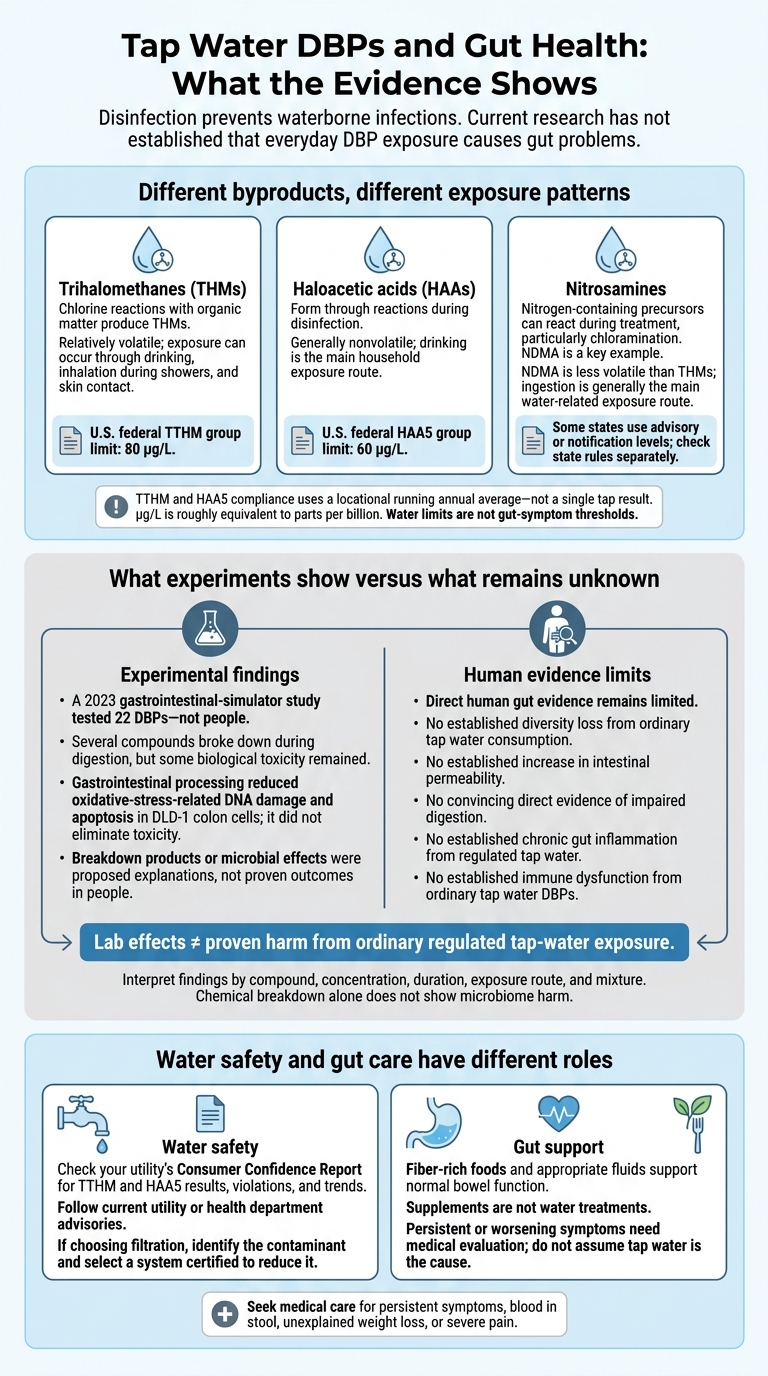
Tap Water DBPs and Gut Health: What the Evidence Shows
How Disinfection Byproducts Form in City Water
Each disinfectant produces a different mix of byproducts. Chlorine reacts with organic matter to form THMs and HAAs. Chloramine can form nitrosamines, including NDMA, from nitrogen-containing precursors. Ozone can turn bromide into bromate, while chlorine dioxide produces chlorite and can also produce chlorate. Treatment order, dose, and contact time affect the mix.[2][3][7]
These differences help determine which compounds can reach the gut and which appear most often in lab studies. Researchers have identified hundreds of DBPs, but routine monitoring tracks only some of them.[3]
Trihalomethanes, Haloacetic Acids, and Nitrosamines
| Group | Formation and named compounds | Volatility and exposure | U.S. status |
|---|---|---|---|
| THMs | Form through reactions with organic matter. Include chloroform, bromodichloromethane, dibromochloromethane, and bromoform. | Relatively volatile. Exposure can come from drinking, inhalation during showers, and skin contact. | Federal TTHM group MCL: 80 µg/L.[9][10] |
| HAAs | HAA5 includes monochloroacetic, dichloroacetic, trichloroacetic, monobromoacetic, and dibromoacetic acid. Bromide favors brominated forms. | Generally nonvolatile; drinking is the main household exposure route. | Federal HAA5 group MCL: 60 µg/L.[9] |
| Nitrosamines | Nitrogen-containing precursors can react during treatment, particularly chloramination. N-nitrosodimethylamine (NDMA) is a key example. | NDMA is less volatile than THMs; ingestion is generally the main water-related exposure route. | Some states use advisory or notification levels; check state rules separately.[3][7] |
This chemistry helps explain why gut-health studies focus on a few DBP families, similar to how researchers examine processed foods and gut dysbiosis rather than the entire mix. But compounds formed in water don't always reach the gut intact. Digestion can change them, as the next section explains.
Why DBP Levels Vary
Bromide, iodide, and pH affect which compounds form. Longer **water age - the time water spends in tanks and pipes - **can allow more reactions while a disinfectant residual remains. Household plumbing, stagnation, and hot-water use can also change what reaches a particular tap.[2][11]
Removing organic matter before disinfection and limiting water age can reduce DBP formation. Switching disinfectants may change the mix rather than eliminate it. Researchers are also studying other DBP families.[3][7][8]
TTHM and HAA5 compliance is based on a locational running annual average, not a single tap result. These averages don't describe every tap or short-term peak. Concentrations are reported in µg/L, roughly equal to parts per billion.[1][4][5][6]
sbb-itb-1bbfe7f
What Research Shows About DBPs and Gut Health
The 22-DBP simulator study shows what may happen in the gut - not what happens in people. Human studies rarely measure gut outcomes directly. Epidemiology has mostly examined broader health outcomes, while biomonitoring helps measure exposure rather than prove gut injury. Animal studies can test whole-body effects, but species differences and controlled doses limit how well the findings apply to everyday tap water consumption.[14][16]
What Happens to DBPs During Digestion
After you ingest DBPs, they can change chemically, enter the body through absorption, or interact with gut microbes. Heating can reduce volatile DBPs while concentrating some nonvolatile ones.[15]
A 2023 gastrointestinal-simulator study tested 22 DBPs. Several compounds broke down during digestion, but some biological toxicity remained.[12] Compounds that survive digestion, along with their breakdown products, may then affect microbes and gut cells.
Effects on Gut Microbes, Cells, and Immune Signals
Microbiome models let researchers track DBP breakdown, shifts in microbial communities, and changes in metabolic activity. But chemical breakdown alone does not show harm to the microbiome.
In the 22-DBP study, gastrointestinal processing reduced oxidative-stress-related DNA damage and apoptosis - programmed cell death - in DLD-1 colon cells. It did not eliminate toxicity. Researchers proposed breakdown products or microbial effects as possible explanations, not as proven outcomes in people.
Cell and organoid models can also test cell survival, permeability, and immune signals. However, they cannot reproduce the gut’s full mucus layer, circulation, metabolism, or microbial community.[12][13][15]
How Strong Is the Evidence for Each Gut Outcome?
Before applying a finding to tap water, check the compound, concentration, duration, exposure route, and mixture tested. A high-dose test of one compound cannot establish the risk from lower concentrations of changing mixtures in drinking water. Human studies also face uncertainty tied to diet, smoking, residential history, and exposure estimates.[14][16]
The table separates findings in people from mechanisms studied in the lab.
| Gut outcome | Human evidence | Animal evidence | Cell/organoid evidence | In-vitro microbiome evidence | What is justified? |
|---|---|---|---|---|---|
| Microbial diversity | Insufficient direct evidence | Limited; compound-specific | Usually not measurable | Possible changes need confirmation in repeat studies | No established diversity loss from ordinary tap water consumption |
| Microbial function | Insufficient | Limited | Limited | DBP breakdown and metabolite changes can be measured | Evidence of mechanisms, not proven dysfunction in people |
| Gut lining | Insufficient direct evidence | Depends on compound and dose | Oxidative stress, cell viability, apoptosis, or permeability can be tested | Indirect | No established increase in intestinal permeability |
| Digestion | No convincing direct evidence of impaired digestion | Limited | Not generally modeled | Chemical changes can be studied | DBP breakdown does not prove impaired or improved digestion |
| Inflammation | Insufficient direct evidence | Limited; compound-specific | Inflammatory signals can be measured | Indirect, through metabolites | No established chronic gut inflammation from regulated tap water |
| Immunity | Insufficient direct evidence | Limited relevance for mechanisms | Immune signaling modeled incompletely | Indirect | No established immune dysfunction from ordinary tap water DBPs |
Water Safety and Gut Support Serve Different Roles
DBP exposure varies by city and tap. Check your utility’s latest Consumer Confidence Report for TTHM and HAA5 results, violations, and trends.[6][19][20][22] These results put exposure in context; they don’t diagnose gut effects.
Follow current utility or health department advisories, rather than relying on the annual report alone. Drink water that meets local standards unless officials advise otherwise. If you’re considering filtration, first identify the contaminant, then choose a system certified to reduce it. Neither filters nor supplements replace advisory instructions.[21]
Diet, Hydration, and Lasting Gut Symptoms
Local advisories address exposure. Diet and hydration serve a different role: supporting baseline gut function.
Eat a variety of fiber-rich foods, including beans, vegetables, fruit, whole grains, nuts, and seeds. If fiber causes bloating, increase it gradually. Drink enough fluids to support normal stools, but follow individualized fluid advice if you have a condition that affects how much you should drink.
Persistent or worsening symptoms need medical evaluation. These may be signs of gut dysbiosis or other underlying issues. Don’t assume city water is the cause.
Rebirth RE-1: Claims and Evidence Limits
Microbiome-support claims are separate from water safety. They aren’t evidence of a solution for DBP exposure.
Rebirth RE-1 is marketed as a microbiome-support supplement, not a water-treatment product.[17][18] Product-specific benefits require independent clinical testing of the finished formula. Research on individual ingredients alone does not establish DBP-related benefits.
Conclusion: Human Evidence Is Still Limited
DBPs deserve further study, but direct human evidence of meaningful effects on gut microbes, the gut lining, digestion, and immune signaling remains limited. Trihalomethanes, haloacetic acids, and nitrosamines differ in chemistry and toxicology. Findings for one class should not be applied to all DBPs.[15]
U.S. water systems remain regulated for TTHMs and HAA5.[9] Monitoring and treatment adjustments can reduce exposure while maintaining disinfection against waterborne infections. What remains unclear is whether these exposures cause measurable gut effects in people.
What Future Studies Should Measure
Human studies should measure gut microbes, gut-barrier function, digestion, and immune signaling. That means pairing repeated tap-water and biomarker measurements with measures of microbiome function, validated gut-barrier tests, digestive symptoms, and immune markers. Researchers should also track diet and medications.[1][23]
Lab digestion models can help identify how effects occur, but they cannot fully reproduce human diet, mucus, human metabolism, or microbial diversity. A microbial change in a lab does not, on its own, show disease.
Evidence at a Glance
Current evidence falls into four tiers:
| Evidence level | Supported finding | Evidence source |
|---|---|---|
| Well established | Regulated tap water contains chemically distinct DBPs; monitoring alone does not establish human gut effects. | Water chemistry and regulatory monitoring |
| Supported by experimental evidence | Some DBPs cause biological effects in experiments, but these findings do not establish human gut effects from ordinary regulated tap-water exposure. | Laboratory studies |
| Biologically plausible, not confirmed in humans | Effects on gut microbes or barrier signaling are plausible but remain unconfirmed at ordinary regulated tap-water exposure levels. | Mechanistic and nonhuman studies |
| Unknown | Whether ordinary regulated tap-water exposure causes clinically meaningful gut or immune dysfunction. | Insufficient direct human exposure-outcome evidence |
Research still needs to measure exposure and determine whether observed biological changes lead to lasting symptoms or disease.
FAQs
Does boiling tap water reduce all DBPs?
No. Boiling tap water may remove some volatile disinfectant byproducts (DBPs), but it won’t reduce every type found in city water.
These residues may disrupt the body’s internal balance. Rebiirth RE-1 is described as a clinically backed 3-in-1 synbiotic that combines prebiotics, probiotics, and postbiotics. It’s designed to help restore gut microbiome balance, strengthen the gut lining, and support immune health.
How can I check DBP levels at my tap?
Check your local water utility’s annual water quality report, also called a Consumer Confidence Report. Required in the United States, this report lists regulated contaminants detected in the municipal water supply. These include disinfectant byproducts (DBPs), such as trihalomethanes and haloacetic acids.
If you’re concerned about contaminant levels at your tap, contact your water provider or have a private, certified water testing laboratory analyze a sample.
Should I worry more about DBPs if I have IBS?
People with irritable bowel syndrome (IBS) may have concerns about disinfectant byproducts (DBPs), but it’s not established that DBPs in drinking water worsen IBS or require special precautions for people with IBS. Gut disorders may affect responses to some toxins, though their effects on symptoms, gut permeability, and inflammation depend on the substance and exposure. IBS-D is associated with intestinal barrier problems and gut stress in some people.
Rebiirth RE-1 is marketed as a 3-in-1 eubiotic synbiotic designed to address dysbiosis, or an imbalance in gut microbes. That description alone doesn’t establish that it improves IBS symptoms or protects against DBPs. Talk with your healthcare provider before trying it, since responses to synbiotics vary.