

Your gut sends signals that help control digestion and appetite - but that doesn’t prove a supplement can change them. My takeaway: check human studies on the exact product, not just claims about how its ingredients might work.
Enteroendocrine cells turn food and microbial signals into 3 key chemical messages:
- Serotonin helps control gut movement and secretion. It does not directly increase brain serotonin or improve mood.
- GLP-1 supports insulin release and slows stomach emptying.
- PYY helps you feel full and slows intestinal transit.
These messages act locally, travel through blood, or reach nerves that communicate with the brainstem. Probiotics and synbiotics may affect these pathways, but results depend on the strains, dose, and person.
I would not treat Rebirth RE-1’s 500 billion CFU per serving as proof it works: the supplied sources show no product-specific human results for these hormone, mood, or appetite claims. <u>Supplements should not replace prescribed treatment.</u>
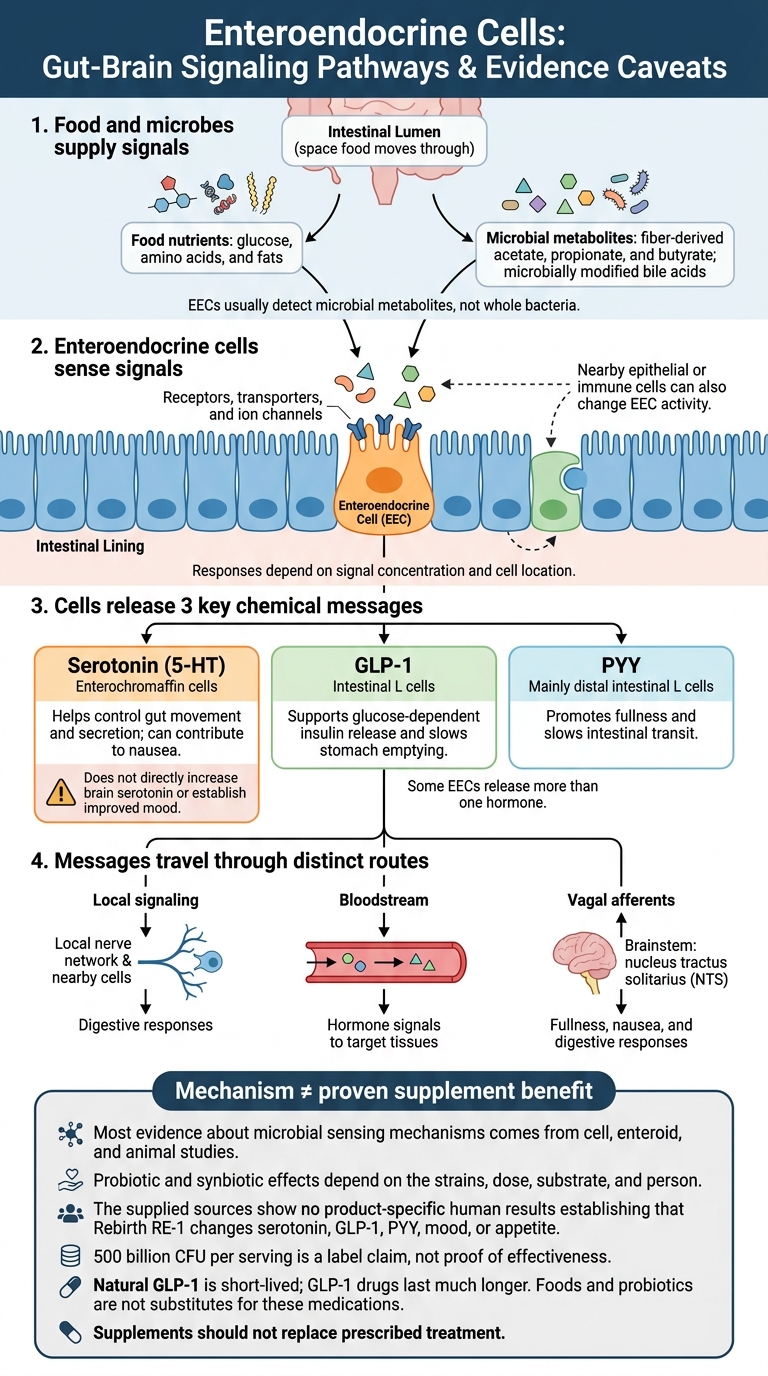
How Enteroendocrine Cells Send Gut-Brain Signals
Enteroendocrine cells connecting with neurons
sbb-itb-1bbfe7f
How Enteroendocrine Cells Sense Food and Microbes
EECs use receptors, transporters, and ion channels to detect chemicals from food and microbes in the gut. Some sensors face the intestinal lumen - the space food moves through. Others respond after molecules cross the intestinal lining.
The response depends on the signal’s concentration and the cell’s location. This detection starts the gut-brain signaling process.
How Glucose, Amino Acids, and Fats Activate EECs
Glucose activates SGLT1, a transporter that carries glucose and sodium into the cell. This triggers calcium entry and hormone release. Sweet-taste receptors, T1R2/T1R3, may also help cells sense glucose.
Amino acids and protein fragments activate receptors such as CaSR. Long-chain fatty acids activate FFAR1/GPR40 and FFAR4/GPR120. These pathways increase calcium inside the cell or activate related chemical signals.
In L-cells, these signals trigger GLP-1 and PYY release. Enterochromaffin cells use similar calcium signaling to release serotonin. Some EECs release more than one hormone.
How Microbial Metabolites Affect Hormone Release
EECs usually detect microbial metabolites, not whole bacteria. These chemicals connect microbiome activity with EEC hormone output. Microbes produce short-chain fatty acids and brain health signals by fermenting fiber, and they also modify bile acids.
Some signals trigger secretion quickly. Others affect hormone production over a longer period by changing gene activity.
| Signal source | Sensing mechanism | Chemical response |
|---|---|---|
| Fiber-derived acetate, propionate, and butyrate | FFAR2/GPR43 and FFAR3/GPR41 on EECs | Changes in calcium and secretion pathways that can trigger GLP-1 and PYY release |
| Microbially modified bile acids | TGR5/GPBAR1; FXR-linked gene regulation | Cyclic AMP signaling or changes in gene activity that alter GLP-1 release |
| Microbial products acting through neighboring cells | Epithelial or immune cells release mediators that affect EECs | Cytokine and other local signaling that can change hormone secretion |
Most evidence about these mechanisms comes from cell, enteroid, and animal studies.
Direct sensing starts at a receptor on the EEC. Indirect signaling starts with nearby cells that change EEC activity. Both routes feed into hormone and nerve signals that carry information beyond the gut wall.
How Gut Hormones and Nerves Carry Signals
EEC signals travel locally, through the bloodstream, or along vagal sensory nerves.[3][4] The main signals are serotonin, GLP-1, and PYY.
Serotonin and Gut Movement
Enterochromaffin cells make most of the serotonin in the gastrointestinal tract. Stretch, nutrients, microbial products, and irritating substances can trigger its release. Serotonin then promotes fluid secretion and intestinal movement.
It can also activate 5-HT3 receptors on vagal afferents. These nerves send messages to the brainstem’s nucleus tractus solitarius (NTS), contributing to nausea, vomiting, and sensations from internal organs.[7][9]
GLP-1 and PYY help handle the fullness side of this gut-brain system.
GLP-1 and PYY in Fullness and Digestion
GLP-1 increases glucose-dependent insulin secretion and slows stomach emptying. PYY, especially PYY3-36, promotes fullness and generally slows the passage of contents through the gastrointestinal tract.
Natural GLP-1 is short-lived; GLP-1 drugs last much longer. Foods or probiotics that increase natural GLP-1 are not substitutes for these medications.[3][5]
| Signal | Main producing cells | Common triggers | Digestive effects | Neural or circulating routes |
|---|---|---|---|---|
| Serotonin (5-HT) | Enterochromaffin cells | Stretch, nutrients, irritants, microbial signals | Coordinates movement and secretion; can contribute to nausea | Local enteric nerves, circulation, vagal 5-HT3 receptors[7][9] |
| GLP-1 | Intestinal L cells | Carbohydrates, fats, protein-derived nutrients | Supports glucose-dependent insulin release; slows stomach emptying | Local receptors, vagal sensory pathways, circulation[3][4] |
| PYY | Mainly distal intestinal L cells | Meal nutrients, including fat | Promotes fullness; slows intestinal transit | Local and circulating signals; sensory pathways[3][5] |
How the Vagus Nerve Sends Signals to the Brainstem
Vagal afferents carry messages to the brain; vagal efferents carry messages back to the gut. Hormone-sensitive nerve endings detect EEC signals, while other endings sense stretch.
These messages reach the brainstem NTS, helping coordinate fullness, nausea, and digestive responses. This nerve pathway is separate from hormones traveling through the bloodstream and enteric nerve circuits working locally in the gut.[3][4]
Some EECs, called neuropod cells, may contact sensory nerves directly. Whether and how this mechanism works in humans remains unsettled.[6][8]
How Probiotics and Synbiotics May Affect EEC Signaling
Probiotics are live microbes with a proven benefit at an adequate dose. Prebiotics are substrates that microbes use selectively. Postbiotics are inanimate microbes or their components that provide a benefit. Synbiotics combine live microbes with selectively used substrates. None of these labels proves an effect on EEC signaling.[10][12][13][15]
What matters is whether changes in microbial activity lead to measurable changes in hormones or symptoms in humans.
Possible Effects on Mood, Appetite, and Digestion
Probiotics and synbiotics can change microbial metabolites, which may alter the signals reaching EECs. The response depends on the strain, dose, substrate, diet, baseline microbiome, gut transit, and host factors.
| Proposed mechanism | Potential outcome | Evidence status | Main limitation |
|---|---|---|---|
| Enterochromaffin signaling | Changes in gut serotonin release and bowel movements | Strain-specific findings | Changes in gut serotonin do not establish improved mood |
| GLP-1 and PYY pathways | Changes in fullness or nutrient handling | Preclinical and early human evidence | Hormone changes alone do not establish appetite control or weight loss |
| Vagal afferent signaling | Changes in gut-to-brain communication | Difficult to measure directly in human trials | Symptom changes cannot establish a vagal mechanism |
Rebirth RE-1 and Microbial Signaling
Ingredient labels matter more than marketing claims.
The synbiotic formulation Rebirth RE-1 includes GOS and inulin, Human Origin Strains (HOSt™), eight listed probiotic strains, a postbiotic component, and 500 billion CFU per serving. These ingredients may influence microbial metabolites, but product-specific effects on EECs remain unproven.[11][14]
How to Assess Clinical Studies and Safety
Mechanisms alone do not predict outcomes. Product claims need human data. Keep proposed mechanisms, strain-specific findings, and product-specific results separate. Check the exact strain combination, dose, and formulation - not just the species name.
Look for randomized, controlled trials with adequate sample sizes, prespecified outcomes, direct hormone measurements where relevant, validated symptom measures, and adverse-event reporting. Also consider whether the study population, duration, and size of the benefit matter clinically. The supplied sources establish no product-specific human results showing that Rebirth RE-1 changes serotonin, GLP-1, PYY, mood, or appetite.
Safety findings should match the formulation and population studied, too. GOS and inulin can cause gas, bloating, abdominal discomfort, or stool changes, especially when introduced quickly. Follow the label, avoid unnecessary dose increases, and discuss persistent or severe symptoms with a clinician.
People with serious illness or immune compromise should seek clinical advice before using live-microorganism products. Parents should seek pediatric guidance for children. High CFU counts and human-origin labeling do not guarantee safety or effectiveness.
Conclusion: What EEC Signaling Means for Gut Health
EECs turn nutrients and microbial metabolites into signals that affect digestion, appetite, and brainstem activity. These signals travel through local nerves, vagal afferents, and the bloodstream.[3][5]
Each hormone has a different role: serotonin supports gut motility and secretion; GLP-1 slows stomach emptying and helps you feel full; PYY slows intestinal transit and reduces appetite.[3][5]
Add fiber-rich foods gradually, and drink fluids as tolerated.[16]
The benefits of probiotics and synbiotics depend on the exact strain, dose, duration, and outcome being measured. Seek medical guidance for persistent symptoms or medical conditions. Supplements should not replace prescribed treatment.[17]
EEC signaling may influence digestion, appetite, and gut-brain communication, but product claims need evidence from human studies.
FAQs
Can gut-brain signals affect my hunger without changing my mood?
Yes. Enteroendocrine cells produce hormones such as GLP-1 and PYY, which help regulate fullness and reward pathways without necessarily changing your mood. Serotonin and ghrelin can affect both appetite and mood, but separate signaling pathways allow hunger to change on its own [1][2].
Rebiirth RE-1 may help support a balanced microbiome, which in turn may support healthy hormone production and hunger signaling [1][2].
How can I tell if a synbiotic improves my digestion?
Track how your digestion feels, including any decrease in bloating or abdominal pain. Many people notice improvements after an initial 7-day reset, though the full effects may take several weeks to months.
Everyone’s microbiome is different, so watch for changes in mood stability, appetite, and sleep, too. Keep a log of your diet, stress levels, and physical activity - all can affect how you respond to the supplement.
What human evidence would support Rebirth RE-1’s gut-brain benefits?
Large-scale trials of Rebirth RE-1 are still underway. Support for its synbiotic approach comes from observational studies in which 94% of users reported less bloating and discomfort within 7 days.
Human research on synbiotics more broadly has reported increased serum tryptophan, improved mood scores, reduced anxiety, and lower cortisol. These findings point to possible gut-brain benefits, but they aren't specific to Rebirth RE-1.