

Your gut can help brown fat burn more fuel - or make it harder for brown fat to do its job.
Here’s the short version: when gut microbes are in balance, they make compounds like short-chain fatty acids (SCFAs) and change bile acids in ways that help turn on UCP1, support beige fat browning, and keep inflammation lower. When the gut is out of balance, LPS leaks into the blood, inflammation goes up, and brown fat makes less heat.
If I boil the article down, these are the main takeaways:
- Brown fat burns calories to make heat, mostly through UCP1.
- Beige fat is white fat that can switch into a more heat-making state.
- A balanced gut microbiome helps by:
-
Dysbiosis can do the opposite:
- lower SCFA output
- weaken bile acid signaling
- let LPS pass into circulation
- shift immune cells toward a more inflammatory pattern
- blunt brown fat thermogenesis
In simple terms, gut health affects how well your body can make heat and use energy. Diet, stress, movement, and antibiotics can all shift this gut-brown fat link.
A fast side note: the article also mentions Rebirth RE-1 as a microbiome reset and synbiotic option, but the core message is broader than any one product: supporting gut balance may help support brown fat activity.
This article explains that chain in four parts: microbiome balance, metabolite signals, immune cross-talk, and how dysbiosis can weaken thermogenesis.
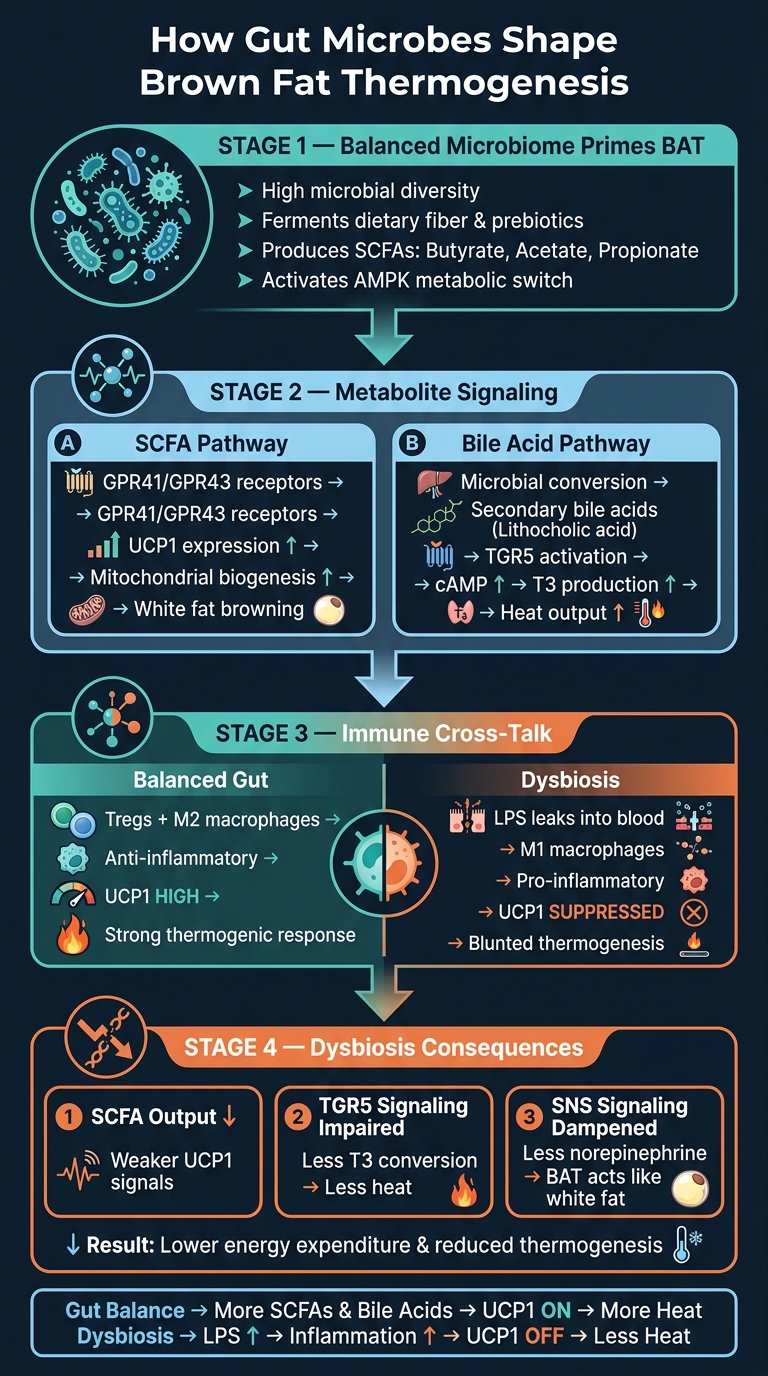
How Gut Microbes Control Brown Fat Thermogenesis
Unlocking the Power of Brown Fat: Boost Your Metabolism Naturally with Dr. William Li
Step 1: How a Balanced Microbiome Primes Brown Fat Function
A balanced gut microbiome helps prime brown fat by producing the signals BAT needs before thermogenesis ramps up.
Microbial Diversity, Energy Signals, and BAT Readiness
When your gut contains a broad mix of helpful bacterial species, it can produce a broader mix of metabolites - especially short-chain fatty acids (SCFAs) like acetate and butyrate. These SCFAs can activate AMPK (adenosine monophosphate-activated protein kinase), a metabolic switch that supports energy expenditure and helps prime white fat for browning.
A healthy gut also helps regulate energy harvest, giving BAT access to glucose and lipids for heat production. Cold exposure and high-fiber diets can also shift microbial composition toward strains linked to thermogenic activity. That priming matters because the next step is metabolite signaling.
Balanced Microbiome vs. Dysbiosis: Effects on Brown Fat
With a balanced microbiome, SCFA-driven AMPK signaling and UCP1 activity are better supported. With dysbiosis, LPS and inflammation go up, and that can blunt thermogenesis.
Where a Microbiome Reset May Fit In
Restoring microbial balance removes barriers that can keep brown fat from working the way it should. Rebirth RE-1 may fit here as a rapid microbiome reset designed to help restore balance when dysbiosis is present.
Next, those microbial signals need to reach brown fat and switch heat production on.
Step 2: How Gut Metabolites Signal Brown Fat to Produce Heat
When gut microbes are in good shape, they make metabolites that travel to brown and beige fat and help switch on thermogenesis.
SCFAs and UCP1 Activation
Gut bacteria break down fiber and prebiotics into short-chain fatty acids (SCFAs), mainly acetate, propionate, and butyrate. These SCFAs signal through GPR41 and GPR43 and help support UCP1 expression, mitochondrial biogenesis, and the browning of white fat.
Put simply, SCFAs help tell fat tissue to burn more fuel instead of storing it. Among them, butyrate stands out because it is closely tied to mitochondrial biogenesis and a higher fuel-burning capacity.
SCFAs are one path. Microbial bile acid conversion is another.
Bile Acid Signaling Through TGR5
Gut microbes also convert primary bile acids into secondary bile acids, such as lithocholic acid, which activate TGR5, a receptor found in high amounts in brown fat [1]. Once TGR5 is activated, it increases cAMP, turns on thermogenic genes, and boosts local T3 production, which can push heat output even higher [1].
These signals don’t just increase heat production. They also help shape the immune tone that lets BAT stay switched on.
Metabolite Classes and Their Effects on BAT
| Metabolite Class | Source in Gut | Main Receptors/Pathways | Likely Effects on BAT/Beige Fat |
|---|---|---|---|
| SCFAs (Acetate, Propionate, Butyrate) | Fermentation of dietary fiber/prebiotics | GPR41/43; Mitochondrial biogenesis | Increases UCP1 expression; promotes browning of white fat |
| Secondary Bile Acids (e.g., Lithocholic acid) | Microbial conversion of primary bile acids [1] | TGR5, FXR [1] | Activates TGR5 to boost T3 production and energy expenditure [1] |
A synbiotic like Rebirth RE-1 pairs prebiotics with probiotics to support the metabolite mix tied to thermogenesis.
Next, immune signaling shows how this metabolite activity can either support or suppress thermogenesis.
sbb-itb-1bbfe7f
Step 3: How Immune Cross-Talk Between the Gut and Adipose Tissue Affects Thermogenesis
SCFAs don't just affect metabolism. They also shape the immune setting around brown and beige fat, and that can make or break thermogenesis.
Signals from the gut have a strong effect on the inflammatory tone that reaches brown and beige fat [3]. And that tone matters. It helps decide whether BAT stays responsive or gets pushed into a suppressed state.
How Anti-Inflammatory Immune Signaling Supports Browning
When the gut microbiome is in good shape, butyrate and propionate promote Foxp3+ Tregs. Those Tregs favor M2-like macrophages and help limit adipose inflammation [4].
That matters because M2-like macrophages help keep adipose tissue in an anti-inflammatory state that supports browning. In plain English, UCP1 expression stays high, mitochondria keep working well, and the tissue responds better to thermogenic triggers like cold exposure.
How Dysbiosis, LPS, and Leaky Gut Can Suppress BAT
When dysbiosis takes hold, the gut barrier starts to weaken. That lets lipopolysaccharides (LPS) - bacterial cell-wall fragments - pass into the bloodstream. This is called metabolic endotoxemia.
Once LPS is in circulation, it turns on pro-inflammatory pathways across the body. In adipose tissue, that pushes the local immune setting away from M2-like macrophages and toward M1-like, pro-inflammatory macrophages. And that's where things start to go sideways.
This immune shift dampens browning signals and directly inhibits UCP1 expression. So even when thermogenic signals are present, brown and beige fat produce less heat. That's one reason dysbiosis is linked to a weaker thermogenic response.
Low-Grade Inflammation vs. Balanced Immune Tone: A Comparison
| Feature | Balanced Immune Tone | Low-Grade Chronic Inflammation |
|---|---|---|
| Primary Immune Cells | Tregs and M2-like macrophages [4] | Th17 cells and M1-like macrophages [4] |
| Gut Barrier Status | Strong and intact | Increased permeability (leaky gut) |
| UCP1 Expression | High; supported by anti-inflammatory signals | Suppressed by inflammatory signaling |
| Mitochondrial Quality | High; efficient oxidative capacity | Impaired; reduced heat-producing capacity |
| Thermogenic Response | Robust and responsive | Weakened or blunted |
Rebirth RE-1 includes 4.5 g of prebiotic fiber (GOS and inulin) per serving [5] to support SCFA production and gut-barrier integrity. This is one direct path through which dysbiosis can lower thermogenesis.
Step 4: How Dysbiosis Leads to a Weaker Thermogenic Response
Dysbiosis can weaken brown fat in a few connected ways. It lowers microbial metabolites, disrupts bile acid signaling, and pushes inflammation up. When all three happen at the same time, BAT output drops.
The Main Ways Dysbiosis Weakens Brown Fat
Dysbiosis lowers SCFA production, which weakens the signals that help maintain UCP1. It can also impair bile acid signaling through TGR5, which slows the conversion of inactive T4 into active T3 inside brown fat cells. That step is key for heat production [1].
Inflammation adds another problem. It can dampen sympathetic signaling to fat tissue. Since norepinephrine is what switches BAT on, weaker SNS input means less heat output. Over time, BAT may lose mitochondria and start acting more like white fat.
The result is lower energy expenditure [6]. And it doesn’t come from one single pathway failing. It comes from several systems getting weakened at once.
That’s why the fix starts upstream: restoring the microbiome.
Practical Steps to Support the Gut-Brown Fat Axis
The most direct way to address this chain is to restore microbial balance so downstream signals - SCFAs, bile acids, immune tone, and SNS activity - can return to a healthier state.
A few steps can help:
- Use prebiotic fibers like GOS and inulin to support SCFA-producing microbes.
- Stress reduction matters too. Chronic stress can alter gut transit time and microbial composition, which may indirectly suppress thermogenic signaling [2].
- If antibiotics are prescribed, use them only when medically needed. That helps protect the gut flora that supports thermogenesis and is often depleted during dysbiosis [2].
If a reset is needed, Rebiirth RE-1, a 3-in-1 eubiotic synbiotic with prebiotics, probiotics, and postbiotics, fits this step as a fast microbiome reset when dysbiosis is the barrier.
Conclusion: Key Pathways to Remember
These same pathways also explain why gut balance can support thermogenesis. A balanced microbiome helps keep BAT ready through microbial diversity and energy signaling. Microbial metabolites - especially SCFAs and bile acids - help drive thermogenesis through UCP1 activation and TGR5 receptor signaling. Immune cross-talk from the gut can either support or suppress browning, depending on whether the balance leans toward Regulatory T-cells (Tregs) or a pro-inflammatory Th17 shift [4].
Taken together, these pathways show how dysbiosis lowers thermogenesis and how microbiome balance helps support BAT.
FAQs
How do gut microbes activate brown fat?
Gut microbes can help switch on brown fat by making short-chain fatty acids (SCFAs). When helpful bacteria break down dietary fiber, they produce SCFAs such as butyrate and propionate. These compounds act like signals in the body, influencing gene expression and how much energy you burn.
This works best when the microbiome stays in balance. If dysbiosis throws that balance off, SCFA production can drop. And when that happens, the body may have a weaker thermogenic response and poorer metabolic function.
What happens to brown fat during dysbiosis?
During dysbiosis, the gut microbiome falls out of balance. You tend to see fewer helpful bacteria that ferment fiber and more species linked to inflammation. When that shift happens, the body may make less of key metabolites such as short-chain fatty acids.
That matters because these microbial signals help regulate energy balance and thermogenesis. When they drop, brown fat function can suffer, thermogenic response may decline, and metabolic disruption can follow. Rebiirth RE-1™ is designed to help address this imbalance while supporting healthy metabolic and immune function.
How can I support the gut-brown fat connection?
Support the gut-brown fat link by building a diverse, balanced microbiome. When your gut is in better shape, it can produce short-chain fatty acids like butyrate, propionate, and acetate. Those compounds help support metabolic regulation and energy balance.
Rebiirth RE-1™ can fit into that routine. Its 3-in-1 synbiotic with 500 billion CFU of Human Origin Strains is made to help restore microbiome balance through 7-day, 4-week, and 12-week reset plans.