

Your gut recovery plan should match your symptoms, stress, food tolerance, and history. The short version is simple: track what happens for 7 days, start with easy foods, add fiber slowly, and build toward 25–38 g of fiber per day and 30+ plant foods per week using a microbiome diet planner over 12 weeks.
Here’s the core idea:
- Step 1: I check my baseline - symptoms, stress, bowel changes, food tolerance, and any antibiotic use.
- Step 2: I build meals around cooked vegetables, whole grains, legumes, healthy fats, and prebiotic foods like garlic, onions, asparagus, and slightly green bananas.
-
Step 3: I move in phases:
- 7 days: calm symptoms and cut back on likely irritants
- 4 weeks: add more fiber and plant variety
- 12 weeks: aim for long-term variety and steadier digestion
- Step 4: I reintroduce foods one at a time and wait 2–3 days before testing the next one.
A few points matter most:
- Too much fiber too soon can lead to bloating or discomfort.
- Stress can affect the gut barrier and change how food feels day to day.
- Serving size matters just as much as the food itself.
- Water intake helps fiber move through the gut. The guide suggests about 64 oz. per day.
This article boils gut recovery down to one clear plan: start simple, track your response, and add more only when your gut is ready.
1-Week Gut Reset Diet - Gut Health Meal Plan
To customize your recovery, you can also plan your gut reset timeline for a 7, 14, or 30-day schedule.
sbb-itb-1bbfe7f
Step 1: Assess Your Gut Recovery Starting Point
Your starting point shapes how much fiber, fat, and food variety your gut can deal with. It also helps to look at what you eat right now, especially how much prebiotic fiber is already in the mix. That baseline can show where your gut may need more support [1].
Age, Life Stage, and Current Eating Pattern
Age and life stage change what recovery looks like, so begin with your day-to-day life, not some one-size-fits-all plan. These factors affect how well you handle more fiber, higher-fat meals, and the speed at which you can add more foods back in during recovery [1].
Symptoms, Stress, and Antibiotic History
Your symptoms give you clues. Pay attention to bloating, irregular bowel movements, signs of poor absorption, low energy, and brain fog [1].
Stress matters too. High stress and higher cortisol can make the gut lining more permeable and leave your digestive system more reactive to food changes [3].
If you've taken antibiotics, use a checklist for restoring gut health as part of your starting assessment. It can affect how much support your recovery plan may call for [1].
Digestive Tolerance and a Simple Symptom Log
Before you change your diet, track meals and symptoms for at least seven days. This gives you a clean snapshot of what your gut is already reacting to.
Use a simple log like this so your notes stay easy to scan:
| Log Category | What to Record |
|---|---|
| Date & Time | MM/DD/YYYY, 12-hour format (e.g., 07/15/2026, 1:30 PM) |
| Meal & Portions | Ingredients and size in cups or oz (e.g., 1 cup lentil soup, 2 oz sourdough) |
| Digestive Symptoms | Bloating, gas, reflux, or pain, with timing (e.g., mild bloating 30 mins post-meal) |
| Systemic Symptoms | Energy level, brain fog, or skin changes |
| Stress Level | Scale of 1–10, with a brief note on cause |
| Bowel Changes | Frequency and consistency (e.g., Type 4 on the Bristol Stool Scale) |
Watch how you respond to raw vegetables, dairy, fats, and legumes. Serving size matters. Maybe a little dairy sits fine, but a larger portion leads to reflux. That kind of detail is useful. It can help shape a food plan that works with your gut instead of against it.
These notes can point to which foods to bring in first. If you're planning major diet changes, take the log to a clinician first.
Use this baseline to choose the foods and reset pace in Step 2.
Step 2: Build the Core Food Plan for Gut Repair
Use your Step 1 log to shape a food plan that fits what you can handle right now. Start with foods your gut already does okay with. Then, as symptoms calm down, add more variety little by little.
Anti-Inflammatory Food Groups to Prioritize
In the early stage of repair, cooked greens are often easier on the gut than raw ones. For grains and legumes, oats, brown rice, and lentils make solid staples. Add healthy fats too, like extra-virgin olive oil, avocado, walnuts, and fatty fish such as salmon.
Put extra focus on prebiotic foods. Garlic, onions, asparagus, and slightly green bananas are practical picks. Prebiotic fibers such as GOS and inulin matter here [1]. Start small and watch how your body responds. If a food seems fine, keep it in rotation. If it stirs up symptoms, scale back and try again later.
Foods to Cut Back on During Recovery
While your gut is settling, cut back on:
- Ultra-processed foods
- Alcohol
- Artificial sweeteners
- Added sugars
Dairy, gluten, caffeine, soy, and corn don't need to be automatic no-go foods. Think of them as symptom-based triggers instead. If your log shows a pattern, adjust from there.
Daily Plate Structure, Fiber Goals, and Sample Meals
A simple plate model can keep meals balanced without making things feel like homework. Aim for:
- Half non-starchy vegetables
- One-quarter protein
- One-quarter whole grains or legumes
- A small portion of healthy fat at each meal
Go slow with fiber. A big jump can make symptoms worse, especially in a sensitive gut. Drink about 64 oz. of water each day to help fiber move through the system and support gut motility [1].
Here’s what that can look like in day-to-day meals:
| Meal | Sample Idea | Key Gut-Supportive Components |
|---|---|---|
| Breakfast | Warm oats with sliced slightly green bananas and flax seeds | Prebiotic fiber, resistant starch |
| Lunch | Grilled salmon over brown rice with a large side of steamed spinach and EVOO | Omega-3s, whole grains, healthy fats |
| Dinner | Lentil and vegetable stew with garlic, onions, and sautéed asparagus | Legumes, prebiotics, cooked vegetables |
| Snack | Fermented coconut yogurt or a small handful of walnuts | Probiotics, anti-inflammatory fats |
From there, swap proteins, rotate vegetables, and shift portions based on what your log shows. This gives you a steady base to build from as you move into the 7-day, 4-week, and 12-week resets.
Step 3: Match the Food Plan to Each Reset Period
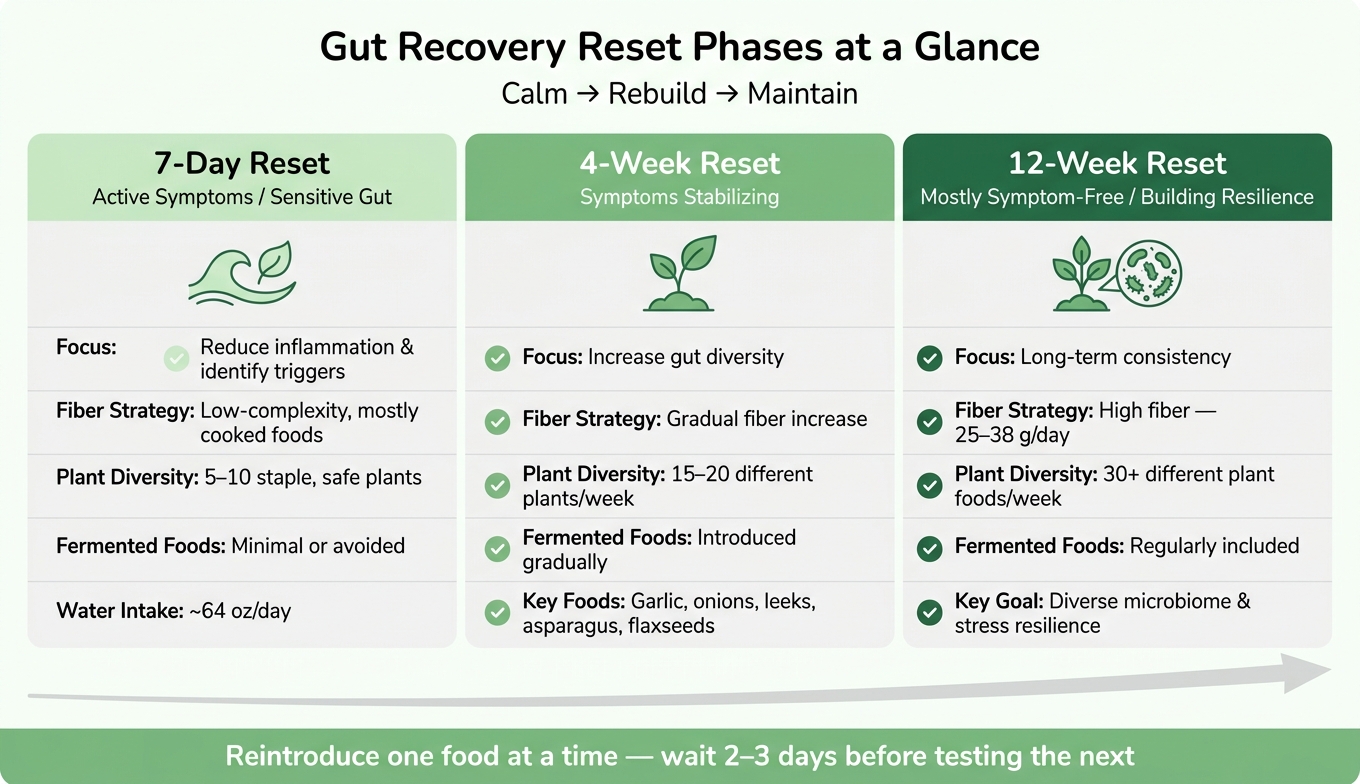
Gut Recovery Reset Phases: 7-Day vs 4-Week vs 12-Week Plan
Once you know what your gut can handle, line up your food plan with the right reset phase. Start with what you learned in Step 2, then adjust by stage: calm first, rebuild next, maintain after that.
7-Day Reset: Calm the Gut and Remove Common Irritants
Use the first 7 days to bring symptoms down. Keep meals simple and easy on digestion. Good options include cooked vegetables like carrots and squash, easy-to-digest proteins, and gentle soluble fibers like oats or peeled apples.
As you add fiber, keep water intake steady. That part matters more than people think. Write down any reaction the same day so you can spot fast triggers. Once symptoms ease up, move into the 4-week reset phase.
4-Week Reset: Gradually Increase Fiber and Plant Variety
When your gut feels more settled, shift your focus to building variety. Prebiotic foods like garlic, onions, leeks, asparagus, and flaxseeds help feed gut bacteria and support short-chain fatty acid production [2].
If bloating or gas picks up, back off a bit and add foods more slowly. This is also the phase to start bringing in fermented foods. Use your log to see which plant foods help expand your tolerance and which ones still need time.
12-Week Reset: Fine-Tune for Long-Term Gut Health
At this stage, aim for 30+ different plant foods per week to support a more diverse gut microbiome [2]. Keep using your log to catch flare-ups tied to stress. High cortisol can increase gut permeability, so leaning on fiber-rich meals during stressful periods may help regulate that response [3].
From here, the focus shifts to structured support and food reintroduction. The goal is to hold onto the progress you've made while testing foods in a more deliberate way.
| Feature | 7-Day Reset | 4-Week Reset | 12-Week Reset |
|---|---|---|---|
| Focus | Reduce inflammation & identify triggers | Increase gut diversity | Long-term consistency |
| Fiber Strategy | Low-complexity, mostly cooked | Gradual fiber increase | High fiber (25–38 g/day) |
| Plant Diversity | 5–10 staple, safe plants | 15–20 different plants per week | 30+ different plant foods per week |
| Fermented Foods | Minimal or avoided | Introduced gradually | Regularly included |
| Best fit | Active symptoms, sensitive gut | Symptoms stabilizing | Mostly symptom-free, building resilience |
Step 4: Add Structured Microbiome Support and Maintain Progress
How Rebirth RE-1 Fits Into a Personalized Gut Recovery Plan
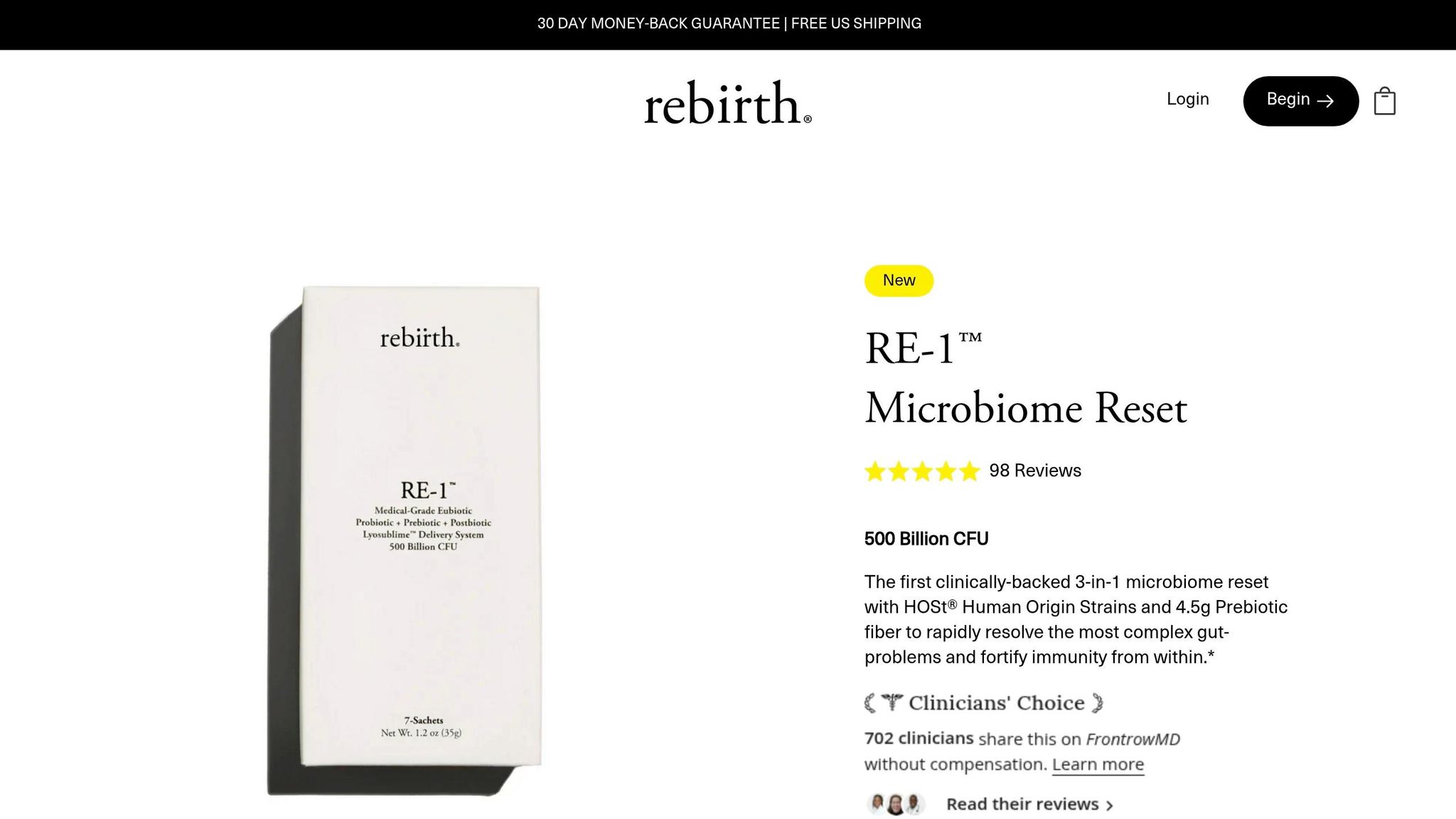
Once your core food plan is set, structured microbiome support can help you stay on track through each reset phase. Food still does most of the work in gut recovery. But adding Rebirth RE-1 can help each phase work a bit better.
RE-1 is a 3-in-1 eubiotic synbiotic that combines prebiotics, probiotics, and postbiotics in one daily sachet, made to work alongside your food plan.
Here’s what that looks like:
- Human Origin Strains (HOSt™) naturally found in the human gut
- 500 billion CFU per serving
- 4.5 g of fiber in each sachet
Use RE-1 as daily support during the 7-day, 4-week, and 12-week phases. Take one sachet with a meal to keep things consistent.
How to Reintroduce Foods and Adjust Based on Your Response
As symptoms settle down, move from rebuilding into testing tolerance. This is the point where you stop guessing and start paying attention to how your body responds.
Reintroduce one cut food at a time, then wait 2 to 3 days before adding another. That gap matters. It gives you a cleaner read on what’s working and what isn’t.
If symptoms stay quiet for 2 to 3 days, keep that food in rotation. If symptoms are mild, try a smaller portion or a gentler prep method, like steaming. If you notice clear symptoms, take that food back out and test it again later in the 12-week cycle. Your symptom log is what helps confirm tolerance, not memory.
Conclusion: Key Principles for a Gut Recovery Food Plan
Lasting gut recovery usually comes back to a few steady habits: start with an honest self-check, build meals around anti-inflammatory and microbiome-supportive foods, and respect your digestive tolerance at each stage.
Follow the phased reset timeline: calm first, diversify next, then maintain. Use your log to keep the foods that work and phase out the ones that don’t. Track weekly patterns so you know what to keep, what to pause, and what to test again later.
FAQs
How do I know if I’m adding fiber too fast?
If you notice bloating or irregular bowel movements, you may be adding fiber too fast.
To help avoid that, take it slow:
- Add new fiber foods in small portions
- Bring in just one new food every few days
- Spread fiber across your meals instead of loading it all into one sitting
- Drink plenty of water
- Pick lightly cooked vegetables instead of raw ones
A two-week food and symptom journal can also help. It gives you a simple way to spot patterns, catch trigger foods, and adjust at a pace that feels okay for your body.
What should I do if healthy foods still cause bloating?
Track your food intake and symptoms in a journal for 2 weeks. That simple habit can help you spot patterns and find foods that may be setting you off. You may also feel better with lower-fructose fruits, like berries or citrus, instead of higher-fructose choices like apples.
It also helps to slow down at meals. Chew each bite well - about 20 times - and give your body a better shot at handling digestion without extra stress. Rebiirth RE-1™ may also help restore microbiome balance.
When should I talk to a doctor before changing my diet?
Talk to a healthcare provider if your symptoms continue after you make dietary changes.
Diet and lifestyle changes can help your gut recover. But there’s a point where it makes sense to bring in a professional. A healthcare provider can look at the full picture and help make sure your plan matches your specific health needs.