

PM2.5 may affect more than your lungs. This review says the same tiny particles in traffic air, industry, and wildfire smoke may also disturb the gut, trigger inflammation, and tie into brain-related changes.
Here’s the short version:
- PM2.5 can reach the gut after you breathe it in and swallow it, or through food and water.
- Gut bacteria may shift after exposure, with lower diversity and fewer bacteria often linked with gut support, such as Lactobacillus and Bifidobacterium.
- Barrier function may weaken. Lower short-chain fatty acids and more LPS can reduce ZO-1 and occludin, two proteins tied to the gut lining.
- Inflammation may follow. Animal studies map a path from gut leak to TLR4 / MyD88 / NF-κB signaling and higher IL-6 and TNF-α.
- Brain effects are still a question in people. Animal work links PM2.5 with memory issues, anxiety-like behavior, neuroinflammation, and blood-brain barrier changes. Human studies show links, but not proof of cause.
- Microbiome support is still a theory-based option. Fiber, probiotics, postbiotics, and synbiotics may help support SCFAs, barrier proteins, and immune balance, but PM2.5-specific human trials are still lacking.
One number in the review stands out: one observational study found 40% higher mood disorder risk and 20% higher anxiety disorder risk in urban vs. rural residents. But I’d keep the key limit in mind: that does not prove PM2.5 caused those outcomes.
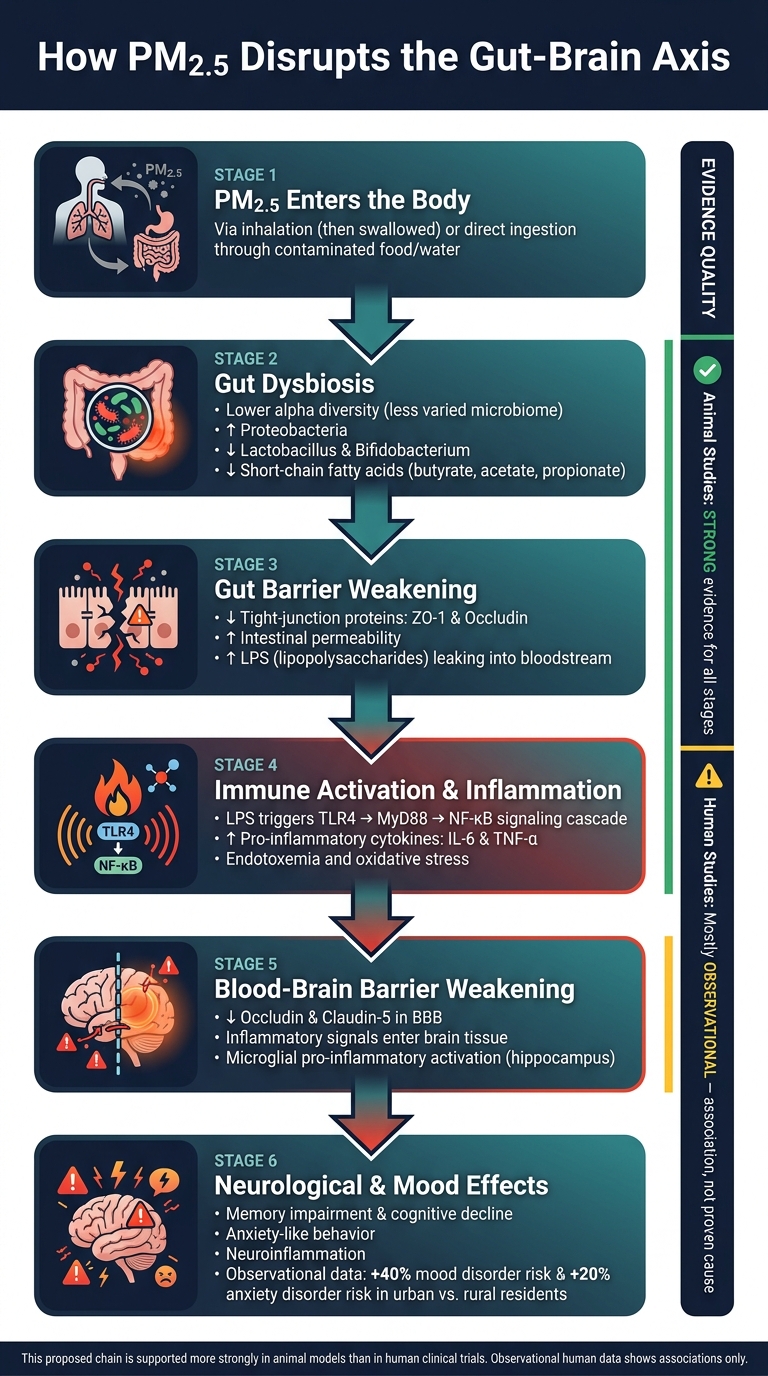
How PM2.5 Disrupts the Gut-Brain Axis: The Proposed Chain
How Air Pollution Is Damaging Our Brains, Causing Dementia | Vantage with Palki Sharma | N18G
sbb-itb-1bbfe7f
Quick take
If I boil the article down to one idea, it’s this:
The proposed chain is PM2.5 → gut dysbiosis → leaky gut → inflammation → brain-related effects.
And just as important:
That chain is backed much more strongly in animals than in humans.
Quick comparison
| Topic | What the review says |
|---|---|
| Main exposure routes | Inhalation with later swallowing; direct ingestion |
| Gut microbiome | Lower alpha diversity; more Proteobacteria; fewer Lactobacillus and Bifidobacterium |
| Gut barrier | Lower SCFAs; lower ZO-1 and occludin; more permeability |
| Immune response | More LPS in blood may trigger TLR4 / MyD88 / NF-κB and cytokines |
| Brain-related signals | Animal links to memory, mood, neuroinflammation, and BBB changes |
| Human evidence | Mostly observational and correlational |
| Reset options discussed | Fiber, probiotics, and synbiotics, postbiotics |
| Product example | Rebirth RE-1 is framed as a hypothesis-driven option, not a proven PM2.5 treatment |
So if you want the plain-English answer: the review makes a strong case that PM2.5 could disrupt the gut-brain axis, but human proof is still limited.
What Studies Show About PM2.5-Driven Gut Disruption
Exposure Routes and Microbiome Changes
PM2.5 can reach the gut in two main ways: after inhalation, when particles are swallowed, and through direct ingestion in contaminated food or water[1].
Once those particles enter the gastrointestinal tract, studies consistently link exposure to lower alpha diversity. Put simply, the gut microbiome becomes less varied[1]. And that matters, because a less varied microbiome is often a less stable one.
Researchers also see a clear pattern in which Proteobacteria tend to increase, while helpful taxa like Lactobacillus and Bifidobacterium decline[1]. In preclinical models, these dysbiotic shifts can show up within just a few weeks[1]. That early change sets off a chain reaction that can weaken the gut barrier.
From Dysbiosis to Leaky Gut
As PM2.5-driven dysbiosis takes hold, levels of the short-chain fatty acids butyrate, acetate, and propionate fall[1]. At the same time, the rise in pro-inflammatory bacteria increases lipopolysaccharides (LPS) in the gut.
That combination is a problem. When helpful microbes drop and LPS climbs, the gut lining becomes more permeable. lower SCFAs and higher LPS work together to reduce inflammation and the tight-junction proteins occludin and ZO-1, which increases intestinal permeability[1].
Animal studies consistently show lower ZO-1 and occludin after exposure, while human evidence is still mostly observational[1].
Barrier weakening and endotoxin leak sit at the center of this process. They connect microbiome disruption to immune activation.
How Gut Changes Drive Immune Activation and Brain Risk
Inflammation, Endotoxemia, and Oxidative Stress
When the gut barrier breaks down, LPS can slip into the bloodstream. Once that happens, TLR4 signaling may set off systemic inflammation through the MyD88/NF-κB cascade, switching on pro-inflammatory gene expression.
Animal studies sketch out this chain pretty clearly. PM2.5 exposure has been linked to gut dysbiosis, leaky gut, TLR4 signaling, and higher levels of pro-inflammatory cytokines such as IL-6 and TNF-α. Human evidence is less direct and mostly observational. It links higher PM2.5 exposure with systemic inflammatory markers and, in some studies, worse cognition or neurodegenerative signals. But in humans, this pathway is still unconfirmed.
That gap matters. Animal work helps map the route, while human studies show an association, not proof. Even so, this proposed mechanism helps explain why researchers are looking closely at possible brain effects next.
Blood-Brain Barrier Disruption and Neuroinflammatory Signaling
The story may not stop in the gut or bloodstream. This inflammatory activity may also reach the brain.
In animal studies, PM2.5-related inflammation has been shown to weaken the blood-brain barrier, including loss of occludin and claudin-5. As the BBB gets more permeable, inflammatory signals may pass into brain tissue more easily. Microglia also move toward a pro-inflammatory state in PM2.5-exposed animal models, including in the hippocampus.
Here again, the animal-human split is important. Animal data lays out the pathway. Human data suggests it could matter, but it does not prove the same process is happening in people. There are still major gaps, especially around exposure thresholds and how much diet and lifestyle may shape risk.
These findings tee up the brain outcomes discussed next.
Brain-Related Outcomes: What Is Known and What Is Not
Cognition, Mood, and Neurodegenerative Signals
When inflammatory signals reach the brain, the next things researchers watch are cognition, mood, and signs tied to neurodegeneration.
Animal studies connect PM2.5 exposure with impaired learning, memory problems, anxiety-like behavior, and neuroinflammation. In people, though, the evidence is still observational. That matters. Observational findings can show a link, but they can't show cause.
One observational study found that urban residents had a 40% higher risk of mood disorders and a 20% higher risk of anxiety disorders than rural residents [1]. Those numbers stand out, but they still don't prove that PM2.5 disrupts the gut-brain axis and then drives these outcomes.
Long-term air pollution exposure has also been linked to neurodegenerative risk. Researchers have seen preclinical protein-misfolding and oxidative-stress signals, along with human associations in high-exposure settings [1]. The hard part is sorting out PM2.5 from other parts of city life, such as noise, light, and social stress.
Evidence Grading and Key Research Gaps
The clearest read on the evidence is this: animal data is strongest for cognition, mood, and neuroinflammation; human data remains correlational.
Researchers still don't have clear dose-response thresholds, so it's not yet known how much PM2.5 exposure is needed to meaningfully disrupt the gut-brain axis. There's also no consensus on the life stages that may face the most risk, whether that's prenatal development, childhood, or older age.
Baseline microbiome differences likely affect how each person responds. In plain English, two people can live in the same place and still not react the same way. That's one reason this area is so hard to pin down.
These gaps help explain why signs your microbiome needs a reset and related strategies are still hypothesis-driven, not proven.
Where Microbiome Reset Strategies May Fit
Dietary Fiber, Probiotics, Postbiotics, and Synbiotic Logic
PM2.5 may disrupt the microbiome and weaken the gut barrier. So it makes sense to look at gut-focused support next. Human intervention data on PM2.5 is still limited, but researchers are studying whether microbiome support could help interrupt this chain earlier.
Dietary fiber, probiotics, and postbiotics each work on a different part of the problem.
- Fiber helps fuel SCFA production, including butyrate, which supports the intestinal barrier.
- Probiotics may help restore microbial balance and compete with opportunistic pathogens.
- Postbiotics provide bioactive compounds that may support the gut lining directly, without relying on live bacteria to survive.
Animal studies suggest these options may increase tight junction proteins and reduce systemic inflammation after PM2.5 exposure [1]. Human intervention data tied to PM2.5 is still limited.
Rebirth RE-1 as a Hypothesis-Driven Microbiome Reset Approach
This is where synbiotic reset products enter the picture. One example is Rebirth RE-1. It fits this mechanistic model, but it has not been tested for PM2.5 exposure.
Rebirth RE-1 is a 3-in-1 synbiotic that combines prebiotics, probiotics, and postbiotics. It uses Human Origin Strains (HOSt™), which are human-derived strains, delivers 500 billion CFU per serving, and comes in 7-day, 4-week, and 12-week formats.
No clinical trial has tested Rebirth RE-1 for PM2.5-induced gut-brain dysregulation. Its relevance here comes from broader research on the microbiome, barrier integrity, and immune function. In plain terms, it belongs in this discussion as a hypothesis-driven approach to gut ecosystem support under environmental stress, not as a proven treatment.
Conclusion: Key Takeaways from Current Evidence
Current evidence suggests a plausible chain: PM2.5 exposure may link to gut dysbiosis, barrier breakdown, immune activation, and then brain-related changes. Animal studies support that pathway. Human studies show associations, but they do not prove cause and effect.
Microbiome reset strategies have a sound mechanistic case because they aim at the gut disruption near the start of that chain. Even so, PM2.5-specific human intervention trials are still missing.
FAQs
Can PM2.5 affect the gut as well as the lungs?
Yes. Research suggests PM2.5 and other airborne pollutants can pass from the lungs into the bloodstream and throw off the gut ecosystem.
That shift may lead to gut inflammation, weaken the gut barrier, and lower microbial diversity. From there, the effects may spread further, influencing immune function, metabolism, and neuroinflammation through the gut-brain axis.
How strong is the human evidence linking PM2.5 to brain-related changes?
The human evidence is still taking shape. Research links pollution and urbanization to shifts in the microbiome that may disrupt gut-brain communication. It also suggests that pollutants can contribute to systemic inflammation and neuroinflammation, which may affect cognitive and emotional health.
That said, direct human studies measuring PM2.5 exposure alongside brain-related changes are still limited. A lot of what we know so far comes from broader microbiome research or animal models, which means longer-term human studies are still needed.
What can I do to support my gut if I’m exposed to PM2.5?
PM2.5 exposure can increase inflammation, weaken gut barrier function, and cut down microbial diversity. That can throw your gut off balance, so it helps to use targeted support that works to rebuild resilience.
Rebiirth RE-1™ is a 3-in-1 eubiotic synbiotic made with prebiotics, probiotics, and postbiotics. Its Human Origin Strains (HOSt™) and Lyosublime™ delivery system are designed to help restore microbiome balance and support immune health.