

Your gut can affect your sleep. If you want the short answer: probiotics have the most human sleep data, prebiotics work more slowly by feeding gut bacteria, postbiotics are more stable and act more directly, and a 3-in-1 synbiotic may fit when sleep issues have more than one gut-related cause.
Here’s the article in plain English:
- Prebiotics feed gut bacteria that make SCFAs like butyrate, which may support NREM sleep. They usually take weeks, not days.
- Probiotics add live bacteria. Some strains may help with stress-related sleep problems, with effects often seen in 4 to 8 weeks.
- Postbiotics are non-living microbial compounds. They do not need to stay alive or colonize the gut, so they are often the most stable option.
- 3-in-1 synbiotics combine all three routes: feed bacteria, add live strains, and supply microbial byproducts in one formula.
A few numbers stand out:
- A trial found 4 weeks of prebiotic yeast mannan improved sleep quality.
- A meta-analysis covering 890 people found a modest PSQI sleep score improvement with probiotics.
- A 2024 study reported that L. paracasei 207-27 improved sleep duration and lowered cortisol after 28 days.
- In animal work, butyrate increased NREM sleep by nearly 50% over 4 hours.
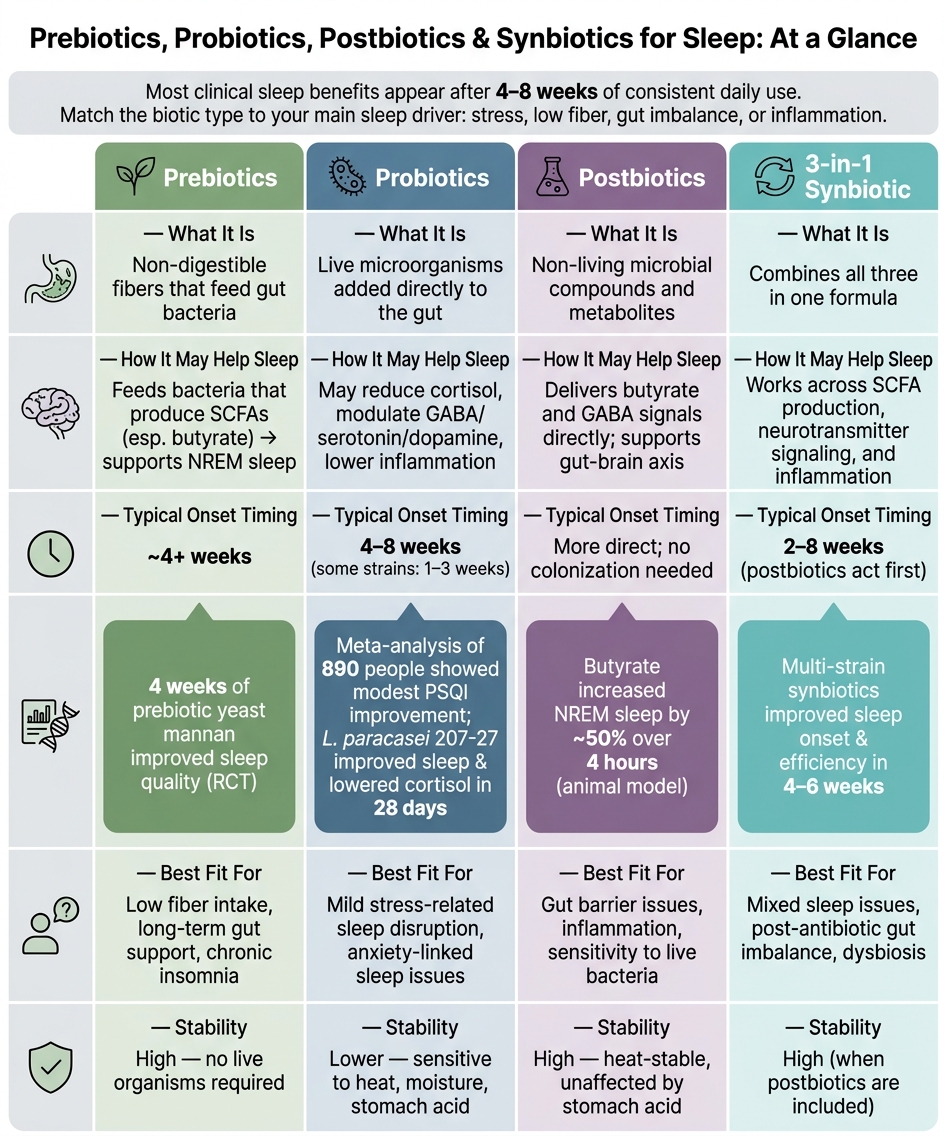
Prebiotics vs Probiotics vs Postbiotics vs Synbiotics for Sleep
New Review Links Gut Microbes to Sleep Disorders Like Insomnia and Apnea
sbb-itb-1bbfe7f
Quick Comparison
| Option | How it may help sleep | Typical timing | Best fit |
|---|---|---|---|
| Prebiotics | Feed gut microbes that make SCFAs (like prebiotics and short-chain fatty acids) | About 4+ weeks | Low fiber intake, long-term gut support |
| Probiotics | Add live strains that may affect stress, inflammation, and neurotransmitters | About 4 to 8 weeks | Mild stress-linked sleep trouble |
| Postbiotics | Deliver non-living microbial compounds directly | Often more direct | People who want stability or do not want live bacteria |
| 3-in-1 synbiotic | Combines all three paths | Often 2 to 8 weeks, depending on formula | Mixed sleep issues tied to gut imbalance |
Bottom line: I’d match the product type to the main problem first - stress, low fiber, post-antibiotic gut issues, or a mix of those - then look at how long you’re willing to wait and whether product stability matters to you.
1. Prebiotics
Prebiotics can help sleep, but not in a direct way. They feed gut microbes that make SCFAs [1][7]. These are non-digestible fibers that pass through to the colon intact, where helpful bacteria such as Bifidobacterium, Lactobacillus, Faecalibacterium, and Roseburia ferment them for fuel [1][7].
Sleep Pathway
That fermentation leads to short-chain fatty acids (SCFAs), mainly butyrate, acetate, and propionate. And this is where sleep comes in. SCFAs, especially butyrate, help support non-rapid eye movement (NREM) sleep and play a role in balancing GABA, serotonin, and the hypothalamic-pituitary-adrenal (HPA) axis [7].
Timing
Prebiotics tend to work over time, not overnight. In a randomized, double-blind controlled trial, 4 weeks of prebiotic yeast mannan supplementation led to a marked improvement in sleep quality in healthy adults [5]. It makes sense to take prebiotics with regular meals, since gut microbial activity tracks with feeding cycles and circadian rhythm [7].
Best Use Case
Prebiotics may be a good match for people with chronic insomnia. People with insomnia often have lower levels of SCFA-producing bacteria such as Faecalibacterium, Prevotella, and Roseburia [1][7]. Food sources like whole grains, vegetables, nuts, and seeds can help support those microbes.
Next: probiotics, which deliver live microbes directly instead of feeding the ones already in the gut.
2. Probiotics
Prebiotics feed the microbes already in your gut. Probiotics do something else: they add live microorganisms directly. So the effect is more direct, but there’s a catch. Results depend on whether the strain survives digestion and stays consistent from one product to the next.
Sleep Pathway
Probiotics may help sleep by affecting neurotransmitters, stress signals, and inflammation. Gut bacteria such as Lactobacillus and Bifidobacterium can synthesize or modulate GABA, serotonin, and dopamine [3]. They may also lower cortisol, reduce inflammation, and support the gut barrier by preserving tight-junction proteins.
Timing
Sleep-related effects usually show up after 4 to 8 weeks, although some strains seem to act sooner, within 1 to 3 weeks. If live-strain viability is the weak point, postbiotics can be a steadier option.
Best Use Case
Probiotics tend to work best for adults with mild stress-related sleep disruption, including sleep problems linked to anxiety or depression [4][9][5]. A meta-analysis of 890 participants found a modest PSQI improvement. And a 2024 trial in mildly stressed adults found that L. paracasei 207-27 improved sleep duration and lowered cortisol after 28 days [4][9].
Stability
Because probiotics are live, they need to survive digestion and remain viable. Dose can vary by strain, and storage conditions matter.
Next: postbiotics, the bioactive compounds left after microbial activity, which avoid viability issues.
3. Postbiotics
Postbiotics are non-living compounds made by microbes. That includes inactivated cells and metabolites like short-chain fatty acids (SCFAs). The big difference is simple: they can work without surviving digestion or setting up shop in the gut. Unlike prebiotics, they don’t need fermentation. Unlike probiotics, they don’t need to stay alive.
Sleep Pathway
Postbiotics can support sleep through the microbiota-gut-brain axis by affecting neurotransmitters such as GABA and serotonin and by helping calm inflammation [3]. SCFAs like butyrate may also send signals through the vagus nerve and support non-rapid eye movement (NREM) sleep.
The animal data here is hard to ignore. In animal models, butyrate increased NREM sleep by nearly 50% over a four-hour window [8].
Postbiotics may also help defend both the gut barrier and the blood-brain barrier by supporting tight junction proteins like ZO-1 and Claudin-1 [2]. That matters because when those barriers get leaky, sleep can take a hit.
Timing
Postbiotics skip the colonization step entirely, so their signaling is more direct than that of live probiotics. In plain English, they don’t need extra time to settle in before doing anything.
A 30-day study in chronic sleep deprivation models found that steady daily use significantly reduced anxiety- and depression-like behaviors linked to sleep loss [2].
Best Use Case
Postbiotics make sense for people dealing with gut barrier issues, inflammation, or sensitivity to live bacteria. Those problems can directly disrupt sleep architecture, so this isn’t just a gut story - it can turn into a sleep story fast.
One example is Levilactobacillus brevis, a strain that is especially relevant because it produces GABA [2].
Stability
Because postbiotics are non-living, they tend to stay stable in storage and through stomach acid. That also makes dosing more predictable than with live probiotics [1].
That predictability is one reason postbiotics often fit into a broader microbiome reset approach.
4. 3-in-1 Synbiotic Approach
A 3-in-1 synbiotic works across all three routes at once: it feeds helpful microbes, adds live strains, and supplies ready-made microbial compounds.
That matters because sleep issues don’t always come from just one gut route. When more than one route is involved, a combined formula can do more than a single biotic on its own.
Sleep Pathway
Taken together, these three parts work across sleep-linked routes, including SCFA production, neurotransmitter signaling, and inflammation control [1][3][8].
The gut plays a big part in sleep signaling because it makes most of the body’s serotonin, which is a precursor to melatonin [3].
Each layer also works on a different timeline. Postbiotics tend to act first, while prebiotics and probiotics usually take more time to build.
Timing
Sleep changes often show up within 4 to 8 weeks, although some strains have shown changes in about 14 days [4][5]. Postbiotics usually move first.
That makes a 3-in-1 option a better fit when sleep trouble is persistent, has more than one driver, or is linked to gut imbalance.
Best Use Case
This type of approach fits sleep problems linked to dysbiosis, stress, or low-grade inflammation [3][5].
Rebiirth RE-1 is one example. It’s a clinically backed 3-in-1 eubiotic synbiotic with HOSt™ strains, 500 billion CFU per serving, sachet delivery, and Lyosublime™ technology for better delivery. It comes in 7-day, 4-week, and 12-week reset formats.
Stability
Postbiotics help with stability because they’re heat-stable and less affected by stomach acid. Prebiotics also feed the live strains after digestion [1]. RE-1 does not need refrigeration.
Choosing the Right Option for Your Sleep Goals
Sleep support starts with the main cause. For some people, it's stress. For others, it's gut imbalance after antibiotics, not enough fiber, or simply wanting broader help that may work sooner. The best move is to match the biotic to the main issue first, then look at speed and day-to-day staying power.
| Scenario | Best Fit | Why It Helps |
|---|---|---|
| Stress-related sleep disruption | Probiotics | Specific probiotic strains may suit stress-linked sleep disruption [3][5] |
| Post-antibiotic gut imbalance | 3-in-1 Synbiotic | Reintroduces beneficial strains while providing broader reset and gut barrier support (see our guide to synbiotics) [3] |
| Low fiber intake | Prebiotics | Supports regular SCFA production, especially butyrate, which may promote deeper NREM sleep [8][6] |
| Short-term sleep support | 3-in-1 Synbiotic | Some multi-strain synbiotic formulas have improved sleep onset and sleep efficiency in 4 to 6 weeks [5][11] |
| Long-term maintenance | Prebiotics + Postbiotics | Provides steady signaling molecules and gut barrier support over time [8] |
One thing matters more than the label on the bottle: strain choice. Two probiotics can sit in the same category and still do very different jobs. That's because different strains act on different sleep-linked pathways, and most clinical gains show up after 4 to 8 weeks of steady daily use [4][5].
There’s also a practical side to this. Some options may act sooner. Some are easier to stick with. Some make more sense if your gut feels off and your sleep is taking the hit. Those trade-offs in speed, stability, and fit come next.
Pros and Cons of Each Biotic Type
Use this quick comparison to line up each biotic type with your main sleep goal.
| Biotic Type | Main Pros | Main Cons |
|---|---|---|
| Prebiotics | Steady support for helpful bacteria and butyrate production; high stability [8] | Slower onset; depends on the gut microbes you already have to ferment fiber [6] |
| Probiotics | May help if sleep issues are tied to stress [4][5] | Effects depend on the strain; live bacteria are sensitive to heat, moisture, and stomach acid [4][10] |
| Postbiotics | Stable in storage and digestion; can signal directly through metabolites such as butyrate and GABA [1][3] | Less clinical data than probiotics; effects are limited to the compounds in the formula [1][10] |
| 3-in-1 Synbiotic | Multi-pathway support that combines prebiotic fuel, live strains, and postbiotic signaling [3] | More complex formulas can make it harder to tell which ingredient is doing the heavy lifting [3] |
The trade-offs are pretty straightforward. Probiotics have the strongest sleep data, prebiotics tend to work more gradually, and postbiotics are the most stable.
So the next move is simple: match the biotic type to the sleep issue first, then think about the speed and stability you want. Rebiirth RE-1™ is one example of that setup: a sachet-based 3-in-1 synbiotic with HOSt™ strains, 500 billion CFU per serving, and Lyosublime™ delivery.
Conclusion
Each biotic can support sleep through the gut-brain axis, but they don’t all work the same way. The main difference comes down to speed, stability, and directness. Prebiotics feed the microbes already there. Probiotics add live strains. Postbiotics deliver the end products directly. So in sleep care, the better question isn’t which biotic is “best” across the board. It’s which route matches the problem in front of you.
A simple way to think about it:
- Prebiotics support daily microbial fuel
- Probiotics may help with stress-linked sleep issues
- Postbiotics offer stable microbial metabolite support
For people dealing with a clear microbiome imbalance, combo support can make sense, especially when sleep trouble has more than one cause. That’s where a 3-in-1 synbiotic lines up well with a multi-pathway approach.
Rebiirth RE-1™ is a 3-in-1 eubiotic synbiotic with HOSt™ strains, 500 billion CFU per serving, sachet delivery, and Lyosublime™ technology. For broader microbiome reset goals, a 3-in-1 synbiotic brings all three routes together in one daily format.
FAQs
How do I choose between prebiotics, probiotics, and postbiotics for sleep?
It depends on what you want to do with the microbiota-gut-brain axis: probiotics add helpful bacteria, prebiotics feed them, and postbiotics deliver the bioactive compounds linked to neurotransmission, inflammation, and sleep homeostasis.
For sleep support, many experts point to a 3-in-1 synbiotic approach. The idea is simple: help restore gut balance while addressing dysbiosis tied to poor sleep and stress. Rebiirth RE-1 brings all three together in one formula.
Can gut support help if stress is keeping me awake?
Yes. The gut and brain are closely linked, so stress can throw off the gut microbiome. And when you support a balanced microbiome, it may help with stress management and better sleep.
Some prebiotics and probiotics may help lower stress and anxiety while also supporting sleep quality. Gut microbes also make compounds that affect sleep and the body’s stress response, which may help interrupt the cycle of stress-related insomnia.
When should I try a 3-in-1 synbiotic for sleep?
Consider a 3-in-1 synbiotic if you deal with sleep disturbances, insomnia, or poor sleep quality tied to gut microbiome imbalance.
The gut-brain axis goes both ways. Stress, anxiety, irregular sleep cycles, and a Western diet can throw your gut out of balance, and that can make sleep worse. A synbiotic combines prebiotics, probiotics, and postbiotics to help bring that balance back. Rebiirth RE-1 may help support that reset over 7 days, 4 weeks, or 12 weeks.