

If you want the short answer, here it is: take your probiotic with a meal or 30 minutes before one, keep it 2 to 3 hours away from antibiotics, and stick to the same daily anchor more than the same exact clock time. Timing can help with survival through stomach acid and cut mild side effects, but the bigger driver is daily use.
Here’s the article in plain English:
- For bloating, regularity, and gut comfort, I’d tie the dose to the meal you miss the least.
- For immune support, I’d focus on the same time every day, even if that time is morning one week and bedtime the next.
- For antibiotics, I’d start the probiotic the same day or within 48 hours and keep taking it for 7 to 14 days after the antibiotic ends.
- For C-section recovery, I’d use the first meal I can count on after discharge and follow the same 2 to 3 hour spacing rule from antibiotics.
- If my routine is messy, I wouldn’t chase the “perfect” hour. I’d pick one repeatable cue like waking up or going to bed.
A few details matter more than most people think. One study found better survival when probiotics were taken with oatmeal or low-fat milk instead of water or apple juice. And when used during or after antibiotics, probiotics may cut antibiotic-associated diarrhea risk by 40% to 55% and may lower C. difficile risk by about 60% in high-risk groups.
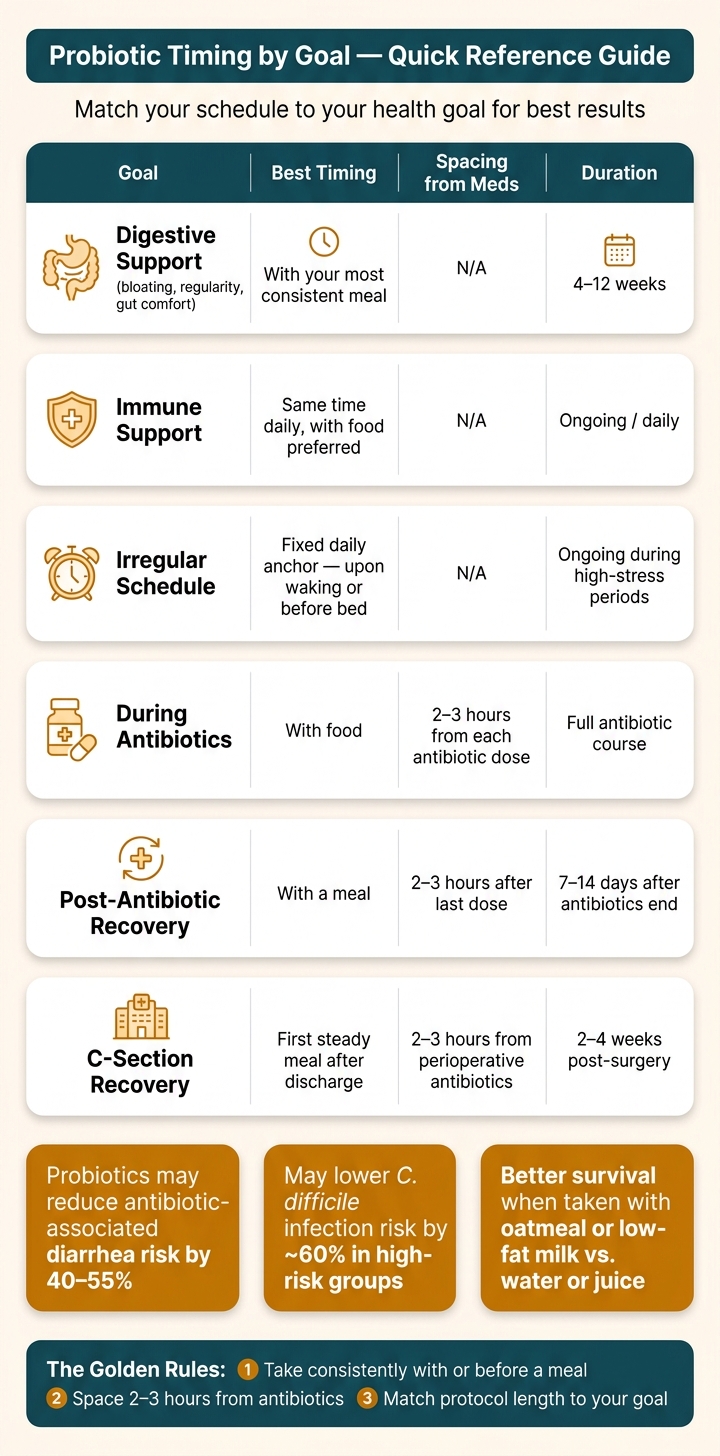
Probiotic Timing by Goal: Quick Reference Guide
When Is The Best Time To Take A Probiotic Supplement? (Based On Studies)
sbb-itb-1bbfe7f
Quick comparison
| Goal | Best timing | What matters most |
|---|---|---|
| Digestive support | With your most steady meal | Repeat the same meal anchor |
| Immune support | Same time each day, with food preferred | Immune health and daily use |
| Irregular schedule | Upon waking or before bed | One fixed cue |
| During antibiotics | With food, 2 to 3 hours from each antibiotic dose | Spacing + staying on it |
| After antibiotics | With a meal | Restoring gut health for 7 to 14 days |
| C-section recovery | First steady meal after discharge | Spacing, routine, and duration |
If I were using this guide to set a plan, I’d treat timing as a support tool - not a magic fix - and build the schedule around the goal first.
Probiotic Timing Basics Before You Pick a Schedule
Before you set a schedule, it helps to know which timing rules actually matter. In this guide, probiotics are the part that needs the most attention. Prebiotics and probiotics (along with postbiotics) are much less tied to meal timing. If you're trying to get the timing right, probiotics are the main thing to focus on.
Why? Probiotics are more sensitive to timing because stomach acid can cut down how many live microbes make it to the intestines, where the pH is higher.
With Food, Before Food, or on an Empty Stomach
Take probiotics with a meal or 30 minutes before a meal [4]. One study found that bacteria survived much better when taken with oatmeal or low-fat milk than with water or apple juice [4].
Taking probiotics 30 minutes after a meal led to lower survival rates [4]. So if breakfast, lunch, or dinner fits your routine, any of them can work. Just take your dose with food that has some fat or protein.
Some formulas play by different rules. Products with enteric-coated or delayed-release formats are made to get past stomach acid, which gives you more room if your meal schedule is all over the place.
Time of Day, Drink Choices, and Delivery Format
Morning works well for a lot of people because it's easy to tie it to a habit you already have, like breakfast or your usual supplement routine. Evening is also a solid option if mornings feel hectic or if you notice digestive adjustment during the day [2][3].
A couple of drink choices are worth watching:
- Avoid hot coffee and acidic drinks like apple juice, which can compromise live cultures [1][4].
- Water or milk are the safest options.
Delivery format matters too. Standard capsules and powders get the most from the meal-timing guidance above. Enteric-coated or dual-encapsulated formats are made to bypass stomach acid, so they're less tied to what you eat or when you eat it. Check the label each time, since some products are made for one approach and not the other.
Use these rules as your default, then adjust based on your goal in the next section.
Probiotic Timing Plans by Health Goal
Start with the basic meal-timing rules above. Then match your schedule to your main goal.
Digestive Support: Timing for Bloating, Regularity, and Gut Comfort
If you're taking a probiotic for digestive support, tie it to the meal you stick with most often. For a lot of common probiotic strains, taking them with food works well. So the best choice is usually the meal you repeat day after day - breakfast, lunch, or dinner.
This is one of those cases where consistency beats perfection. If breakfast happens at the same time every weekday, use that. If lunch is your only steady meal, go with lunch instead.
Digestive goals tend to work best with meal-linked timing. Immune support leans more on steady daily use.
Immune Support: Why Daily Consistency Matters More Than Clock Time
For immune support, taking your probiotic at the same time each day matters more than taking it at some exact hour. Morning is often the easiest default because it's simple to attach it to something you already do.
A few easy anchors:
- Next to your coffee maker
- By your toothbrush
- With your first glass of water
If your routine changes from day to day, keep the habit simple. Pair the probiotic with one thing you almost never skip, and it becomes much harder to forget.
When schedules move around, consistency still wins - but your anchor can shift with it.
Urban Stress and the Gut-Brain Axis: Timing for Irregular Schedules
If your schedule is all over the place, don't chase perfect timing. Go for repeatability. Pick one fixed daily anchor - like waking up or bedtime - and keep it there [2].
If your mornings are hectic, bedtime works just fine. And if meal timing changes a lot, flexible formats can make the routine easier to hold onto.
| Goal | When to Take It | U.S. Routine Anchor |
|---|---|---|
| Digestive Support | With your most consistent meal | Breakfast before the commute, or first bites of lunch |
| Immune Support | Same time daily, morning preferred | Next to your coffee maker or toothbrush |
| Irregular Schedule | Fixed daily anchor, AM or PM | Upon waking for shift work, or right before bed for late nights |
Post-Antibiotic and C-Section Recovery Schedules
When recovery is the goal, timing comes down to three things: spacing, a steady meal anchor, and how long you stick with the plan.
How to Time Probiotics During and After Antibiotics
Start the probiotic the same day you start antibiotics, or within 48 hours. Then space the two by 2 to 3 hours. That gap helps limit antibiotic kill-off of the probiotic.
Keep taking the probiotic for 7 to 14 days after your last antibiotic dose to help support microbiome recovery [6]. Used during and after antibiotics, probiotics can lower the risk of antibiotic-associated diarrhea by 40% to 55%. They may also lower the risk of C. difficile infection by about 60% in high-risk groups [5].
C-Section Recovery: Meal-Linked Timing After Hospital Antibiotics
The same spacing rule applies after a C-section, but the daily anchor often shifts to the first meal after discharge. Recovery can include antibiotics, opioids, and iron, which may slow the gut [7]. That’s why a steady daily routine matters so much here.
After discharge, use the first meal you can reliably tolerate as your daily anchor. If you are breastfeeding, check LactMed or ask your healthcare provider whether your probiotic is appropriate while nursing [7].
Structured Reset Protocols and Where Rebirth RE-1 Fits
If you use a fixed reset protocol, keep the same timing rules. Use the product only as the daily anchor.
Rebirth RE-1 is a daily microbiome reset sachet sold in 7-day, 4-week, and 12-week protocols. If you’re still on antibiotics, the same 2 to 3 hour spacing rule still applies [8].
| Recovery Context | Recommended Protocol |
|---|---|
| Short antibiotic course (5–7 days) | 7-Day Reset |
| Standard post-antibiotic recovery | 4-Week Reset |
| C-section or prolonged disruption | 12-Week Reset |
After the antibiotic course ends, take it with your preferred meal or daily routine. If recovery is taking longer, extend the protocol to 8 to 12 weeks.
Timing Tables and Key Takeaways
Timing Rules by Goal
Use the table below to get to the right schedule fast.
| Goal | Best Timing Relative to Meals | Spacing from Meds | Daily Routine Anchor | Typical Duration |
|---|---|---|---|---|
| Digestive Support | With or just before a meal | N/A | Breakfast or dinner | 4–12 weeks [5] |
| Immune Support | Same time daily, with food preferred | N/A | Morning supplement stack | Ongoing/daily |
| Post-Antibiotic Recovery | With food | 2–3 hours after antibiotic dose [6] | Any consistent daily anchor | Antibiotic course + 7–14 days [6] |
| C-Section Recovery | With food | 2–3 hours after perioperative antibiotics [6] | Bedtime or mealtime | 2–4 weeks post-surgery [3] |
| Urban Stress | Tie it to a fixed morning or bedtime routine | N/A | Tie it to a fixed morning or bedtime routine | Ongoing during high-stress periods |
Once you set the timing, the next piece is protocol length.
Protocol length matters. Probiotics work only while you keep taking them.
Rebirth RE-1 is available in 7-day, 4-week, and 12-week protocols.
Conclusion: The Timing Rules That Matter Most
If you only remember three rules, stick with these:
- Take it consistently, with or just before a meal.
- Space it 2 to 3 hours from antibiotics.
- Match protocol length to the goal.
FAQs
What if I miss a dose?
If you miss a dose of Rebirth RE-1, just pick back up with your regular schedule the next morning.
Missing one dose usually won’t cause a major setback, but staying consistent still matters. These bacteria work best with daily use, so taking it off and on can limit how well the strains do their job.
Can I take probiotics at night?
It depends on the product instructions, because timing can vary from one formula to another. Some probiotics can be taken at any time. Rebiirth RE-1, though, is meant to be taken once a day in the morning on an empty stomach with water.
The main thing is consistency. Take your probiotic at the same time each day, and always follow the directions on the product label.
How long until I notice results?
Many users start to feel better within the first week of steady use. Common early changes include less bloating and less discomfort.
With Rebiirth RE-1, some relief may show up within 7 days. But full gut microbiome restoration usually takes steady use through the 4-week or 12-week program. For the best results, take it every morning on an empty stomach.