

Yes - ultra-processed foods can affect your gut within days. A few UPF-heavy meals may lead to bloating, gas, reflux, constipation, or loose stools, and if this pattern keeps happening, it can shift gut bacteria, lower fiber intake, and cut down short-chain fatty acids like butyrate.
Here’s the short version:
- UPFs often crowd out fiber-rich foods, which means gut microbes get less of the fuel they use.
- Low fiber can lower gut bacteria variety and reduce compounds that help support the colon.
- Some additives like emulsifiers and some sweeteners may also change the gut environment.
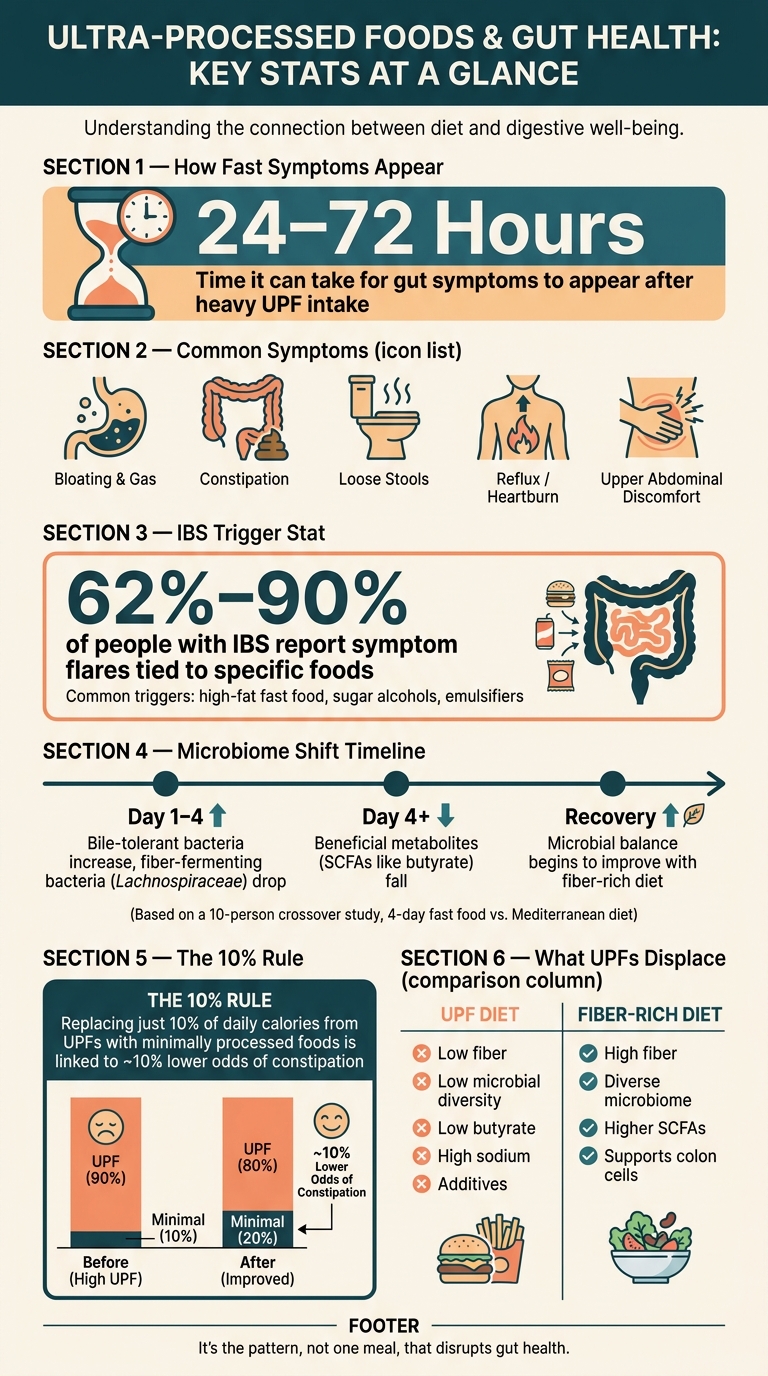
- People may notice symptoms in 24 to 72 hours, especially after fast food, packaged meals, sugar alcohols, or large high-fat meals.
- IBS symptoms can flare more easily, and studies say 62% to 90% of people with IBS link flares to certain foods.
- The main issue is repeat intake, not one burger or one packaged snack.
- A simple fix is to cut back on UPFs and add back fiber from vegetables, legumes, fruit, and whole grains.
What I’d take from the article: your gut can change fast, but it can also recover with steady food changes. One stat that stands out: replacing 10% of daily calories from UPFs with less processed foods is linked with about 10% lower odds of constipation.
So if you feel off after a stretch of drive-through meals or packaged foods, the message is simple: it’s often the pattern, not one meal, that causes the problem.
Ultra-Processed Foods & Gut Health: Key Stats at a Glance
How ultra-processed foods change gut bacteria
Less fiber means less microbial diversity and fewer beneficial metabolites
The biggest problem with UPFs is often what they push out of the diet: fiber-rich foods.
The main pathway is pretty simple. UPFs replace the fiber that gut microbes feed on.
Gut bacteria ferment dietary fiber and turn it into short-chain fatty acids (SCFAs) and inflammation, especially butyrate. Butyrate helps feed colon cells and supports gut stability. When fiber intake drops, butyrate-producing bacteria tend to drop too, including Faecalibacterium prausnitzii, Roseburia, and Lachnospira. A cross-sectional study found that people with high UPF intake had lower levels of these SCFA-producing genera than people with low UPF intake.[3]
Less fiber also means less microbial diversity and a gut ecosystem that’s less able to handle stress. This creates a cycle where stress further disrupts the microbiota.
How additives, emulsifiers, and sweeteners affect the gut
Fiber loss is a big part of the story, but it’s not the whole story.
Some UPF ingredients may also change the gut environment itself. Animal studies suggest that some emulsifiers, including carboxymethylcellulose (CMC) and polysorbate 80, can disrupt the mucus barrier and promote low-grade inflammation.[7][8] The data on artificial sweeteners are mixed, but some controlled trials have shown microbiome shifts at higher exposures.[10][11]
Short-term microbial shifts versus long-term dysbiosis
These shifts can happen fast, even within a few days.
In a 10-person crossover study, just 4 days of eating burgers and fries led to a marked increase in bile-tolerant bacteria and a drop in fiber-fermenting Lachnospiraceae, compared with a Mediterranean diet eaten during the same study.[5][6] Beneficial metabolites also fell during the fast-food phase, then increased again on the Mediterranean diet within that same 4-day period.[5]
That said, a single meal or a short stretch of fast food probably isn’t the main issue. The bigger concern is repetition. When UPF-heavy eating becomes a pattern, those microbial shifts are more likely to stick.
sbb-itb-1bbfe7f
Digestive symptoms linked to ultra-processed foods
Bloating and gas after fast food or packaged meals
These diet-driven shifts in the gut often show up first in a pretty familiar way: bloating, gas, and that heavy, puffed-up feeling. Many people notice symptoms within 24 to 72 hours after moving into a heavy UPF or fast-food pattern.[13][14]
A few things are usually at play. High sodium can lead to water retention, which can feel like bloating even before digestion fully slows down. Then there are sugar alcohols like sorbitol, mannitol, and xylitol. They’re common in sugar-free candies, protein bars, and diet ice cream, and the gut doesn’t absorb them well. That means they can pull water into the intestines and set off gas, cramping, and bloating.[22][12]
People with IBS or a sensitive gut often get hit harder. Between 62% and 90% of people with IBS report symptom flares tied to specific foods, and common triggers include high-fat fast food, sugar alcohols, and emulsifiers.[21]
Constipation, loose stools, and changes in bowel habits
When constipation shows up after a UPF-heavy stretch, low fiber is usually the main reason. Without enough fiber, stool loses bulk, the colon pulls back more water, and transit slows. The result is pretty straightforward: stools become harder, drier, and less frequent.[18][20]
Eating the same low-plant, fast-food meals again and again can make things worse over time. Less plant variety can chip away at regular bowel patterns, so trips to the bathroom may start to feel less predictable.[20][4] You can check your current status with a microbiome balance quiz.
On the flip side, some people deal with the opposite problem. High-fat meals, large sugary drinks, and oversized portions can speed up transit and trigger loose stools or urgency, especially in people who are already sensitive. A skipped meal followed by a big fast-food order can do it too.[19][22]
Reflux and upper abdominal discomfort
High-fat, energy-dense meals tend to sit in the stomach longer before moving into the small intestine. That delay can leave you feeling overfull, pressured, or uncomfortable. It also relaxes the lower esophageal sphincter (LES), the valve that helps keep stomach acid where it belongs.[15][16][17] Once that valve loses some tone, heartburn and a sour taste in the mouth can follow.
Large carbonated drinks can add fuel to the fire. They increase gas volume and pressure in the abdomen, which gives stomach contents more chances to reflux.[17] Big, high-fat meals, especially late at night, are among the most common triggers.[15][17]
If that pattern keeps repeating, reflux can shift from an occasional problem to a regular one. Over time, repeated high-fat late-night meals may lead to inflammation and changes in the gut barrier.
Inflammation, gut barrier function, and recovery after a UPF-heavy diet
How UPFs may affect the gut barrier and inflammation
If bloating, reflux, or bowel changes keep showing up, it may point to more than simple digestive discomfort. It can also be a sign that your gut barrier is under strain.
A UPF-heavy diet can lower the metabolites that come from fiber fermentation, weaken the gut barrier, and push low-grade inflammation. As the microbiome shifts, tight junctions may loosen, which makes it harder for the intestinal lining to hold firm. When that barrier breaks down, it can set off inflammatory signals and add to systemic low-grade inflammation.[1]
That’s why recovery usually has two parts: cut back on UPFs, then build fiber intake back up.
What to eat to support your microbiome after heavy processed-food intake
Start with more prebiotic fiber, with extra attention to GOS and inulin. These help feed helpful microbes and support metabolite production.
When a microbiome reset product may help
For some people, food changes alone can feel slow after a period of heavy processed-food intake. Rebirth RE-1 is a 3-in-1 synbiotic sachet with prebiotics, probiotics, and postbiotics made to support microbiome balance alongside diet changes.
If you want more structure, Rebirth RE-1 is one option to use with those diet changes.
Ultraprocessed Foods and Your Gut | Dr. Will Bulsiewicz Live Q&A
Conclusion: What the science says in practical terms
What matters most isn't one meal here or there. It's the pattern.
Research keeps pointing to the same thing: regular ultra-processed food intake - not the occasional meal - is what most often disrupts microbial diversity and short-chain fatty acid production.[9][23][2] And these changes don't always take long to show up.
Gut microbes can shift within days. But in most cases, steadier improvement comes from a few weeks of eating more fiber on a consistent basis.
That’s why small, repeatable food swaps can do more than stressing over a single meal. For example, replacing 10% of daily calories from ultra-processed foods with minimally processed foods is linked with about 10% lower odds of constipation.[24]
In plain terms, the best-supported move is simple: eat more vegetables, legumes, whole grains, and other fiber-rich foods, and make UPFs an occasional part of your diet instead of a daily one. If progress feels slow after a long stretch of heavy UPF intake, a microbiome reset plan may help as a short-term support. For readers coming off a heavy processed-food phase, Rebirth RE-1 can be used as a short-term add-on alongside diet changes.