

Your gut can affect how well you burn fat. In this article, I’d sum it up like this: prebiotics, probiotics, and postbiotics help shape gut signals that affect fat oxidation, gut barrier function, and immune balance.
Here’s the short version:
- Fat burning happens in mitochondria, where fatty acids are turned into ATP.
- Gut microbes make compounds like butyrate, propionate, and acetate that help guide this process.
- When the gut barrier is weak, inflammation and endotoxin leak can get in the way of steady fat use.
-
Each biotic has a different job:
- Prebiotics feed gut microbes and support SCFA production.
- Probiotics help shift the microbial mix.
- Postbiotics supply microbial compounds that support the gut lining and immune function.
- The article also lays out a simple timeline:
- 7 days: less gut stress, less bloating, more regular bowel movements
- 4 weeks: steadier digestion, energy, and meal tolerance
- 12 weeks: better waist and weight trends, exercise tolerance, and mental clarity
- One product example in the piece is Rebiirth RE-1™, listed at 500 billion CFU per sachet, 4.5 g of GOS and inulin per serving, and $279 for 4 weeks.
What stood out to me is the main idea: gut support doesn’t just affect digestion. It may also shape how your body uses fuel over time. That’s the lens for the rest of the article.
Is your gut microbiome preventing weight loss? | Dr. Suzanne Devkota and Prof. Tim Spector
sbb-itb-1bbfe7f
How the microbiome influences fat oxidation inside mitochondria
Gut microbes make metabolites that can directly shape how mitochondria burn fat. That matters because these compounds act like messengers. They tell the body when to turn fat-burning pathways up or down.
SCFAs that trigger fat-oxidation signals
Microbial SCFAs such as acetate and butyrate help signal fat oxidation by activating metabolic pathways linked to AMPK and beta-oxidation [2].
This isn’t just a lab idea. It shows up in people, too. In one 16-week study, B. longum BB536 intake was associated with reduced visceral fat, even without changes in diet or exercise [2]. In plain English, shifts in the microbiome may affect both fat storage and how well the body burns fat.
How gut barrier integrity supports metabolism
Fat oxidation also depends on a low-inflammation gut environment. When the gut barrier weakens, inflammation can interfere with fat oxidation and make metabolic flexibility harder to maintain. A stronger barrier helps limit inflammatory stress and endotoxin leakage, which can help protect mitochondrial fat-burning pathways [3].
That’s why prebiotics, probiotics, and postbiotics each have their own role in helping restore these signals.
What prebiotics, probiotics, and postbiotics each do
Prebiotics, probiotics, and postbiotics aren't interchangeable; each has its own role. And they tend to work best together, not on their own. After SCFA signaling and gut-barrier integrity, the next step is to separate what each biotic class brings to the table.
Prebiotics: feeding beneficial microbes to increase SCFAs
Prebiotics are fermentable fibers that feed beneficial microbes and increase SCFA output. Rebirth RE-1™ provides 4.5 g of fiber from GOS and inulin per serving [1].
Probiotics: strain-specific support for microbial balance
Prebiotics feed microbes. Probiotics help rebalance them.
Probiotics support microbial balance. Human Origin Strains (HOSt™) are human-origin strains that help restore microbial balance [1].
Postbiotics and how the three biotics work together
Postbiotics are microbial compounds that support gut barrier integrity and immune balance [1].
Put simply, prebiotics are the fuel, probiotics help restore the microbial community, and postbiotics give direct support to the gut barrier and immune system. That layered setup - a synbiotic approach - supports the full chain from gut ecosystem health to metabolic signaling.
| Biotic Category | Main role in the fat-metabolism pathway | Gut Barrier & Immune Role |
|---|---|---|
| Prebiotics | Feed beneficial microbes and raise SCFA output | Fuels beneficial flora to support barrier health |
| Probiotics | Restore microbial balance to improve metabolic efficiency | Reduces inflammatory stress through ecosystem repair |
| Postbiotics | Deliver direct metabolic signaling via microbial compounds | Strengthens gut barrier integrity and immune defense |
That distinction matters because the gut-to-mitochondria effect doesn't happen all at once. It builds over days, weeks, and months.
How to apply biotics across 7-day, 4-week, and 12-week reset plans
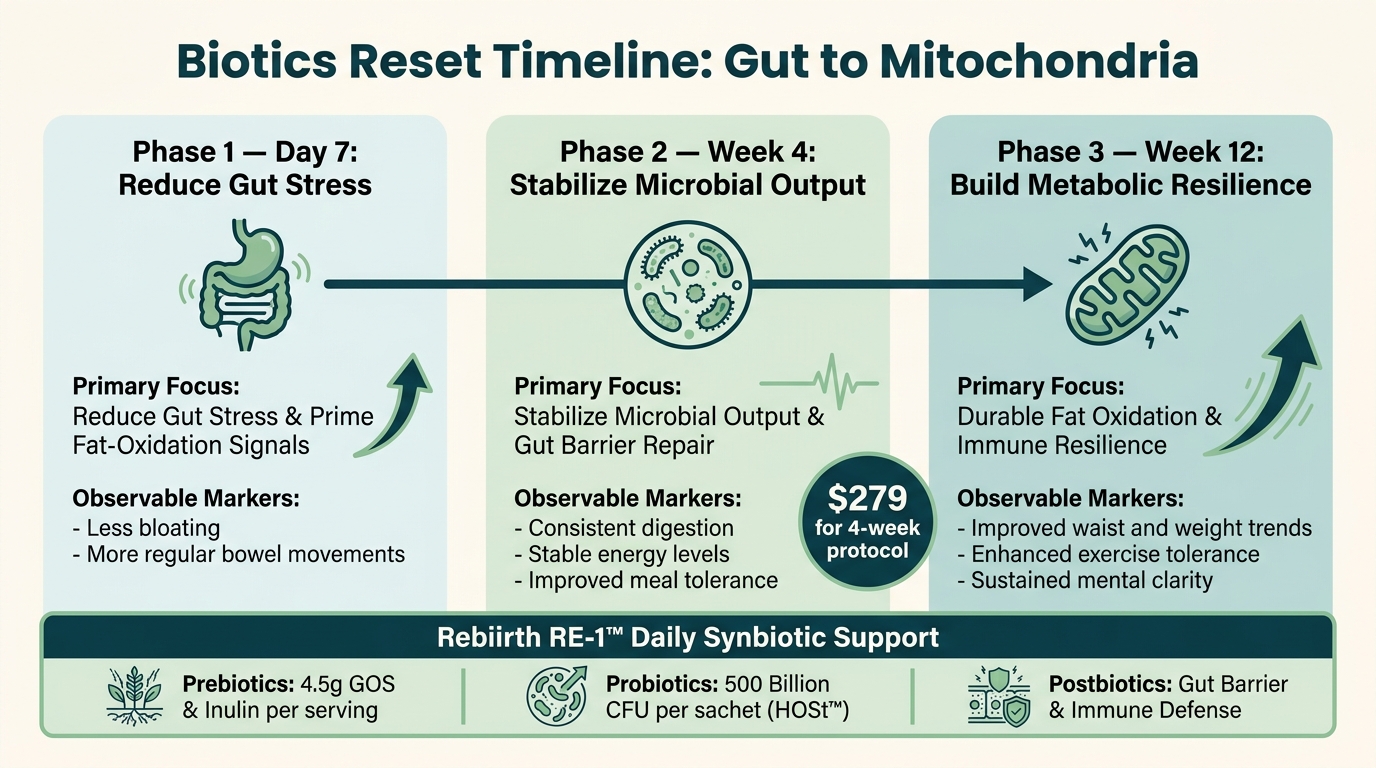
Biotics & Fat Metabolism: 7-Day, 4-Week & 12-Week Reset Timeline
Biotic support works in phases. These gut signals don’t change overnight, so it helps to think in stages instead of expecting everything to click at once.
7-day reset: reduce gut stress and prime fat-oxidation signals
The first seven days are about taking pressure off digestion. The short-term goal is to calm gut stress, improve regularity, and start priming fat-oxidation signals through early SCFA production and gut barrier support, and lower immune stress.
Rebiirth RE-1™ fits this phase well. It’s a 3-in-1 synbiotic with 500 billion CFU per sachet, plus prebiotics, HOSt™ probiotics, and postbiotics [1]. Early changes often show up in simple ways: less bloating and more regular bowel movements [1].
Once gut stress starts to ease, the next step is getting microbial output onto steadier ground.
4-week reset: stabilize microbial output and support mitochondrial adaptation
By week 2, the focus shifts from repair to stability. The goal here is to help the microbiome stay balanced and handle the usual swings from diet and stress. That’s when more steady SCFA production and early gains in metabolic flexibility can start to show up [1].
It helps to track a few plain, useful markers:
- Body weight
- Waist size
- Energy
- Meal tolerance
- Exercise tolerance
These are everyday signs of how well your body is handling fuel. A full 4-week protocol with Rebiirth RE-1™ costs $279 [1].
That steady base helps set up the longer 12-week adaptation phase.
12-week reset: build lasting microbiome and metabolic resilience
By 12 weeks, microbiome shifts can help support steadier mitochondrial fat use. Over time, the gut ecosystem can become less reactive to day-to-day disruptions, while immune balance becomes more steady [1].
Here’s the checkpoint view:
| Checkpoint | Primary Focus | Observable Markers |
|---|---|---|
| Day 7 | Reduce gut stress; prime fat-oxidation signals | Less bloating, more regular bowel movements [1] |
| Week 4 | Stabilize microbial output; gut barrier repair | Consistent digestion, stable energy, improved meal tolerance [1] |
| Week 12 | Durable fat oxidation; immune resilience | Improved waist and weight trends, enhanced exercise tolerance, sustained mental clarity [1] |
Conclusion: the practical role of biotics in supporting mitochondrial fat metabolism
Biotics support mitochondrial fat metabolism by helping shape the gut environment that influences how the body uses fuel. Prebiotics, probiotics, and postbiotics each play a part through metabolite production, barrier repair, and immune balance [2].
This doesn't happen overnight. These signals shift little by little, which is why timing matters. The effects build over time, so the 7-day, 4-week, and 12-week plans line up with the pace of gut and metabolic adaptation [1][2].
That also makes a structured synbiotic approach simpler to stick with. Rebiirth RE-1™ is a 3-in-1 synbiotic that combines prebiotics, HOSt™ probiotics, and postbiotics in daily sachets with 500 billion CFU per serving [1][2].
Start with gut repair, then keep microbial output and immune balance steady long enough for metabolic benefits to build.
FAQs
How do gut microbes affect fat burning?
Gut microbes shape fat metabolism in a few direct ways.
For starters, they help transform bile acids. That matters because bile acids play a big part in how well your body absorbs fat. Gut microbes also produce enzymes that help break down dietary triglycerides into fatty acids your body can absorb.
They also ferment fiber into short-chain fatty acids (SCFAs). These compounds help regulate appetite, support insulin sensitivity, and affect proteins such as Fiaf that play a role in fat storage.
What’s the difference between prebiotics, probiotics, and postbiotics?
- Prebiotics are non-digestible fibers that feed helpful gut bacteria.
- Probiotics are live microorganisms that help bring the gut back into balance.
- Postbiotics are helpful compounds, such as butyrate, made during fermentation.
Together, they help support gut barrier integrity, immune function, and metabolic health. Rebiirth RE-1 brings all three together in one clinically backed 3-in-1 eubiotic sachet.
How long does it take to notice results?
Some results can show up fast. In fact, 94% of users reported less bloating and abdominal pain after 7 days of using Rebiirth RE-1.
Other changes - like better digestion, more steady energy, improved mood, and support with weight management - often become more noticeable after 4 weeks.
Think of the 7-day plan as a starting reset. The 4-week and 12-week plans are built to support progress over a longer stretch.