

Here’s the short answer: the article says the immune and metabolic models have the best human data right now, while the neural and barrier models still rely more on indirect markers and inference.
If you want the whole piece in one view, it comes down to this:
- Synbiotics are live microbes plus a substrate used together for a health effect.
- Gut-brain signaling is two-way: the gut can affect the brain, and the brain can affect the gut.
- Researchers usually sort this into 4 models:
- Immune: looks at inflammation markers like CRP, IL-6, and TNF-α
- Neural: looks at HRV, brain imaging, and symptom scales
- Metabolic: looks at SCFAs, bile acids, and tryptophan-related markers
- Barrier: looks at gut permeability, zonulin, and LPS
- The human evidence is mixed because many trials are short - often 28 to 90 days, with 12 of 19 studies in one 2026 review lasting about 4 weeks
- A repeated problem is simple: marker changes do not prove brain effects, and most studies show correlation, not a tested cause-and-effect chain
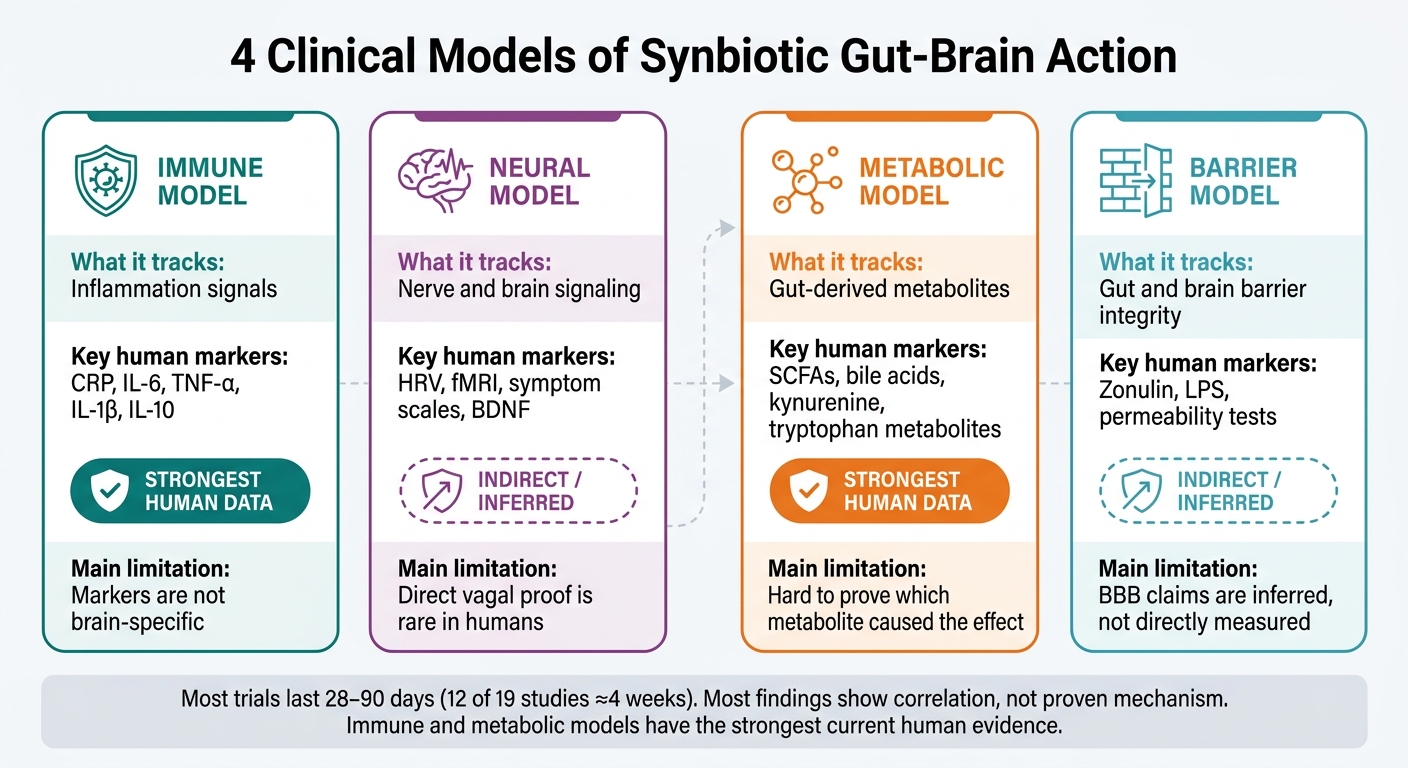
4 Synbiotic Gut-Brain Models: Evidence Strength Compared
A Dual-Action Probiotic Approach to IBS and the Gut–Brain Axis
sbb-itb-1bbfe7f
Quick comparison
| Model | What it tracks | Best-known human markers | Main issue |
|---|---|---|---|
| Immune | Inflammation signals | CRP, IL-6, TNF-α, IL-1β | These markers are not brain-specific |
| Neural | Nerve and brain signaling | HRV, fMRI, symptom scales | Direct vagal proof is rare |
| Metabolic | Gut-made compounds | SCFAs, bile acids, kynurenine, tryptophan markers | Hard to prove which metabolite caused what |
| Barrier | Gut and brain barrier leak | Zonulin, LPS, permeability tests | BBB claims are often inferred, not measured |
Bottom line: I’d read this article as a map of 4 ways synbiotics might affect the gut-brain axis, with the strongest current human support sitting in immune and metabolic data, not in direct proof of mechanism.
1. Immune Model
Mechanism
Synbiotics may change what gut microbes do, cut endotoxin exposure, and shift cytokine signaling through TLR pathways. In turn, those changes can affect the brain indirectly. Researchers usually track this through inflammatory and mucosal biomarkers.
That said, plausible biology isn't the same as proven brain benefit.
Human Biomarkers
The main readouts are CRP, hs-CRP, IL-6, TNF-α, IL-1β, IL-10, salivary IgA, endotoxin, and permeability markers.
These are proxy markers. They can hint at immune and gut-barrier changes, but they do not prove brain benefit.
Clinical Support
In adults with prediabetes or type 2 diabetes, a 2025 meta-analysis of 22 randomized controlled trials found reductions in CRP, IL-6, and TNF-α.[3] The effects were stronger in people who started with higher inflammation and in studies with longer intervention periods.
Still, pooled biomarker results remain mixed across strains, doses, and study groups. So while the signal is there, it doesn't land the same way in every trial.
Limitations
High heterogeneity makes this hard to read cleanly. Average effects can blur big differences between strains, doses, duration, and participant groups.
A 2025 systematic review of randomized trials found no significant overall effect on IL-6, CRP, or endotoxin, even though propionate and Lactobacillus abundance increased.[2] A 2023 systematic review of depression-focused trials also found no significant between-group differences in IL-1β, IL-6, IL-10, or TNF-α after probiotic administration.[4]
There's also a basic problem here: marker changes do not equal brain improvement. CRP and cytokines can shift for lots of reasons, including infection, obesity, exercise, and medication use. That matters because immune signaling often overlaps with neural pathways. So the next step is to look at the neural side more directly.
2. Neural Model
While the immune model tracks inflammatory proxies, the neural model looks at something faster: signaling that moves through the enteric nervous system, the vagus nerve, and spinal sensory pathways.
Mechanism
The neural model suggests that synbiotics can affect the brain through the ENS, vagal afferents, and spinal sensory routes. In this view, microbial activity helps shape enteroendocrine and sensory signaling, which then feeds into brain circuits tied to emotion, attention, cognition, and interoception.[5][14] What makes this model stand out is its focus on direct functional readouts, such as autonomic measures, neuroimaging, and validated symptom scales. Those tools aim to track signaling itself, not just inflammation.
Animal work adds some support here. In several studies, probiotic effects on behavior and neurochemistry disappeared after vagotomy.[14][16] That matters because it points to the vagus nerve as part of the route, at least in some cases. Human studies have also reported changes in vagal indices after multispecies probiotic use in people with depression and in healthy controls.[6][10]
Researchers have proposed a set of candidate neural mediators, including GABA, serotonin, dopamine, acetylcholine, tryptophan metabolites, and SCFAs and other neural mediators.[6][11][12] But there’s a catch: seeing these compounds in the periphery does not prove they are driving central nervous system effects. Blood markers can hint at a link, but they don’t settle the case.
Human Biomarkers
Researchers usually group neural-model biomarkers into four main buckets:
| Biomarker Category | Examples | Key Limitation |
|---|---|---|
| Vagal & autonomic measures | Heart-rate variability, gastric electrical activity, vagal tone | Indirect and not gut-specific |
| Neuroimaging | fMRI resting-state connectivity, task-based brain activity | Indirect CNS readout |
| Neurochemical & neurotrophic | Tryptophan-pathway metabolites, SCFAs, BDNF, serotonin metabolites, GABA-related measures | Peripheral markers only |
| Clinical neural outcomes | Anxiety scores, depressive symptoms, sleep quality, cognitive reactivity, stress reactivity, gastrointestinal sensations | Placebo- and reporting-sensitive |
Each category gives part of the picture. None gives the whole thing on its own.
Clinical Support
One randomized human neuroimaging study followed 36 healthy women who consumed a fermented milk product containing Bifidobacterium lactis I-2494, yogurt starters including Streptococcus thermophilus and Lactobacillus bulgaricus, and Lactococcus lactis subsp. lactis for 4 weeks. Functional MRI showed reduced activity in a network involved in emotion and interoception during negative emotional stimuli, along with altered resting-state connectivity involving the midbrain.[13][14]
What’s striking is that mood scores changed little, yet brain activity shifted. That makes the neural signal here more about function than proof of cause. In plain terms, the study supports the neural model, but it does not prove vagal causation.[14][17]
A newer systematic review reached a similar middle-ground conclusion. It found that oral probiotic interventions may alter resting-state brain activity or functional connectivity, reduce activation in some brain regions during negative-emotion tasks, and in some cases improve sleep quality.[5][15]
For synbiotics in particular, a 2025 randomized controlled trial in people with Parkinson's disease reported that a synbiotic containing Lactobacillus acidophilus and inulin, used alongside levodopa for 3 months, led to higher serum BDNF and lower TNF-α than controls.[8] BDNF is a neurotrophic marker, not a direct readout of vagal activity or central neurotransmission. So this points to possible neurotrophic effects, not confirmed activation of a neural signaling route. The trial also reported motor and nonmotor symptom improvement, but clinical gains alone don’t prove mechanism.[8]
That’s the recurring theme in this area: the findings are useful, but they don’t isolate one path cleanly. Several of these signals overlap with metabolic pathways.
Limitations
Human evidence is still limited and uneven. Studies vary by strain, dose, imaging task, analytic method, and brain region of interest, which makes side-by-side comparison tough. One review found no consistent link between microbiota shifts and brain connectivity.[7] On top of that, most synbiotic trials do not directly measure vagal signaling.
There’s also a boundary problem. SCFAs and tryptophan metabolites can act through both neural and metabolic routes at the same time. So calling an effect “neural” means you need actual neural or neurobehavioral outcomes, not just peripheral metabolite data.[9][12]
The strongest studies pull several streams together at once:
- microbiome data
- metabolite profiles
- autonomic measures
- neuroimaging
- validated clinical endpoints[9]
Because these metabolites also shape immune and metabolic pathways, the next model turns to that overlap.
3. Metabolic Model
Mechanism
The metabolic model shifts the focus. Instead of asking how synbiotics affect nerves, it asks what they change in the gut metabolome and what those compounds go on to do.
Here’s the basic idea: prebiotics feed fermentation, while probiotic strains add to or support metabolic activity. Together, they can reshape the gut-derived metabolome through four main routes: SCFA signaling, tryptophan-to-indole metabolism, bile-acid conversion, and energy regulation.[21][22][23]
Among SCFAs, butyrate gets the most attention. It has been linked to insulin sensitivity, barrier support, lower neuroinflammation, and possible effects on cognition.[26]
Human Biomarkers
Researchers usually track a mix of stool, blood, urine, and metabolic markers, including:
- Fecal and plasma SCFAs
- Urinary indoles
- Bile acids
- Tryptophan and kynurenine metabolites
- Glucose, insulin, HbA1c, HOMA-IR, and lipids
- GLP-1, PYY, and CRP[19][21]
Clinical Support
A 2024 review reported that a synbiotic made up of 15 g of prebiotics plus a four-strain probiotic blend - Lactobacillus acidophilus T16, Bifidobacterium bifidum BIA-6, Bifidobacterium lactis BIA-7, and Bifidobacterium longum BIA-8 - reduced depression and anxiety and increased BDNF.[24]
Separate metabolomics studies in mood disorders also show intervention-specific shifts. The catch? Most of those studies are small or uncontrolled.[25]
Zoom out a bit, and the picture gets more interesting. A meta-analysis of 19 randomized controlled trials with 1,405 participants found meaningful improvement in standardized depression and anxiety measures after synbiotic supplementation.[25] That supports the idea of a possible clinical effect. But it does not prove that a given metabolite change caused the mental health benefit.
Limitations
This is the big sticking point: causality. Most studies don’t follow the full chain from synbiotic intake to metabolite exposure to neural change to symptom improvement.[27]
And the field is messy in a very human, real-life way. Formulations differ. Doses differ. Diet differs. Baseline microbiomes differ. On top of that, higher or lower metabolite levels may reflect diet, medication, transit time, or host metabolism instead of the synbiotic itself.[18][20][23]
That’s why marker type matters. Fecal markers can show local gut change. Plasma markers can show systemic exposure. Symptom scores can show clinical effect. But linking those pieces takes integrated multi-omics designs that track them together.[25][20]
Because metabolites can also affect permeability, the barrier model asks whether gut integrity is the more direct target.
4. Barrier Model
Mechanism
Some metabolites can tighten the barrier. Others can weaken it. That leads to a simple question: can synbiotics help restore barrier integrity?
The barrier model looks at whether synbiotics vs. probiotics differ in how they strengthen both the intestinal barrier and the blood–brain barrier (BBB). When either one gets too permeable, LPS can move from the gut lumen into circulation. That can add to systemic inflammatory signaling. Prebiotics feed helpful microbes, probiotics may support mucus and tight-junction proteins, and SCFA production, especially butyrate, may help preserve occludin and claudin-5 in the gut and BBB. In plain terms, that may help limit LPS entry into circulation.[29][31][33]
Animal work gives this idea some support. Germ-free animals show greater BBB permeability than conventionally colonized controls. When researchers introduced SCFA-producing bacteria or sodium butyrate, that permeability fell.[22] That's strong mechanistic evidence. But there's a catch: it's animal evidence. Human trials almost never measure BBB function directly, so most of the clinical case here is indirect.
Human Biomarkers
Human studies usually rely on a small set of proxy markers. The most common are serum or fecal zonulin, circulating LPS or endotoxin activity, and CRP and IL-6 as downstream signs of barrier leak, not as primary immune proof. Researchers also follow SCFA-producing taxa and stool SCFAs for added context.[28][30][32]
Direct BBB measurement is much harder. It usually calls for advanced neuroimaging or cerebrospinal fluid sampling, and neither is standard in most synbiotic trials.[30][9] So zonulin and LPS mainly reflect the gut side of the story. Claims about the BBB still rest on inference.
Clinical Support
The human data don't point cleanly in one direction. One meta-analysis of 13 trials found lower zonulin after pro- and synbiotic use, with a standardized mean difference of −0.49 and I² = 74.9%.[32] But a 2025 systematic review found no significant overall effect on zonulin across four trials.[2]
LPS data are just as uneven. A meta-analysis of 24 trials reported a significant reduction, with a standardized mean difference of −0.54 and I² = 94.4%.[32] Still, the certainty was very low, and a separate review found no consistent change.[2]
Limitations
This model has four main limits.
- Zonulin is indirect, and assay methods differ across labs.[34][35]
- LPS testing is technically sensitive, which helps explain the wide variation across studies.[32]
- Most human studies only measure gut-side markers, so the BBB step remains mostly inferential.[30][9]
- Trial designs vary a lot in strains, doses, duration, and participant health status, which makes clean comparisons hard.[2]
That leaves barrier effects in an odd spot. They matter, but they're still tough to pull apart from immune and metabolic pathways.
Strengths and Weaknesses Across the Four Models
All four models map onto real gut-brain pathways. The main difference is simpler than it may sound: some are much easier to test in humans than others. So this comparison isn't just about mechanism. It's also about how strong the human evidence can be.
Immune and metabolic models are the easiest to study in people because researchers can measure blood, stool, and urine markers before and after treatment. Neural and barrier models are tougher. They need direct pathway measures that many trials just don't collect. In practice, immune and metabolic work often uses CRP, IL-6, TNF-α, SCFAs, tryptophan metabolites, and bile acid derivatives. That makes these models a better fit for dose-response and mediation analyses. By contrast, HRV on its own doesn't prove vagal mediation, and claims about the BBB usually depend on measures that most trials don't include.[37][38][41][42]
Put side by side, the pattern becomes clear. Some models come with cleaner human readouts, while others leave more room for guesswork.
| Model | Best human readouts | What human data supports | Common overreach | Key unresolved questions |
|---|---|---|---|---|
| Immune | CRP, IL-6, TNF-α, cytokine panels, immune-cell profiles | Changes in inflammatory markers and immune-cell profiles that coincide with symptom or cognitive changes[40] | Treating a nonspecific cytokine shift as proof the gut caused a brain effect | Does immune change mediate clinical improvement, or only correlate with it? |
| Neural | Autonomic measures, fMRI, gut motility, brain connectivity | Changes in emotion and default-mode network activity/connectivity[44] | Treating HRV or symptom improvement alone as proof of vagal mediation | Can human trials directly test vagal pathway involvement? |
| Metabolic | Fecal and circulating SCFAs, bile acids, kynurenine compounds, tryptophan metabolites | Metabolite shifts linked to immune tone and neurotransmitter-related signaling[36][39] | Assuming a measured metabolite was produced by the intervention, reached the brain, and caused the outcome | Do stool or blood metabolite changes reflect actual tissue exposure? |
| Barrier | Validated gut-permeability tests or direct BBB measures | Changes in validated intestinal permeability measures or direct BBB-related imaging or fluid biomarkers[42] | Equating improved intestinal permeability with improved blood-brain barrier integrity | Can trials measure both barriers simultaneously with validated methods? |
Across all four models, the same study design problems keep showing up. A 2026 systematic review of 19 human probiotic studies found intervention periods ranging from 28 to 90 days, and 12 of the 19 studies lasted about four weeks.[5] That's often not long enough to tell whether microbiome changes stick or whether any clinical effect lasts. Then you pile on differences in strains, doses, prebiotic substrates, delivery systems, participant health status, and outcome measures, and comparing studies starts to feel like comparing apples to oranges.[5][1][25][46]
Another issue is that most studies show correlation, not mediation. Very few follow the full chain from synbiotic exposure to biomarker change to symptom change.[45][43] Until trials are built with prespecified mediation analyses, repeated sampling across multiple compartments, and enough follow-up time, these models stay in a middle ground: useful, evidence-based, but still unconfirmed at the level of mechanism. That’s the gap.
Conclusion
Taken together, these four models don’t carry the same level of human support. Metabolic and immune models have the strongest human evidence. Human studies can track SCFAs, tryptophan metabolites, CRP, IL-6, and TNF-α.[48][49] By contrast, neural and barrier models make sense on paper, but human trials rarely measure autonomic or permeability endpoints in a direct way.[47][22]
That said, the most likely explanation is not that one model works alone. It’s that several systems move at the same time. The best fit is an integrated model: synbiotics may shift microbes, metabolites, barrier function, and immune signaling together, with downstream effects on autonomic signaling and behavior.
That’s also where the current gap shows up. Most studies still don’t test mechanism head-on. If researchers want clearer answers, future trials need to build mediation into the design from the start. That means predefining mediation analyses and lining up formulation, dose, cell count, duration, sampling, and endpoints before enrollment.[48][47]
Until then, the four models are best viewed as evidence-weighted, but still mechanistically incomplete. That is the current boundary of the field.
FAQs
Which gut-brain model has the strongest human evidence?
The neural model - especially the vagus nerve - has the strongest human evidence right now for gut-brain communication.
In plain English, this means signals from gut microbes may travel along this nerve to brain regions tied to emotion and arousal. That’s a big deal, because it gives researchers a direct route to study instead of just a loose theory.
Human studies back this up. They suggest this pathway can carry messages from the gut to the brain, and some probiotic interventions have been linked to lower stress, less anxiety, lower cortisol, and better mood, sleep quality, and stress-related depression.
Why don’t biomarker changes prove brain benefits?
Changes in biomarkers - like shifts in inflammatory markers or neurotransmitter levels - don’t, on their own, prove that the brain is getting a clear benefit. That’s a big sticking point in this research. Many studies are small, and a lot of them lean on subjective reports instead of objective tools, which makes it tough to pin down direct effects on brain function.
There’s another catch: results often depend on the specific strain used, and study timelines can vary a lot. So even when gut-related changes show up, it’s not always easy to link them to clear gains in mental health or cognitive performance. What’s needed are larger studies with longer follow-up periods and better measurement methods.
How long do synbiotic gut-brain studies usually last?
Study length can vary a lot. In many protocols, it ranges from 7 days to 3 months, and some studies follow participants for as long as 24 weeks.
Results can show up fairly soon. In some cases, bacterial shifts and symptom relief appear within 7 to 30 days. But shorter trials only show the early picture. Longer studies help check whether those gains stick over time.
There’s also a practical point here: effects may fade when support stops. That’s why consistent, long-term intake is often recommended.