

Long-term stress can shift your gut bacteria for weeks, months, or longer. From what I see in the article, the main pattern is simple: higher cortisol over time is linked with lower bacterial diversity, fewer helpful bacteria like Lactobacillus and Bifidobacterium, less butyrate production, and a leakier gut barrier.
Here’s the short version:
- Animal studies show cause more clearly: in as little as 10 to 13 days, repeated stress hormone exposure changed gut bacteria and gut barrier function.
- Human studies point the same way: long-term stress has been linked with lower diversity, shifts toward more inflammatory bacteria, and changes that may last 6 months or more in some groups.
- The gut barrier may weaken too: one rat study found a 3-fold increase in colonic permeability after 10 days of corticosterone exposure.
- Timing matters: stress in pregnancy or early life may leave longer-lasting effects on the microbiome and stress response.
- There are still gaps: most human research shows links, not proof of direct cause.
If you want the main takeaway in one line, it’s this: when cortisol stays high for too long, the gut ecosystem may shift in ways that affect digestion, immune signaling, and recovery after stress ends.
This article then walks through the animal data, the human data, and what those gut changes may mean for the barrier, inflammation, and day-to-day gut symptoms.
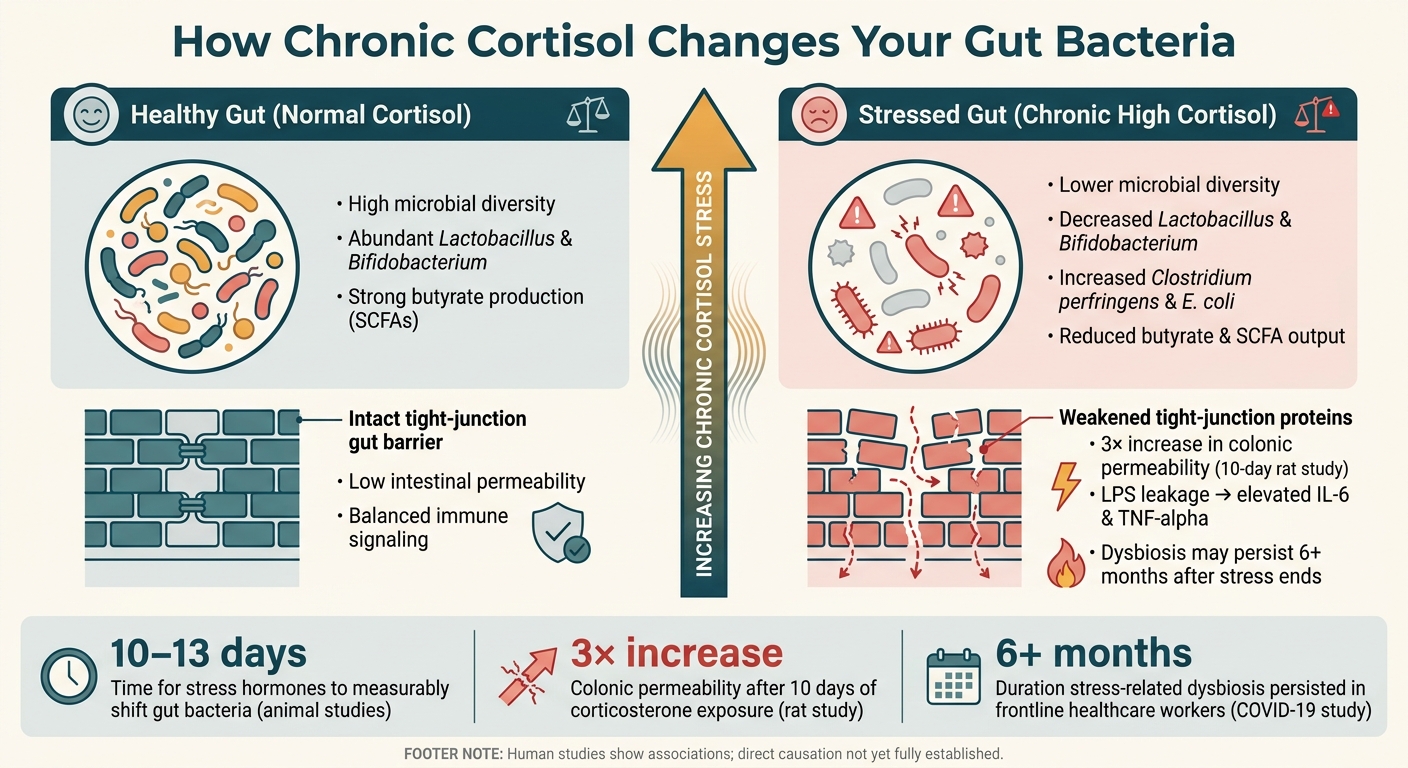
How Chronic Cortisol Changes Your Gut Bacteria
The Gut Adrenal Connection
What Animal Studies Show About Chronic Stress, Cortisol, and Gut Bacteria
Animal studies let researchers test cause and effect in a way human studies usually can't. That makes it easier to watch how the gut changes over time and to connect those changes to stress hormones more directly.
Findings from Chronic Corticosterone and Dexamethasone Models
Chronic corticosterone exposure tends to reduce gut microbial diversity. In plain terms, the gut community becomes less varied. At the same time, helpful bacteria like Lactobacillus and Bifidobacterium drop in relative abundance, while opportunistic and inflammatory species grow. The core pattern is pretty clear: fewer helpful anaerobes, more inflammatory species.
A 2020 study published in Microorganisms found exactly that in chickens. Researchers added corticosterone (CORT) to drinking water at 10 mg/L and 30 mg/L. After 12 days, sequencing showed lower diversity and more Clostridium perfringens in the small intestine [9]. Synthetic glucocorticoids such as dexamethasone lead to similar shifts, including drops in helpful anaerobes and gains in facultative species [3].
As butyrate-producing anaerobes fall, short-chain fatty acid (SCFA) output also falls, especially butyrate. That matters because butyrate helps fuel colonocytes and supports the intestinal barrier [3].
| Bacterial Group | Change Under Chronic CORT | Why It Matters |
|---|---|---|
| Lactobacillus | Decrease | Reduced helpful populations [1][3] |
| Bifidobacterium | Decrease | Reduced helpful populations [1][3] |
| Clostridium perfringens | Increase | Higher risk of necrotic enteritis and inflammation [9] |
| E. coli (facultative anaerobes) | Increase | Favored when oxygen gradients collapse [3] |
| Clostridia (butyrate producers) | Decrease | Reduced SCFA and butyrate production [3] |
Put together, these shifts suggest weaker colonization resistance and lower SCFA output.
Stress Models Linked to Barrier Damage and Inflammation
The story doesn't stop with which microbes go up or down. CORT can also weaken the gut barrier itself. In a January 2013 study from the University of Michigan, male rats received 10 straight days of subcutaneous CORT injections. Researchers found a threefold increase in colonic permeability, along with a colon-specific drop in tight-junction proteins and glucocorticoid receptors [10]. The effect was region-specific: the colon changed more than the jejunum [10].
"Our findings indicate that CPS [chronic psychological stress] was associated with region-specific decrease in epithelial tight junction protein levels in the colon, increased colon epithelial permeability to low molecular weight macromolecules which were largely reproduced by CORT treatment." - G. Zheng et al., Department of Internal Medicine, University of Michigan [10]
When the glucocorticoid receptor antagonist RU-486 was administered, these effects were also seen with CORT treatment, which points to a receptor-mediated pathway [10]. In other words, this doesn't look random. It looks tied to how glucocorticoid signaling works in the gut.
Once that barrier starts to break down, the problem can snowball. Bacterial fragments such as lipopolysaccharide (LPS) can move into the bloodstream [3], which can activate the HPA axis and drive more cortisol release [11][8]. So a shift in the microbiota isn't just a lab detail. It can feed into digestion problems and immune signaling in a direct way.
Species and Early-Life Effects on the Microbiota
Timing matters, and so does the animal model. Early-life stress models, including maternal deprivation, show that stress during key developmental windows can leave lasting effects on colonic barrier function and mucosal immunity into adulthood [10][11]. These changes line up with HPA-axis alterations and long-term microbiota shifts, especially when stress happens again and again [5][10][11].
Species differences matter too. Chickens given CORT show more Clostridium perfringens, while rat models show colon-specific permeability changes rather than jejunal changes [9][10]. That's an important distinction when trying to make sense of human data. Different models show different parts of the same stress-gut picture.
These shifts set up the barrier and immune effects covered next.
What Human Studies Suggest About Cortisol and Lasting Microbiota Shifts
Human research points in the same direction, but there’s a catch: most of it shows associations, not direct cause and effect. Higher perceived stress has been linked with lower alpha diversity, and major life stressors have been tied to changes in beta diversity. The clearest signals tend to come from stress markers tracked over time, not one-time measurements.
Across studies, chronic stress and higher cortisol levels are tied to lower levels of helpful anaerobes and higher levels of pro-inflammatory taxa such as Proteobacteria [1][2][3]. In one study of 136 healthy adults, higher stress exposure was also linked with a weaker ability to produce butyrate [1].
Some longitudinal data suggest these shifts can stick around even after the stressful period ends. In frontline healthcare workers followed during the COVID-19 pandemic, stress-related dysbiosis lasted for 6 months or more [3][5]. A 4-month study of medical students found that all 8 participants labeled durably resilient had high microbiome stability, compared with 62% of non-resilient participants [13]. That’s a small study, sure, but the pattern is hard to ignore. Stress during development may leave even longer-lasting changes.
Prenatal and Early-Life Stress Findings
Stress during pregnancy has been linked with differences in the infant microbiota, including shifts in Proteobacteria, Actinobacteria, Lachnospiraceae, Bacteroidaceae, and Prevotellaceae [6][12]. Early-life stress may also leave lasting marks on gut-brain signaling and influence how the HPA axis develops over time [2][12]. Researchers have also pointed to Bifidobacterium infantis as a species that may help shape the infant stress response during development [2].
Study Design Limits in Human Microbiome Research
This is where things get messy. Most human microbiome studies are cross-sectional, so they can’t tell us whether stress drove the microbiota change or whether the microbiome affected a person’s stress vulnerability [1]. Researchers usually depend on self-reported stress scales, salivary cortisol profiles, and observational data [3][2].
A few limits show up again and again:
- Small sample sizes can weaken confidence in the findings. For example, the medical student resilience study had only 8 durably resilient subjects [13].
- Diet, sleep, medication use, and baseline microbiome differences can all blur the picture [3].
These shifts matter because they may affect the gut barrier and immune signaling.
sbb-itb-1bbfe7f
How These Microbiota Changes May Affect Digestion and Immune Health
Gut Barrier, Mucus, and Intestinal Permeability
These microbiota shifts matter because they change how the gut barrier works, not just which bacteria are present. When butyrate-producing anaerobes drop, colonocytes lose a key fuel source, and the barrier gets less support [3][12].
Stress-related dysbiosis can also thin the mucus layer by lowering goblet cell function and mucin production [3][7]. On top of that, corticotropin-releasing hormone (CRH) can switch on mast cells. Those mast cells then release mediators that disrupt tight junctions and increase intestinal permeability [3][4][14][15].
Once the barrier starts to weaken, more immune-triggering bacterial products can get through. Chronic stress may also lower stomach acid and digestive enzyme production, which can add to bloating and gas [14].
Inflammation adds another layer to the problem. It can change the colon’s conditions in a way that favors less helpful microbes. For example, chronic inflammation can increase oxygen levels in the colon, which harms beneficial anaerobes and gives E. coli and other facultative bacteria more room to grow [3].
Immune Signaling and Inflammation
When the barrier becomes more permeable, bacterial fragments such as lipopolysaccharide (LPS) can move into the bloodstream. That can trigger inflammatory signals such as IL-6 and TNF-alpha and keep a rough cycle going: inflammation drives more cortisol release, and that added stress puts more strain on the gut environment [3][12][17].
At the same time, a shift toward Proteobacteria and away from Lactobacillus and Bifidobacterium means less barrier support and lower short-chain fatty acid production [3][16][17]. Mast cell activation may also play a role in food sensitivities and bloating [16][4].
What the Research Shows, Where the Gaps Are, and How Microbiome Support Fits In
Key Takeaways from Current Research
When you put the studies side by side, a clear pattern starts to show up: long-term cortisol exposure changes the microbiota, weakens barrier support, and slows recovery. The clearest signal is this one: chronic cortisol exposure is linked to lower microbial diversity and lower levels of bacteria often seen as helpful, especially Lactobacillus and Bifidobacterium [2][16][7].
Animal research gives a better sense of how this may happen. Cortisol can flatten the gut’s low-oxygen setting, which can wipe out strict anaerobes and give facultative anaerobes like E. coli an edge. It can also switch on virulence programs in some bacteria [3]. That helps explain why barrier function may weaken and why inflammatory risk may go up.
Human research is less clear-cut. It shows that these microbial shifts occur, but it still doesn’t show with certainty whether cortisol is causing the shifts or just moving alongside them.
Gaps in Current Data and Future Research Needs
There are still some big holes in the data. Human studies are mostly correlational, so it’s hard to rule out diet, genetics, and day-to-day habits as the main drivers. Salivary cortisol helps, but it only gives part of the picture.
What’s missing? Research needs:
- Longer-term longitudinal studies
- Standardized microbiome testing methods
- Better tools to tell short-term microbial swings from stable microbiota changes
Without that, it’s tough to separate a passing shift from a lasting change.
Why Microbiome Restoration Is Being Discussed
This is why microbiome support is often framed around restoring the conditions that help helpful bacteria stick around. Recovery depends on both barrier integrity and the microbial setting, so restoration plans tend to look at both sides of the equation.
Rebirth RE-1 is a clinically-backed 3-in-1 eubiotic synbiotic designed to support microbiome balance and immune health as part of that broader approach.
FAQs
Can stress-related gut changes be reversed?
Yes. Stress-related gut changes can be reversed, but you usually have to work on both sides of the problem: the stress response and the gut itself.
That means helping rebuild the mucin layer, bringing back helpful bacteria like Lactobacillus, and supporting short-chain fatty acid production so the gut barrier can seal up better. On the stress side, steady circadian anchors matter a lot. Regular eating windows and morning light exposure may help bring cortisol patterns back into a healthier rhythm.
In most cases, measurable improvements show up in about 14 to 60 days.
How do I know if cortisol may be affecting my gut?
Look for a mix of gut-related and whole-body signs. Long-term stress can show up as bloating, food sensitivities, or irregular bowel movements. It can also come with brain fog, mood shifts, joint aches, or skin flare-ups.
Sleep trouble matters too. Fatigue, waking in the middle of the night, or not being able to fall back asleep may point to cortisol rhythms that are off.
If these symptoms stick around or feel severe, talk with a healthcare professional.
Why do animal and human findings differ?
The main difference is control.
In human studies, it’s much harder to keep all the moving parts in check. People differ in baseline microbiome diversity, diet, sleep, and genetics. And each of those factors can shape the cortisol-microbiome relationship.
Animal studies are different. Researchers can isolate specific mechanisms and test cause and effect in a controlled setting.
Human long-term data is still early, and real-time stress tracking isn’t as precise as it is in lab experiments.