

Chronic stress can upset your gut in a very direct way. If stress stays high for weeks or months, it can change gut movement, weaken the gut lining, lower microbe diversity, and lead to symptoms like bloating, gas, constipation, diarrhea, and stomach pain.
Here’s the short version:
- Stress hormones stay high, especially cortisol and other endocrine pathways
- Digestion slows or gets erratic
- The gut barrier gets weaker
- Bacteria and bacterial byproducts can slip through
- Inflammation goes up
- Helpful microbes drop, including Lactobacillus and Bifidobacterium
- Gut symptoms get harder to ignore
In plain terms: when your brain stays in stress mode, your gut often pays the price.
A few habits can help break that loop:
- Sleep 7–9 hours on a steady schedule
- Walk 30–45 minutes, 5 days a week
- Practice slow belly breathing
- Eat more fiber-rich plant foods
- Add prebiotic and fermented foods
- Get medical care if symptoms keep getting worse
One key point: stress-related gut issues are not “just in your head.” They involve changes in the gut lining, immune activity, and the microbiome itself.
If I had to sum up the article in one line, it would be this: long-term stress can push the gut out of balance, but stress control and gut-supportive food can help move it back.
How Stress Affects Your Gut
Understanding how gut dysbiosis affects your health is the first step in managing the physical toll of psychological stress.
sbb-itb-1bbfe7f
How stress disrupts the gut-brain axis
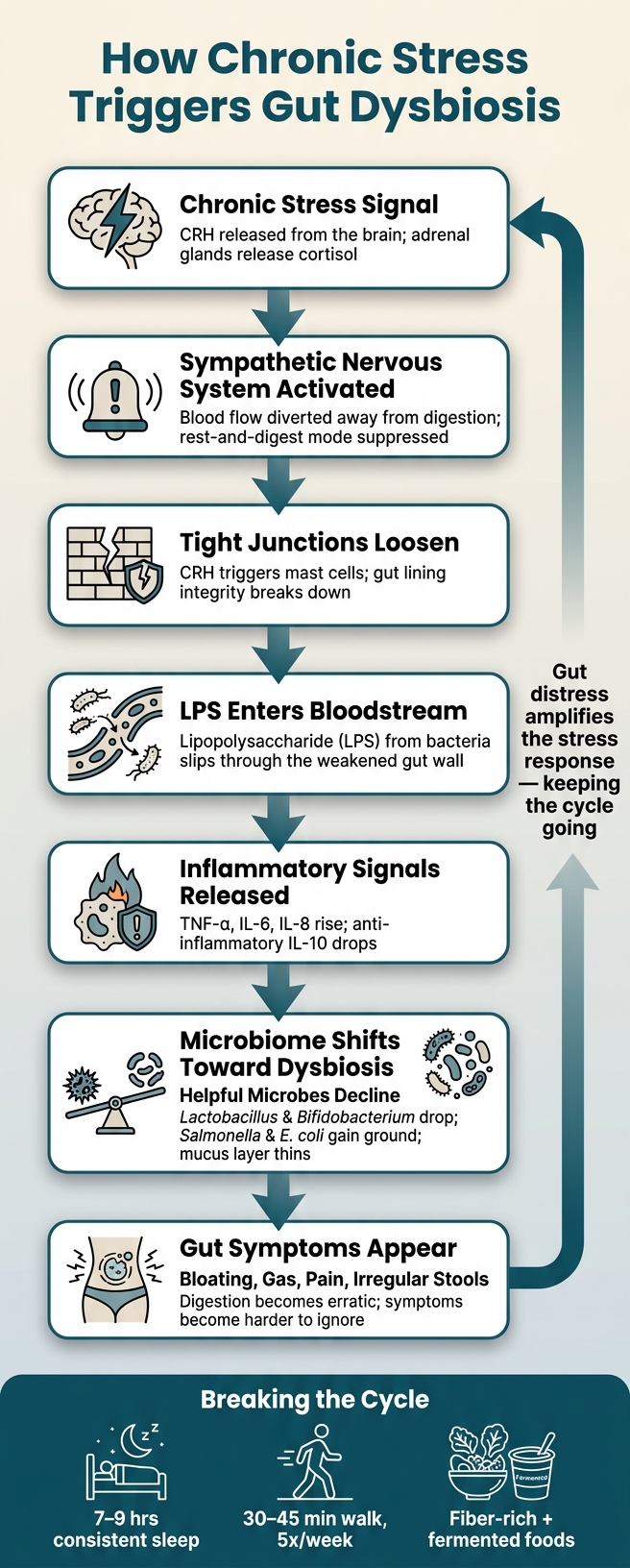
How Chronic Stress Causes Gut Dysbiosis: The Vicious Cycle
Chronic stress keeps the body stuck in stress mode. And when that alarm system stays on, digestion starts to take the hit. Bit by bit, stress changes how the gut moves, how it breaks down food, and how well it guards itself.
Cortisol, CRH, and fight-or-flight signaling
When stress hits, the brain releases corticotropin-releasing hormone (CRH), which then sets off cortisol release from the adrenal glands.[1][8][4] If stress keeps going, that system keeps firing too. The body stays in fight-or-flight mode instead of settling back into rest-and-digest.
Cortisol, along with sympathetic nervous system activation, pulls blood away from digestion.[9][4] That matters more than it may sound at first. Less support for digestion can slow gut function over time and shift the gut’s internal balance. As that happens, digestion slows and the barrier that protects the gut starts to weaken.
How stress weakens digestion and the gut barrier
The gut lining depends on tight junctions, which act like seals between cells and help keep bacteria and their byproducts inside the gut.[10][11] Chronic stress can loosen those seals. CRH can also trigger mast cells to release chemicals that weaken the gut barrier.[13][14][15][16]
Once that barrier starts to break down, bacterial components like lipopolysaccharide (LPS) can pass into the bloodstream and switch on immune cells.[2][10][11] That can add to low-grade systemic inflammation. Over time, the same barrier damage can also change the intestinal setting in ways that push the microbiome out of balance.[2][11][3] The result is a setup for gut-brain axis endocrine dysbiosis, digestive symptoms, and added strain on the immune system.
How chronic stress leads to dysbiosis, digestive symptoms, and immune stress
How the microbiome shifts during long-term stress
Once the gut barrier starts to weaken, the balance inside the gut can change fast. This sets the stage for gut dysbiosis.
Healthy microbes normally make organic acids like short-chain fatty acids like lactic, acetic, and butyric acid. These acids help keep gut pH lower and make life harder for harmful bacteria.[17] But stress can throw that balance off. When that happens, pH may shift, and opportunistic microbes like Salmonella and E. coli can start to gain ground.[17]
The mucus layer can also get thinner, which makes it easier for unwanted microbes to reach the gut lining.[17]
As those shifts build up, digestion tends to get less steady, and symptoms often become harder to ignore.
Digestive symptoms people may notice
These changes can show up as bloating, gas, abdominal pain, constipation, or diarrhea. Stress can make these symptoms worse even if a person’s diet stays the same.
It’s a bit like a system losing its buffer. The more irritated the gut becomes, the more obvious the day-to-day symptoms can feel.
Why the immune system gets involved
The gut is also home to a large share of the body’s immune system. So when the barrier gets leaky, the effects don’t stay limited to digestion.
When LPS crosses a weakened gut barrier, immune cells release inflammatory signals such as TNF-α, IL-6, and IL-8.[17] At the same time, anti-inflammatory IL-10 drops, which helps keep low-grade inflammation going and makes it harder for helpful microbes to bounce back.[17]
That inflammatory loop can slow recovery and keep dysbiosis in place.[17]
What helps reverse stress-related gut dysbiosis
This cycle can be reversed. When stress throws the gut off balance, recovery usually starts in two places at once: dialing down the stress signal and helping the microbiome recover. In plain English, that means three things need to work together: lower the chronic stress load, eat in a way that feeds the right microbes, and, when symptoms stick around, consider a structured microbiome reset.
Stress regulation habits that support the gut
A few steady habits can help the gut-nervous system connection settle down:
- Keep a steady 7–9-hour sleep schedule to help reset cortisol rhythms.[19][20]
- Do moderate exercise, like a 30–45 minute brisk walk five days a week, to support microbial diversity.[18][22]
- Practice slow diaphragmatic breathing to calm the nervous system and support motility.[21][23]
Cognitive-behavioral tools, such as reframing and scheduled worry time, can also lower stress load.[24]
Foods and nutrients that support microbiome balance
Food has a big say in what happens in the gut. A mix of plant fibers from vegetables, legumes, whole grains, and fruit helps feed helpful bacteria and supports short-chain fatty acid production.[28][24] Prebiotic foods like garlic, onions, oats, and green bananas can be especially helpful for feeding Bifidobacteria and other helpful strains.
A fiber-rich diet paired with fermented foods has been linked to lower perceived stress and measurable shifts in the microbiome.[25] At the same time, cutting back on ultra-processed foods can help protect microbial diversity and reduce proinflammatory bacteria.[26][27] Better food choices, along with lower stress, can also help calm the inflammatory loop that keeps dysbiosis in place.
Where a structured microbiome reset may fit in
Once the stress response starts to settle, the next step is to feed the microbes that help bring the gut back into balance. If symptoms have been hanging on, a structured microbiome reset may offer extra support alongside diet and stress changes.
Rebirth RE-1 is a clinically backed 3-in-1 synbiotic with prebiotics, probiotics, and postbiotics in one daily sachet. It provides 500 billion CFU per serving plus 4.5 g of prebiotic fiber, uses human-derived strains made to work with the gut environment, and includes the proprietary Lyosublime™ delivery system, which is designed to protect active ingredients through digestion. It comes in 7-day, 4-week, and 12-week reset formats, based on how long symptoms have been present.
Conclusion: Breaking the stress-gut cycle
Chronic stress isn't just something you feel in your head. It can keep stress signaling switched on, slow digestion, weaken the gut barrier, and push the microbiome toward dysbiosis [4][2]. That can show up as bloating, irregular stools, abdominal pain, and immune strain. And when the gut is off, it can turn up the stress response too, which is how the cycle keeps going [5][6][2].
Because this loop works in both directions, recovery usually needs help on both sides: lowering stress and supporting the gut. Regular sleep, movement, fiber-rich foods, and slower breathing can help calm stress signaling while giving the gut a better shot at recovery [7][12].
If dysbiosis keeps sticking around, a more structured reset may help. For established dysbiosis, a structured microbiome reset such as Rebirth RE-1 can fit alongside diet and stress management.
Seek medical care for unexplained weight loss, blood in stool, persistent vomiting, fever, severe abdominal pain, or symptoms that keep getting worse.
Breaking the cycle starts with calmer stress signaling, gut-supportive food, and getting care at the right time when symptoms don't let up.
FAQs
How does stress affect gut bacteria?
Chronic stress can throw the gut-brain axis off balance. It also sets off hormones like cortisol and norepinephrine. Over time, that shift can change the microbiome, reducing helpful bacteria like Lactobacillus and Bifidobacterium while giving harmful bacteria such as E. coli more room to grow.
When that balance starts to slip, the intestinal lining can weaken. Permeability and inflammation may go up, while short-chain fatty acid production can drop. And that can ripple through multiple parts of the body, affecting digestion, immunity, and mood.
Can stress cause bloating and diarrhea?
Yes. Chronic stress can lead to bloating, diarrhea, and stomach discomfort.
Here’s why: stress hormones like cortisol and norepinephrine can throw off the gut microbiome, weaken the intestinal lining, and alter how digestion works. When that keeps happening over time, it can contribute to gut dysbiosis, which is linked to these common symptoms.
Rebiirth RE-1 is a 3-in-1 synbiotic made to help restore microbial balance.
How long does it take the gut to recover?
Gut recovery looks a little different for everyone, but many people start to feel better sooner than they expect. Bloating and abdominal discomfort can ease in as little as 7 days.
A 4-week protocol may help steady shifts in the microbiome. If you're aiming for longer-term repair of gut microbiota diversity and support for the gut-brain connection, a 12-week regimen is often recommended. In some cases, full recovery can take up to 3 months of steady care.