

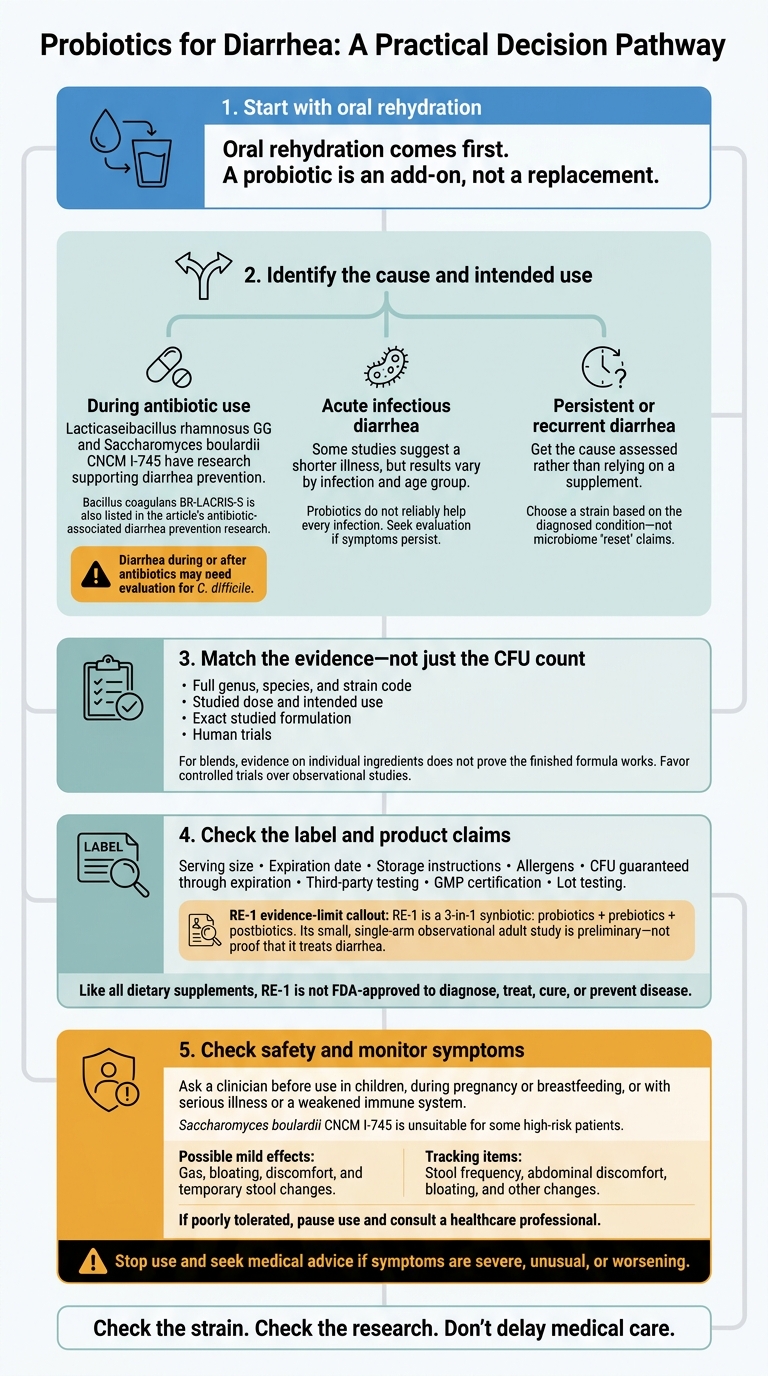
My starting point for diarrhea is oral rehydration - not a probiotic. If you’re considering one, match the exact strain, dose, and formula to the cause of your diarrhea. A high CFU count alone doesn’t tell you whether it will help.
Here’s what I’d keep in mind:
- During antibiotic use: Lacticaseibacillus rhamnosus GG and Saccharomyces boulardii CNCM I-745 have research supporting diarrhea prevention. That doesn’t prove they treat diarrhea once it starts.
- For an infection: Results vary, and probiotics don’t reliably help every infection or age group.
- For lasting or repeated diarrhea: Get the cause checked rather than relying on a supplement.
- For safety: Ask a clinician before use in children, during pregnancy or breastfeeding, or if you have a serious illness or weakened immune system.
- For RE-1: Its 3-in-1 formula combines probiotics, prebiotics, and postbiotics. A small adult study without a comparison group does not prove it treats diarrhea.
My bottom line: <u>check the strain, check the research, and don’t delay medical care.</u> Diarrhea during or after antibiotics may need evaluation for C. difficile.
Probiotics for Diarrhea: Strain, Cause, and Safety
Probiotic Strains: What the Research Shows
Check the full genus, species, and strain code to see whether a product matches the study. A label that says only “blend” doesn’t tell you which exact strains it contains. For diarrhea support, look for human trials that tested the exact strain for the intended use. These strains have the clearest diarrhea-specific human data.[1]
| Organism | Exact strain | Best-supported use | Limits |
|---|---|---|---|
| Lacticaseibacillus rhamnosus | GG | Prevention of antibiotic-associated diarrhea | Benefits vary by population; results for acute infectious diarrhea are inconsistent |
| Saccharomyces boulardii | CNCM I-745 | Prevention of antibiotic-associated diarrhea | Findings don’t apply to every yeast strain; unsuitable for some high-risk patients |
For products that combine strains, the finished formula must match the studied formula exactly. Check whether researchers tested the complete formula or just its individual ingredients. Favor controlled trials over observational studies, since controlled trials help isolate the formula’s effect.[1]
sbb-itb-1bbfe7f
Choosing Probiotics by the Cause of Diarrhea
Start with the cause, then match the strain and timing. Probiotic effects vary by strain and by what’s causing the diarrhea - even within the same probiotic category.
| Clinical purpose | Strains studied | Research findings | Limits | When to seek medical care |
|---|---|---|---|---|
| Antibiotic-associated diarrhea prevention | Bacillus coagulans BR-LACRIS-S | Starting probiotics with antibiotics may lower the risk of antibiotic-associated diarrhea.[1] | Evidence for prevention does not prove they help treat diarrhea. | Diarrhea during or after antibiotics may need evaluation for C. difficile. |
| Acute infectious diarrhea in adults and children | Specific studied strains | Some studies suggest a shorter illness. | Results vary by infection and age group. | Seek evaluation if symptoms persist. |
| Persistent or recurrent diarrhea | Condition-specific strains | Findings vary by diagnosed condition and the outcome measured. | “Reset” claims do not prove that a product helps with the diagnosed cause. | Seek assessment for lasting or repeated diarrhea. |
Antibiotic-Associated Diarrhea
If diarrhea starts during or after antibiotics, get it evaluated rather than treating it as a routine reason to take a supplement.
Acute Infectious Diarrhea in Adults and Children
Oral rehydration solution comes first. Evidence for probiotics is limited and does not show a reliable benefit for every infection. If symptoms persist, move beyond symptom support and seek evaluation for other causes.
Children should use probiotics only with clinician guidance. Findings from adult studies don’t necessarily apply to children.
Persistent or Recurrent Diarrhea
Lasting or repeated diarrhea needs assessment for infection, medication effects, inflammatory bowel disease, and other causes. Choose a strain based on the diagnosed condition - not claims about a microbiome reset.
Probiotic Safety, Labels, and Use
Once you’ve matched a strain to the cause of diarrhea, check its safety, dose, and label before buying. Like all dietary supplements, RE-1 is not FDA-approved to diagnose, treat, cure, or prevent disease. Choose the exact strain, dose, and formulation studied in humans - not just a high CFU count.[1]
Side Effects, High-Risk Groups, and Warning Signs
Mild side effects can include gas, bloating, discomfort, and temporary stool changes. RE-1’s GOS and inulin may also cause gas or bloating in sensitive people.[1] Pregnant or breastfeeding people and children should use it only under healthcare guidance. Follow a healthcare professional’s advice, and don’t exceed the recommended daily dose.[1]
Stop use and seek medical advice if symptoms feel severe or unusual, or keep getting worse.
How to Read Labels and Track Symptoms
Check the full strain name, serving size, expiration date, storage instructions, allergens, and CFU guaranteed through expiration. Look for third-party testing, GMP certification, and lot testing. Research on one ingredient does not prove that the finished formula works for diarrhea.[1]
After starting a product, track stool frequency, abdominal discomfort, bloating, and any other changes. If you don’t tolerate it well, pause use and consult a healthcare professional.
Rebirth RE-1: Features and Research Limits
For products like RE-1, the label matters as much as the strain list. RE-1 is a 3-in-1 synbiotic containing probiotics, prebiotics, and postbiotics. It comes in sachets and is marketed in 7-day, 4-week, and 12-week formats.[1]
Its product-specific evidence comes from a small, single-arm observational study in adults with general gut symptoms. That evidence is preliminary - not proof that RE-1 treats diarrhea.[1]
Conclusion: Choose by Strain, Cause, and Safety
Choose the right probiotic by matching its identified strain to the cause of diarrhea.[1]
Start with oral rehydration. A probiotic is an add-on, not a replacement.
Children need clinician guidance before use. People who are pregnant or breastfeeding should also seek medical advice before taking a probiotic.
FAQs
When should I take probiotics with antibiotics?
To help prevent antibiotic-associated diarrhea, start probiotics within 48 hours of your first antibiotic dose [1]. Space them 2 to 3 hours apart from antibiotics to help the probiotic bacteria survive [1][2].
Yeast probiotics that resist antibiotics, such as Saccharomyces boulardii, can be taken at the same time as antibiotics without losing effectiveness [3][2]. After your antibiotic course, Rebiirth RE-1 offers a high-potency, 3-in-1 synbiotic designed to restore balance to your gut microbiome [4][1][2].
How long should I try a probiotic for diarrhea?
With consistent use, you may start to feel relief within a few days or one to two weeks, followed by gradual improvement over two to four weeks [1][2][3]. If you haven’t seen the results you want after four weeks, consider trying a different product [3][2].
Rebiirth RE-1 offers 7-day, 4-week, or 12-week microbiome reset protocols designed to restore gut balance and support immune health [3][4].
Which diarrhea symptoms need urgent care?
Contact a healthcare professional if you have severe bloating, discomfort that doesn’t go away, unusual symptoms, or diarrhea that gets worse or persists despite your efforts to manage it [1, 3].
If you’re immunocompromised, pregnant, or have a severe gastrointestinal condition, talk with a healthcare provider before starting any new supplement containing live microorganisms [2].