

Your gut can change how your body handles stress. This article comes down to seven linked paths: cortisol/HPA signaling, vagus nerve activity, inflammation, gut barrier strength, microbial neurotransmitters, sleep/circadian timing, and immune cross-talk.
If I had to sum it up in plain English, it’s this: stress can disturb the gut, and an imbalanced gut can make stress hit harder. That loop may affect cortisol, cytokines like IL-6 and TNF-α, sleep quality, mood signals like GABA and serotonin, and even intestinal permeability. The gut also matters because it contains 100+ million neurons and about 70–80% of the body’s immune cells.
Here’s the short version of what the article covers:
- HPA axis: gut microbes may affect cortisol output and stress recovery
- Vagus nerve: gut signals can shift brain-body stress signaling in near real time
- Inflammation: dysbiosis can push cytokines like IL-1β, IL-6, IL-18, and TNF-α higher
- Gut barrier: lower SCFAs such as butyrate can weaken tight junction support
- Neurotransmitters: microbes help shape GABA, serotonin, dopamine, and acetylcholine signaling
- Sleep timing: gut changes can disrupt sleep, and poor sleep can feed stress back
- Immune signaling: gut microbes and immune cells help control how long stress signals stay active
Bottom line: I’d read this as a simple map of how the gut-brain axis works during stress, not as seven separate systems. Each one can push the others.
Gut-Brain Axis Explained: IBS, Anxiety, Stress & Gut Health Connection
sbb-itb-1bbfe7f
Quick Comparison
| Mechanism | What it mainly affects | Main stress link | Common result |
|---|---|---|---|
| 1. HPA axis | Cortisol signaling | Higher stress reactivity | Anxiety, low mood |
| 2. Vagus nerve | Brain-gut nerve traffic | Lower vagal tone | Mood and motility changes |
| 3. Inflammation | Cytokines | More immune activation | Low-grade inflammation |
| 4. Gut barrier | Tight junctions | More permeability | GI issues, immune triggers |
| 5. Neurotransmitters | GABA, serotonin, dopamine | Altered signaling | Mood and focus changes |
| 6. Sleep/circadian | Sleep-wake timing | Poor recovery from stress | Fatigue, worse sleep |
| 7. Immune cross-talk | Macrophages, inflammasomes | Longer stress signaling | More inflammation |
If you want the article in one sentence: it explains how gut microbes may shape stress through hormone, nerve, immune, barrier, brain-chemical, and sleep pathways that keep feeding into each other.
Why the Gut–Stress Connection Matters
This connection matters because stress and the microbiome affect each other through nervous, endocrine, and immune signaling. In plain English, the relationship runs both ways. A stressful week can change digestion, shift microbial balance, and affect the intestinal lining [1]. At the same time, an imbalanced gut microbiome can influence the HPA axis and cortisol signaling [1]. That matters because the gut is packed with neural and immune activity.
The GI tract holds over 100 million neurons and roughly 70–80% of the body's immune cells [2]. So it isn't just where food gets processed. It's a major hub for neural and immune signaling.
Chronic stress can increase intestinal permeability, disrupt microbial balance by changing motility and gut conditions, and push the body toward a more pro-inflammatory immune state. Meanwhile, gut microbes make metabolites, including SCFAs and tryptophan derivatives, that can affect mood and cortisol regulation [1]. Put those pieces together, and it becomes easier to see why stress resilience depends on more than hormones alone.
The next seven sections break down the specific pathways behind that loop, starting with cortisol and the HPA axis.
1. Cortisol Signaling and the HPA Axis
The HPA axis is the body’s main stress-response system, and gut microbes can influence how strongly it reacts. When you run into a stressor, the hypothalamus releases CRF, which signals the adrenal glands to produce cortisol. In the short term, that loop helps. Cortisol supports the body during an immediate threat, and then the system settles back down.
Problems start when that stress system stays out of balance. Chronic HPA dysregulation is linked to anxiety and depression. It can also increase intestinal and blood-brain barrier permeability, which weakens both lines of defense [1].
Gut microbes may also shape HPA activity through metabolites like SCFAs and tryptophan derivatives. These compounds may affect how strongly you react to stress and how well you recover afterward [1]. Early microbiome development also helps shape HPA maturation and stress reactivity later in life [1].
This HPA feedback loop is one path in the gut-brain connection. The next path runs through neural signaling via the vagus nerve.
2. Vagus Nerve Activity and Autonomic Signaling
If the HPA axis is the hormone-based stress loop, the vagus nerve is the fast neural one. It acts like the main two-way highway between the brain and the gut, sending sensory signals up and parasympathetic signals down [1][2]. As the main parasympathetic pathway, it connects straight to enteric circuits, smooth muscle, and mucosal tissue [2].
Long-term stress can throw this system off and lower vagal tone. And that matters. Higher vagal tone helps support the cholinergic anti-inflammatory pathway and can help suppress TNFα, IL-1β, and IL-6 [1][2].
Gut microbes play a part here too. They can shape vagal signaling through short-chain fatty acids and tryptophan metabolites [1][2]. The gut microbiota also help mature the adult enteric nervous system through serotonin networks, which then affects how the vagus nerve connects with the gut [1].
That fast neural route helps explain why signals from the gut can shift stress reactivity in real time.
3. Inflammation and Cytokine Pathways
Stress doesn’t just move through the vagus nerve. It also pushes on the immune system through cytokines. When the brain reads something as a threat, it can set off the release of pro-inflammatory cytokines such as IL-1β, IL-6, IL-18, and TNFα [1]. IL-1β, IL-6, and IL-18 are linked with depression and HPA-axis dysregulation [1].
A lot of this activity happens in the gut. Gut immune cells pick up microbial signals and then release cytokines that shape enteric neuron activity and inflammation throughout the body [2].
Gut microbes help control how intense this response becomes. When the microbiome is in balance, microbes make butyrate, which helps hold back inflammasomes and limit inflammation [1]. But with dysbiosis, SCFA levels fall, intestinal permeability goes up, and pro-inflammatory signals like IFNγ, IL-17A, and TNFα stand out more strongly [2].
Over time, chronic inflammation can push microglia into overdrive, increase oxidative stress, and feed stress reactivity through NF-κB signaling [1]. Those cytokine changes also weaken the gut barrier, which sets up the next mechanism.
4. Gut Barrier Integrity and Intestinal Permeability
Inflammatory cytokines can weaken the intestinal barrier by disrupting tight junctions. These proteins - occludin, claudins, and ZO-1 - act like the seals between cells in the gut lining. When TNF-α, IL-6, and IL-1β go up, those seals start to weaken, and that happens through specific signaling routes.
TNF-α activates NF-κB–MLCK signaling, which loosens cell junctions. IL-6 increases claudin-2, which makes the barrier leakier [6]. Put simply, as these junctions loosen, it becomes easier for microbial products to pass through the gut lining.
When that barrier is compromised, bacterial products can move into circulation and trigger immune activation. If this keeps happening over time, those bacterial products continue entering circulation and help sustain immune activation [6].
Butyrate-producing bacteria help hold this layer together by fueling colon cells and helping tight junctions work as they should. When dysbiosis lowers SCFA production, that support drops and intestinal permeability goes up. At that point, microbial signals don’t stay as contained as they should.
Once the barrier weakens, microbial signals and metabolites can move more easily into pathways that affect brain chemistry.
5. Microbial Neurotransmitter Production
Gut microbes don't just help with digestion. They also make and adjust signaling molecules like GABA, serotonin, dopamine, and acetylcholine. Those chemicals shape mood and the body's stress response [2][3].
Chronic stress can throw this system off balance. It can disrupt the microbiome, lower SCFA production, and cut neurotransmitter output that helps the gut and brain stay in sync [1]. When that signal weakens, stress can hit harder.
One example is Bifidobacterium adolescentis, which produces GABA, a neurotransmitter tied to stress regulation [3].
Dopamine shows how big this effect can be. In germ-free mice, 90% of gut dopamine is inactive. With a normal microbiota, 90% is active [2]. Clostridia species and E. coli use beta-glucuronidase (GUS) to reactivate dopamine [2]. That shift changes how gut signals move into neural and immune stress circuits.
These chemical changes also affect sleep timing and circadian recovery, which leads into the next mechanism.
6. Sleep Patterns and Circadian Crosstalk
Sleep, stress, and the gut don’t run on separate tracks. They move together through the body’s daily clock. Circadian signals travel through gut–brain neural pathways, helping coordinate gut motility and microbial activity across the day [1]. That daily rhythm plays a direct role in sleep quality and how well the body recovers from stress.
Stress can throw that timing off in more than one way. One key issue is butyrate. When stress lowers butyrate, barrier support can weaken, and microglial function can suffer too [1].
Gut microbes also shape the chemistry tied to sleep. Healthy gut microbes help regulate sleep through enteric serotonin networks, which drive rhythmic gut motility and gut–brain signaling [1]. On top of that, microbial GABA and serotonin signaling help regulate sleep quality and gut motility [3]. If microbial GABA levels fall, sleep quality may drop with them [3].
Then the loop tightens. Poor sleep can feed back into the same stress cycle by increasing HPA activity and inflammatory cytokines such as IL-1β, IL-6, and IL-18 [1]. Stress-induced activation of NLRP3 inflammasomes in the gut epithelium has also been linked to disrupted sleep patterns and depression [1].
7. Immune–Microbiota Cross-Talk
Stress doesn’t stop at nerve signaling. It spills into the immune system through the sympathetic nervous system. When that system turns on, it releases catecholamines such as norepinephrine. Those molecules bind to β2-adrenergic receptors on intestinal macrophages and change how those cells behave. In the muscularis layer, macrophages shift toward a regulatory, protective state. In the lamina propria, they remain pro-inflammatory [2]. That split helps keep the cytokine loop from the previous section in motion.
Gut microbes help shape this immune response too. SCFAs such as butyrate support immune regulation and help reduce inflammation. At the same time, some T cells release acetylcholine in response to sympathetic signals, which helps dial down inflammation through α7-nicotinic receptors on macrophages [2].
When this signaling breaks down, inflammation climbs and stress pathways keep firing. NLRP3 and NLRP6 inflammasomes activate in the gut epithelium, releasing cytokines that signal the hypothalamus to release CRF and prolong the stress response [1].
These immune signals don’t work in isolation. They feed back into the HPA, barrier, and microbial pathways described above.
How the Seven Mechanisms Work Together
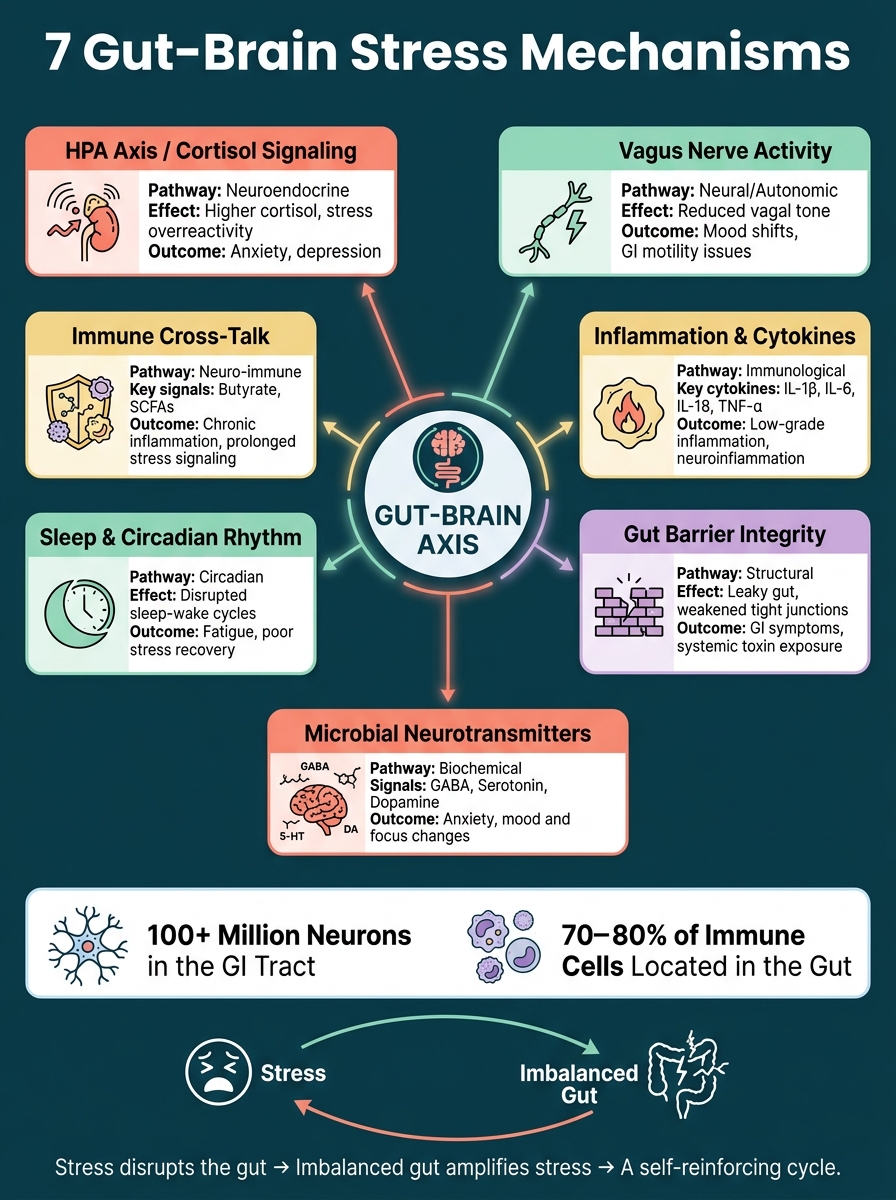
7 Gut-Brain Stress Mechanisms: How Your Microbiome Shapes Stress Response
These pathways don't act on their own. They feed into each other and can turn stress into a self-reinforcing loop.
Stress-driven cortisol can make the gut barrier and the blood-brain barrier more permeable. That gives microbial products more room to trigger cytokines, which then keep the HPA axis switched on [1]. At the same time, vagal signaling helps push back through the cholinergic anti-inflammatory pathway, and butyrate helps support barrier strength and microglial function [1][2]. But when SCFA output falls, that brake gets weaker, and cytokine-driven stress signaling can keep going.
Microbes also affect neurotransmitters like dopamine and GABA. Those chemicals shape stress reactivity and sleep, which then feed back into HPA activity and inflammatory signaling [2][3]. In plain English: each mechanism can nudge the others, making the full system feel less like seven separate parts and more like one tightly linked network.
The table below maps each mechanism to its main stress-related effect.
Comparison Table: What Each Mechanism Affects
The table below pulls the seven pathways into one place and shows how each one can shape the stress response through the gut-brain connection.
| Mechanism | Pathway Type | Main Microbial Influence | Stress-Related Effects | Common Downstream Outcomes |
|---|---|---|---|---|
| 1. Cortisol Signaling & HPA Axis | Neuroendocrine | Immune signaling | HPA overactivity; higher cortisol | Anxiety, depression, impaired stress reactivity [1] |
| 2. Vagus Nerve Activity | Neural / Autonomic | Microbial effects on autonomic signaling | Reduced vagal tone; weaker anti-inflammatory signaling | GI motility issues; mood shifts [1][2] |
| 3. Inflammation | Immunological | Dysbiosis activates inflammasomes | Elevated IL-1β, IL-6, and IL-18 | Low-grade inflammation, depression, neuroinflammation [1][3] |
| 4. Gut Barrier Integrity | Structural | SCFA support for tight junctions | Leaky gut; weaker stress resilience | GI symptoms, systemic toxin exposure [1][2] |
| 5. Microbial Neurotransmitter Production | Biochemical | Synthesis of GABA, serotonin, and dopamine | Altered neurotransmitter availability | Anxiety, mood disorders, focus and mood changes [1][3] |
| 6. Sleep Patterns | Circadian | Microbial rhythm effects | Disrupted sleep-wake cycles | Poor sleep, fatigue, slower recovery [3] |
| 7. Immune Cross-Talk | Neuro-immune | Butyrate and SCFA signaling | Microglia maturation; pro-inflammatory macrophage activation | Chronic inflammation, impaired immune stress signaling [1][2] |
This side-by-side view makes one thing clear: the microbiome does not affect stress through just one lane. It can shape hormone signaling, nerve activity, inflammation, gut barrier function, brain chemicals, sleep timing, and immune responses at the same time [1][2][3].
Gut-Focused Support Strategies for Stress Resilience
These pathways react to everyday inputs: what you eat, how well you sleep, and how much stress you're carrying. Put simply, the seven mechanisms are most affected by three daily levers: diet, sleep, and stress load.
Fiber is the easiest place to start. Fiber and fermented foods help support short-chain fatty acid production, microbial balance, and barrier integrity [4][5].
Sleep consistency matters more than many people think. Irregular sleep can disrupt circadian crosstalk between the host and the microbiome. That can throw off microbial metabolism and neurotransmitter signaling [1][3]. A regular sleep schedule helps maintain circadian signaling and stress resilience [1][3].
When solid daily habits still don't feel like enough, a more structured reset may make sense. For readers who want targeted support after chronic stress or antibiotic use, Rebirth RE-1 offers a 3-in-1 synbiotic with prebiotics, probiotics, and postbiotics designed to support microbial balance and immune function.
Conclusion
Gut microbes help shape how the body handles stress through seven linked mechanisms: endocrine, neural, immune, barrier, neurotransmitter, and circadian pathways that reinforce one another across the gut-brain axis.
FAQs
Can stress permanently change the gut microbiome?
Chronic stress can change both the makeup and day-to-day activity of the gut microbiome. It may lower microbial diversity, weaken the gut barrier, and give harmful bacteria more room to grow.
That said, these shifts aren’t always permanent. The adult gut microbiome is still changeable, which means it can be brought back into better balance over time. Products such as Rebiirth RE-1 are built to support that process by adding back helpful bacteria and easing inflammation linked to stress.
How long does it take gut changes to affect stress?
With targeted microbiome support like Rebiirth RE-1, sleep quality and day-to-day functioning may start to improve after about four weeks of steady use.
The full effect usually shows up in 8 to 12 weeks, as helpful strains settle in and support the gut-brain axis tied to the body’s stress response.
What are the first signs of a stress-related gut imbalance?
Early signs often show up as gut barrier problems and stress-linked signaling shifts.
That can look like:
- Increased intestinal permeability ("leaky gut"), which can lead to inflammation and diarrhea
- Changes in gut motility and sensitivity, such as more cramping or urgency
- Mood and sleep changes tied to dysbiosis, including trouble falling or staying asleep from elevated nighttime cortisol and disrupted neurotransmitter signaling