

Demulcent care may soothe digestive discomfort, but it does not treat gut disease. My starting rule: try one change at a time, track how you feel, and stop if symptoms worsen.
Here’s how I separate the options:
- Comfort: Marshmallow root, slippery elm, and aloe inner-leaf gel are used for soothing support. Avoid aloe latex. DGL is used for upper-digestive comfort but isn’t a mucilage-forming demulcent.
- Microbiome support: Introduce fibers such as GOS and inulin slowly; either can cause gas or bloating. Prebiotics, probiotics, postbiotics, and synbiotics serve different roles, and results depend on the preparation.
- Optional supplements: Rebirth RE-1 is one synbiotic option - not a required step, though some compare probiotics and synbiotics for specific conditions like SIBO. Ingredient studies and delivery claims do not prove that the finished blend works.
- Timing: I’d use 7 days to check tolerance, 4 weeks to review changes, and 12 weeks to build food-based habits - not to commit to longer supplement use.
Feeling better doesn’t prove the underlying problem is resolved. <u>Persistent or worsening symptoms need medical advice.</u> Check with a clinician or pharmacist about medication timing, pregnancy, breastfeeding, immune conditions, or use in children.
Demulcent Herbs and Fiber-Rich Foods
Marshmallow Root, Slippery Elm, Aloe, and DGL
These herbs can help with digestive comfort alongside care that supports gut-barrier function: (a key step in restoring gut health)
- Marshmallow root: This mucilage-rich root has long been used to soothe irritated mucous membranes.
- Slippery elm: Its inner bark forms a mucilage-rich gel when mixed with water.
- Aloe: The inner-leaf gel is used for digestive comfort. Avoid aloe latex, which can cause cramping and diarrhea.
- DGL: Deglycyrrhizinated licorice is used for upper-digestive comfort. Unlike the other herbs, it isn't a mucilage-forming demulcent.
Start with herbs for comfort, then add fiber slowly to support the microbiome.
Prebiotic Fibers and How to Prepare Them
During a 7-day trial, introduce one change at a time. Watch how your digestion responds and stay hydrated.
Ingredient Comparison: Research, Preparation, and Safety
Choose a fiber form your gut can tolerate.
| Ingredient | Support summary | Tolerance considerations |
|---|---|---|
| Galactooligosaccharide (GOS) | Prebiotic fiber that feeds helpful gut flora and is associated with immune function and microflora composition[1] | May increase gas and bloating |
| Low Molecular Weight Inulin | Prebiotic fiber that feeds helpful gut flora and is associated with mineral absorption and bone health[1] | May worsen symptoms in people sensitive to fructans |
Preparation: Start with a low amount, take it with water, and increase gradually. Once you tolerate these fibers, you can pair them with synbiotic support.
sbb-itb-1bbfe7f
Pairing Demulcent Care With Synbiotics
What Prebiotics, Probiotics, Postbiotics, and Synbiotics Mean
Probiotics are live microorganisms that provide a health benefit when taken in adequate amounts. Prebiotics are substrates that host microorganisms selectively use - not all fiber qualifies as a prebiotic. Postbiotics are preparations of inanimate microorganisms or their components that provide a health benefit. Synbiotics combine live microorganisms with a selectively used substrate.[1]
Comparing Comfort and Microbiome Support
Use demulcents for digestive comfort, then add synbiotic support for microbiome goals. These are separate goals. Don’t claim that demulcents improve probiotic survival or restore the microbiome on their own.[1]
| Support | Primary purpose | Practical role | Limitations |
|---|---|---|---|
| Demulcent | Digestive comfort | Soothing support | Relief does not establish microbiome restoration |
| Prebiotic | Support microbial activity | Selectively used substrates | Tolerance varies; gas and bloating may occur |
| Probiotic | Defined health benefit | Live microorganisms | Effects depend on the strain; benefits may be temporary |
| Postbiotic | Support specific functions | Inanimate microorganisms or components | No live cultures; benefits depend on the preparation |
Research on a single strain or preparation does not prove that a finished blend produces the same effects.[1]
Optional Use of Rebirth RE-1
For readers who want to add synbiotic support to their routine, there’s one optional product to consider.
Rebirth RE-1 is an optional synbiotic for 7-day, 4-week, and 12-week routines. Its sachets combine prebiotics, probiotics, and postbiotics and use a Lyosublime™ delivery system.[1]
Strain origin, CFU count, and delivery technology do not prove clinical results. Studies of individual ingredients aren’t proof that the finished product works.[1]
Manufacturer guidance calls for one sachet each morning, taken according to the directions. Gas or bloating may occur.[1] Follow the product directions, and ask a clinician or pharmacist about medication timing, use during pregnancy or lactation, use in children, or complex gut conditions.[1]
Demulcent Herbs With Dr. Glen Nagel
Planning a 7-Day, 4-Week, or 12-Week Routine
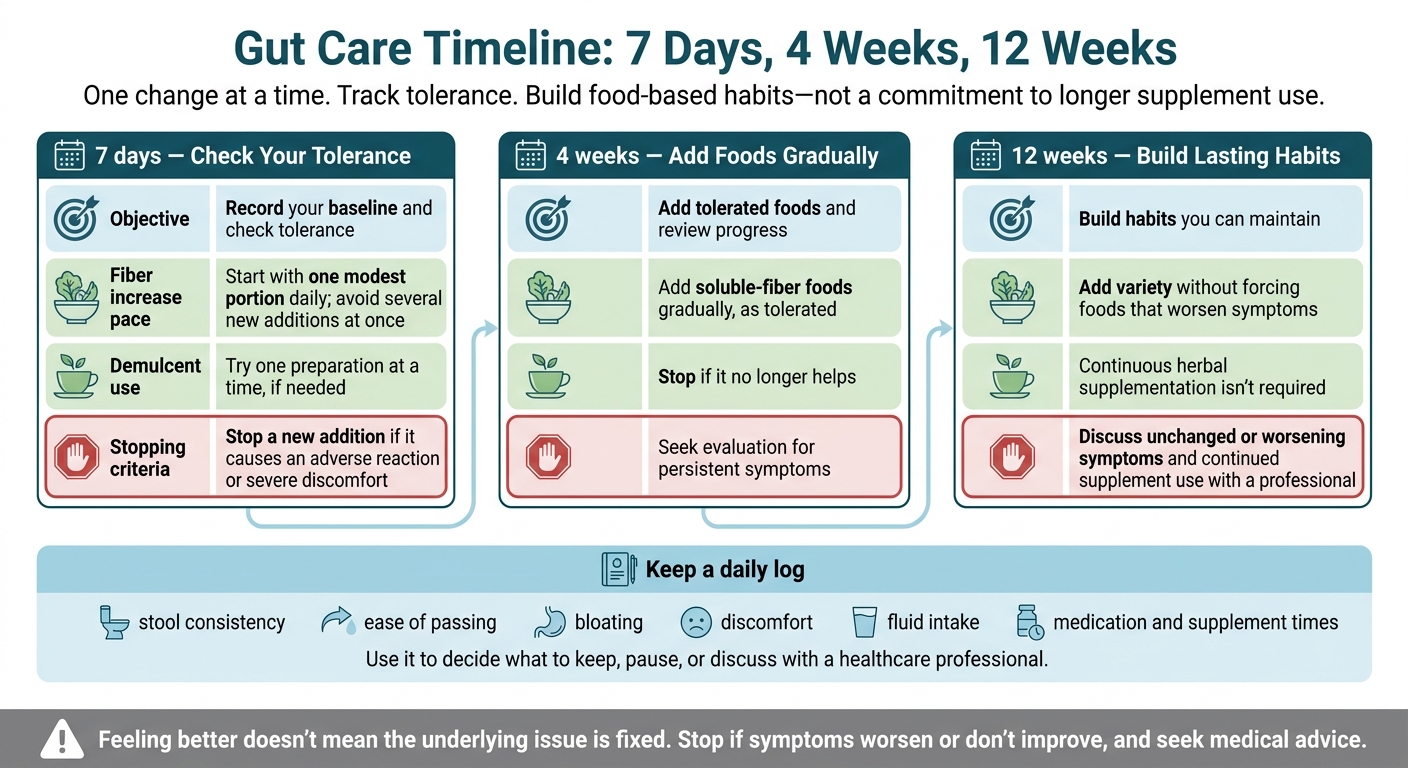
Gut Care Timeline: 7 Days, 4 Weeks, 12 Weeks
Once you find a starting point you tolerate, use these timeframes to pace changes. Keep a daily log of stool consistency, ease of passing, bloating, discomfort, fluid intake, and medication and supplement times. Use it to decide what to keep, pause, or discuss with a healthcare professional.[1]
| Routine detail | 7 days | 4 weeks | 12 weeks |
|---|---|---|---|
| Objective | Record your baseline and check tolerance | Add tolerated foods and review progress | Build habits you can maintain |
| Fiber increase pace | Start with one modest portion daily; avoid several new additions at once | Add soluble-fiber foods gradually, as tolerated | Add variety without forcing foods that worsen symptoms |
| Demulcent use | Try one preparation at a time, if needed | Stop if it no longer helps | Continuous herbal supplementation isn't required |
| Stopping criteria | Stop a new addition if it causes an adverse reaction or severe discomfort | Seek evaluation for persistent symptoms | Discuss unchanged or worsening symptoms and continued supplement use with a professional |
7-Day Routine: Check Your Tolerance
Record your symptoms before making changes. Introduce only one new herb, fiber, or supplement at a time. Keep meals and sleep regular, and try one modest portion of a tolerated fiber food each day, with enough fluids.
Stick with what you tolerate rather than adding something new every day. If the first week is stable, add foods slowly over the next 3 weeks.
4-Week Routine: Add Foods Gradually
Keep meals and hydration consistent, and add soluble-fiber foods one at a time. At week 4, review your log and keep only what helps. This gradual approach links short-term comfort with lasting habits. If symptoms persist, seek evaluation. Avoiding common microbiome reset mistakes can also help prevent unnecessary discomfort.
If you use Rebirth RE-1, follow the labeled morning protocol. Count its fiber toward your daily total, and separate it from medications as directed by a clinician or pharmacist.[1]
12-Week Routine: Build Lasting Habits
By week 12, keep only the foods and supports that improved comfort. Maintain consistent meals, sleep, and hydration. The goal is a routine you can maintain, built around tolerated foods and support - not longer supplementation.
Using supplements longer doesn't automatically make them more effective, and a 12-week routine doesn't require continuous herbal use. Discuss unchanged or worsening symptoms and continued supplement use with a healthcare professional.[1]
Safety and Conclusion: The Limits of Supportive Gut Care
Feeling better doesn’t mean the underlying issue is fixed. Set safety limits first, before starting any demulcent comfort or microbiome support routine.
Medication Interactions and Who Needs Medical Advice
Pause self-care and check with a clinician before use if you’re pregnant, breastfeeding, immunocompromised, or giving live probiotic products to a child. Follow the label’s dosing instructions.[1]
When to Stop Self-Care and Seek Medical Care
Stop if symptoms worsen or don’t improve. Seek medical advice instead of continuing the routine.[1]
Key Steps for Your Gut Care Routine
Keep your routine simple and easy to tolerate: start with one change at a time, add slowly, and keep only what you tolerate. Stop if you’re not improving.[1]
FAQs
Which fiber-rich foods should I try first?
Start with prebiotic-rich foods like garlic, onions, leeks, asparagus, and bananas to feed helpful gut bacteria. Include whole grains and legumes for a steady supply of fiber. Then add fermented foods, such as yogurt, kefir, sauerkraut, or kimchi, that contain live, helpful bacteria.
For best results, pair these foods with Rebiirth RE-1, a 3-in-1 synbiotic designed to restore microbiome balance through a structured 7-day, 4-week, or 12-week routine.
Can I take demulcent herbs with my medications?
If you take medications, talk with your healthcare professional before adding demulcent herbs or any new supplements [1][2]. Supplements such as the 3-in-1 eubiotic synbiotic Rebiirth RE-1 are designed to support gut recovery, but your health needs may differ from someone else’s [1][3].
If you have severe gastrointestinal conditions or other health concerns, medical guidance is especially important to check whether these additions are safe and right for you [2].
How can I tell if my gut routine is helping?
Keep track of your digestion and how you feel overall. Within the first week of a synbiotic protocol, many users report less bloating, more consistent stools, and less abdominal discomfort [1][2][3]. Over 4–12 weeks, you may notice lasting improvements, such as fewer allergy symptoms, greater resistance to recurring infections, and a steadier mood [1][4][5].
If you're not seeing the results you hoped for after four weeks of consistent use, consider changing your approach or trying a different protocol [6].