

Missing sleep can throw your gut off in just 2 days. It can weaken the gut lining, flatten normal day-night microbe activity, lower SCFA output like butyrate, and push the body toward more inflammation.
Here’s the short version:
- Sleep helps set gut timing.
- Irregular sleep can throw off the gut’s 24-hour rhythm, even if total sleep looks okay.
- High cortisol, lower melatonin, and less overnight repair can weaken the gut barrier.
- A weaker barrier can let LPS and other bacterial fragments leak into the bloodstream.
- That can push up markers like IL-6, which are higher in people sleeping under 7 hours vs. 7 to 9 hours.
- Sleep loss can also shift the microbiome away from bacteria like Akkermansia and Faecalibacterium.
- If you want your gut to recover, sleep timing comes first: steady bedtimes, 10–20 minutes of morning sunlight, and dinner 2–3 hours before bed.
Put another way: if your sleep is short, late, or all over the place, your gut has a harder time repairing itself. And if your gut is inflamed, sleep can get worse too. That back-and-forth loop is the main issue.
I’d sum the article up like this: sleep debt disrupts gut rhythm, weakens the barrier, changes the microbiome, and slows gut recovery. The fix starts with steady sleep, then diet and gut support work better.
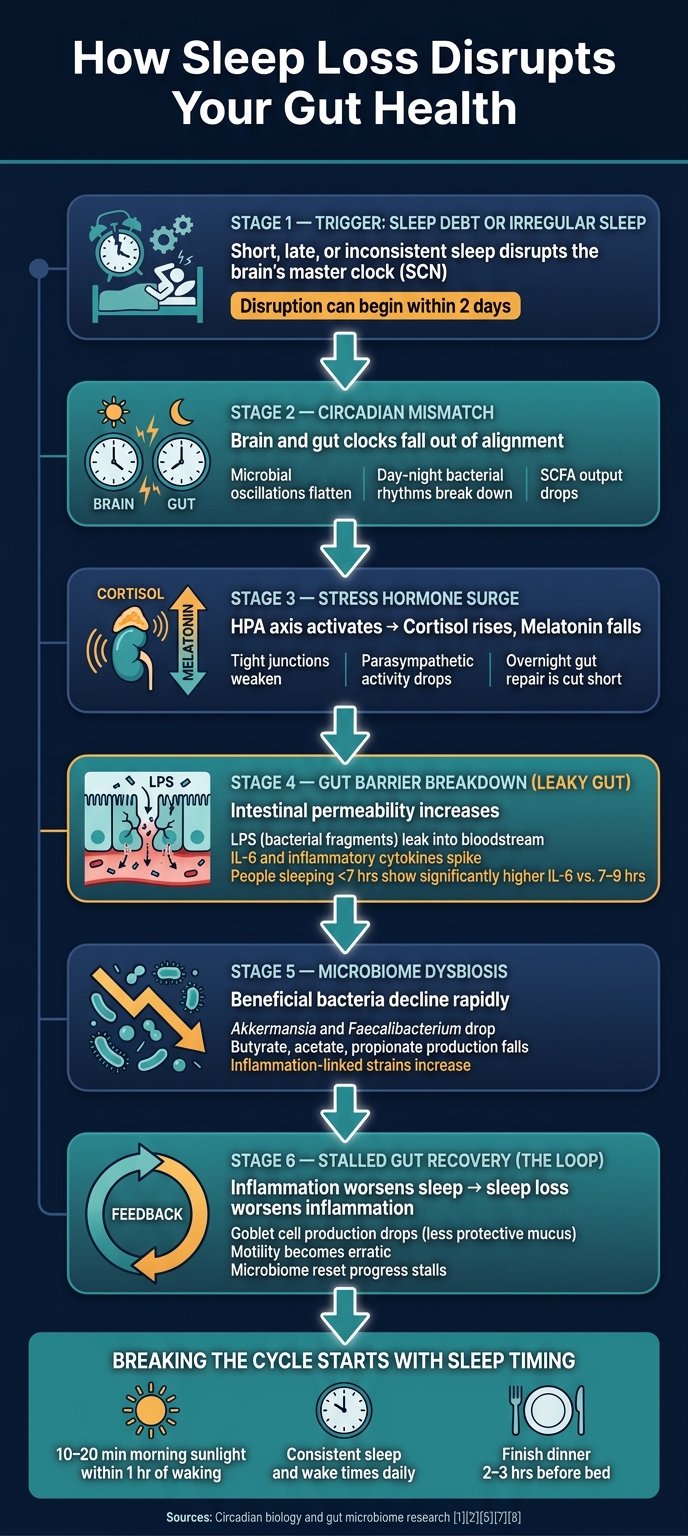
How Sleep Loss Disrupts Your Gut: The Step-by-Step Chain
Irregular Sleep and Harmful Gut Bacteria | Dr. Will Bulsiewicz Live Q&A
While sleep is a critical pillar of health, dietary choices like processed foods and gut dysbiosis also play a major role in microbiome stability.
sbb-itb-1bbfe7f
How Sleep Loss Disrupts Circadian Rhythm and Microbial Timing
Sleep loss is as much about timing as it is about total hours. The gut runs on a steady 24-hour schedule, and irregular sleep can throw that schedule off fast. When sleep timing shifts, microbial rhythms flatten and the microbiome takes longer to reset. Recognizing the signs your gut needs a reset is the first step in restoring balance.
How Circadian Alignment Supports Digestion, Immunity, and Microbial Rhythms
The brain's master clock - the suprachiasmatic nucleus (SCN) - syncs body rhythms to light and dark [2]. It works alongside local gut clocks that help regulate microbial activity, metabolite production, and barrier repair [5][2].
When those systems stay in sync, digestion tends to run on time. Gut motility follows a daily pattern, bile acids are released when needed, and the mucosal immune barrier holds up better [2][4]. Feeding and fasting cycles also help keep microbes on schedule. If meals happen at odd times, that signal gets weaker [5][2]. During sleep, some bacterial groups hit their peak activity and take part in overnight repair [5].
Once that timing drifts, the gut starts to lose its normal day-night rhythm.
How Sleep Restriction and Irregular Schedules Disrupt the Gut's Internal Clock
Irregular sleep can create a circadian mismatch between the brain and the gut [2]. So even if total sleep time looks fine on paper, inconsistent bedtimes and shift work can still lead to inflammatory and metabolic disruption [4].
When the SCN sends off-beat timing signals, microbial oscillations flatten. The usual day-night swings in bacterial populations stop working the way they should. SCFA output drops, and the gut shifts toward conditions linked to dysbiosis [5][2][4].
The result is pretty direct: irregular motility, flatter microbial cycling, lower SCFA output, and slower barrier repair.
That mismatch then feeds into the next issue: higher stress hormones and weaker barrier repair.
How Stress Hormones and Barrier Damage Turn Sleep Loss Into Dysbiosis
When that timing gets thrown off, the body moves into a stress state. Sleep loss switches on the HPA axis, which pushes cortisol up and weakens gut defenses [5][2].
How Elevated Cortisol Changes Gut Function and Weakens Tight Junctions
When cortisol stays high for too long, tight junctions start to weaken and intestinal permeability goes up. At the same time, parasympathetic activity drops. That can slow motility, disrupt bile flow, and cut into the gut’s overnight repair window [5].
The gut also loses part of the recovery work it normally does at night. Melatonin usually helps protect the GI tract with antioxidant support and helps repair the barrier during sleep, but melatonin levels fall when sleep gets cut short [1]. A 2026 study linked sleep deprivation to vagus-nerve signaling that increases gut serotonin, adds oxidative stress, and slows epithelial renewal [3].
Once the barrier is damaged, inflammation doesn’t stay neatly contained in the gut. This systemic shift is one of the many signs your gut microbiome needs a reset to restore balance.
How Barrier Dysfunction Triggers Immune Activation and a Self-Reinforcing Loop
A weaker barrier makes it easier for bacterial fragments to slip into the bloodstream. Lipopolysaccharides (LPS) can leak from the gut into circulation, which sets off an immune response and pushes up inflammatory cytokines such as IL-6 [5][6]. People who sleep less than 7 hours a night show much higher levels of these inflammatory markers than those who get 7 to 9 hours [5].
That sets up a loop: poor sleep weakens the barrier, and the inflammation that follows makes sleep harder [5][6].
Barrier breakdown also changes the microbiome. As the barrier gets weaker, helpful species drop and butyrate production falls, which slows repair even more [5]. That’s often the point where microbiome reset progress starts to stall due to common mistakes.
How Sleep Debt Affects Digestion, Microbiota Composition, and Reset Progress
How Sleep Loss Changes the Gut Environment Through Digestive Disruption
When sleep debt starts to wear down the gut barrier, the trouble doesn't stop there. Digestion slows, nutrient handling shifts, and microbes that are usually kept in check get more room to grow. In practice, the gut environment changes before symptoms become obvious.
Sleep debt disrupts the gut's overnight cleanup contractions - the rhythmic muscular activity that moves food through between meals. This process follows a 24-hour circadian rhythm. When that rhythm gets thrown off, transit time can become erratic. Shift workers, who live with chronic circadian misalignment, report much higher rates of constipation, reflux, and IBS symptoms than people with regular schedules [1].
Sleep loss also lowers goblet cell production, which means there is less of the protective mucus layer that coats the gut lining. With less of that coating in place, the lining becomes more reactive to irritants. That can feed bloating and discomfort directly [4]. Bile acid recycling also gets disrupted, which weakens one of the gut's built-in checks on opportunistic microbes [4].
There’s another layer to this. Sleep loss shifts appetite toward sugar-heavy foods by disrupting leptin and ghrelin, and that pattern can further feed dysbiosis [2][6].
Once transit slows and gut defenses weaken, the microbial mix starts to change too.
How Microbial Diversity, SCFA Production, and Metabolic Balance Can Decline
Chronic sleep loss affects the microbiome in ways researchers can measure. Helpful bacteria decline, and the balance between major bacterial groups shifts toward species linked to inflammation [2][4]. Short-chain fatty acid (SCFA) production - butyrate, acetate, and propionate - also drops, leaving the colon lining with less fuel and reducing support for lower systemic inflammation [4][8].
SCFAs do more than feed the colon. They also help keep body clocks aligned [1]. So when SCFA output stays flat, that timing signal weakens too. And when that happens, reset progress can slow right along with it.
Sleep Debt and Dysbiosis vs. Restorative Sleep and Eubiosis: A Side-by-Side Comparison
| Feature | Sleep Debt & Circadian Misalignment | Restorative Sleep & Circadian Alignment |
|---|---|---|
| Microbial Diversity | Reduced; helpful bacteria decline [4] | High; diverse and rhythmic populations [1] |
| SCFA Production | Flattened; low butyrate and acetate [4] | Rhythmic; peaks during active feeding hours [1] |
| Microbiome Reset Progress | Stalled; cell repair slows [4] | Optimized; consistent circadian signals support eubiosis [1] |
When sleep is restorative and circadian rhythms line up, the gut has what it needs to repair, diversify, and maintain eubiosis. When sleep is short or broken up, reset progress slows [7]. The next step is to restore sleep timing so diet and microbiome support can work better.
How to Support a Microbiome Reset by Improving Sleep
Sleep and Circadian Habits That Help Restore Gut Stability
When sleep debt starts throwing off the gut, the first job is to get timing back on track.
The gut likes a steady rhythm. Keep your sleep and wake times consistent, get 10–20 minutes of morning sunlight within the first hour after waking, and finish dinner 2–3 hours before bed [1][4]. Those small habits help line up your body clock with your gut clock.
At night, make the room and your routine a little quieter. Dim the lights and shut off screens at least an hour before sleep so melatonin can do its job [1][4]. A short walk after meals can also help with motility and daily gut timing [1][4][9].
Diet and Microbiome Support That Work Better When Sleep Is Addressed
Once sleep timing starts to improve, food changes tend to work better.
A fiber-rich, plant-forward diet helps the gut make SCFAs, especially butyrate. That matters because butyrate feeds the colon lining and helps regulate inflammation [4]. But here’s the catch: if you’re short on sleep, those diet shifts may not land the way you want. Better sleep sets the stage so nutrition changes have a better shot at sticking [1][4].
That also makes targeted microbiome support more useful. For readers using a microbiome reset formula, Rebiirth RE-1 is a 3-in-1 synbiotic with prebiotics, probiotics, and postbiotics designed to support microbiome balance during sleep recovery.
Sleep deprivation can shift the microbiome toward inflammation-linked strains within hours to days [4]. Pairing sleep repair with targeted microbiome support gives beneficial bacteria a better chance to return, including strains like Akkermansia and Faecalibacterium, which can drop fast under sleep debt [4].
Conclusion: The Step-by-Step Chain From Sleep Loss to Stalled Gut Recovery
Restoring sleep is the first step in restoring gut stability because it helps reset circadian timing, supports barrier repair, and gives the microbiome a better chance to recover.
FAQs
How quickly can sleep loss affect the gut microbiome?
Sleep loss can affect the gut microbiome fast. Measurable shifts in microbial balance, including drops in helpful bacteria and rises in pro-inflammatory markers, may show up after as little as two consecutive nights of restricted sleep.
Even one night of poor sleep can trigger hormone changes that weaken gut barrier function, and circadian disruption similar to jet lag can shift bacterial composition within three days.
Can irregular sleep harm gut health even if I sleep enough hours?
Yes. Irregular sleep can hurt gut health even if you still get enough total hours. That’s because your gut microbiome, digestive enzymes, and gut barrier repair all run on a 24-hour circadian rhythm.
When your bedtime and wake time keep moving around, those signals can fall out of sync. And once that happens, normal overnight repair may get thrown off. The gut lining can weaken, bacteria may shift toward more inflammatory species, and problems like bloating, constipation, and lower microbial diversity can start to show up.
What should I fix first for gut recovery: sleep or diet?
Fix sleep first. It helps regulate your circadian rhythm, which supports gut barrier repair, hormone signaling, and microbial activity. When sleep is poor, the gut can stay too inflamed for helpful bacteria to thrive. That can make diet changes or probiotic support work less well.
Start with a steady sleep-wake schedule and better sleep hygiene. Once sleep is more stable, a nutrient-rich, fiber-focused diet and tools like Rebiirth RE-1 can better support long-term microbiome balance.