

Your gut and your sleep affect each other, and diet sits in the middle. In plain terms: more fiber, steadier meal times, and a plant-forward eating pattern are linked with better gut diversity and better sleep, while low-fiber diets, late-night eating, and short sleep are linked with poorer gut balance.
Here’s the short version:
- Gut microbes make SCFAs like butyrate, acetate, and propionate from fiber.
- These compounds help support the gut lining, lower inflammation, and send signals through the gut-brain axis.
- Poor sleep can shift the microbiome, even after just a couple of nights of sleep loss.
- Lower microbial diversity is often seen in people with insomnia or lower sleep quality.
- Mediterranean-style eating is linked with better sleep and more SCFA-producing bacteria.
- Western-style eating is linked with lower diversity, lower SCFAs, and poorer sleep.
- Meal timing matters too: eating late or on an irregular schedule may throw off both microbial rhythms and circadian rhythm.
- Supplements like probiotics show small, mixed results, mostly in self-reported sleep scores.
A few numbers stand out:
- In one meta-analysis of 13 studies with 890 participants, probiotics lowered PSQI sleep scores by about 0.59 points.
- A broader review found no clear change in sleep quality or sleep duration from gut-focused interventions.
- In a U.S. survey, adults sleeping 7–8 hours averaged 16.6 ± 9.6 g of fiber per day, vs. 13.2 ± 10.1 g in those sleeping less than 5 hours.
What I take from all this is simple: if you want to support sleep, start with food quality, fiber intake, meal timing, and a steady sleep schedule. The microbiome may be part of the reason those habits help.
Microbial Diversity and Sleep: What Human Studies Show
Lower Microbial Diversity Is Often Linked to Poorer Sleep
Human studies keep pointing in the same direction: people who sleep poorly often have lower gut microbial diversity. Alpha diversity refers to how many microbial species are present and how evenly they’re spread out. In lab-based sleep testing, higher gut diversity was tied to better sleep efficiency, longer total sleep time, and less time awake after falling asleep.[11][8]
One case-control study looked at 20 people with acute insomnia, 38 with chronic insomnia, and 38 healthy controls. The insomnia groups showed lower microbial richness and fewer SCFA-producing species than good sleepers.[15][2][17] The chronic insomnia group stood out even more, with lower levels of Faecalibacterium, Prevotella, and Roseburia - all butyrate-producing bacteria.[2][17] That helps explain why diet may matter so much here: what people eat can shape both sleep patterns and microbiome diversity.
Diet Patterns That Support More Diverse Gut Microbes
Diet plays a big role in shaping microbial diversity. High-fiber, plant-rich eating patterns - especially Mediterranean-style diets - are linked to greater gut diversity and better sleep.[4][13] People with higher adherence to a Mediterranean diet tend to have higher SCFA levels in stool and fewer insomnia symptoms.[13] Plant-rich diets high in fiber and polyphenols are also linked to less fragmented sleep and longer sleep duration.[19][20][22]
Put simply, the same diet pattern that feeds a more diverse gut microbiome may also line up with better sleep.
Limits of the Current Evidence
There’s an important catch: these studies show links, not cause and effect. Many are small, depend on self-reported sleep, and don’t fully account for factors like stress, exercise, medications, alcohol use, or illness.[9][10][12][14] Most are also cross-sectional, which means they look at a single point in time. So the direction of the link is still unclear. Poor sleep might reduce microbial diversity, or a less diverse gut might help drive sleep problems.
Trial data also remain mixed. A meta-analysis of studies aimed at changing gut microbiota found no statistically significant improvement in sleep quality (p = 0.31) or sleep duration (p = 0.43).[18]
Even so, these patterns suggest a few likely pathways, especially SCFAs, inflammation, and circadian rhythm. The next section looks at those proposed mechanisms in more detail.
sbb-itb-1bbfe7f
How SCFAs, Inflammation, and Circadian Rhythm Affect Sleep
Short-Chain Fatty Acids From Fiber Fermentation
Microbial diversity matters in part because more fiber-fermenting microbes make more SCFAs. Butyrate has the strongest link to sleep. It fuels colon cells, helps maintain the gut barrier, and lowers inflammatory signaling by downregulating NF-κB and reducing pro-inflammatory cytokines like TNF-α.[14] In animal studies, butyrate increases NREM sleep.[34][23]
Other SCFAs play a role too. Propionate and acetate move more broadly through the body, where they affect liver metabolism and immune signaling.[26] In infants, higher fecal propionate has been linked to slightly longer nighttime sleep.[35]
In plain terms, feeding these microbes may support better sleep-related signaling. Fermentable fiber from foods such as beans, oats, broccoli, and apples helps support the bacteria that produce SCFAs, which may help steady gut barrier function and sleep-related pathways.[3][23]
Inflammation, Gut Barrier Stress, and Sleep Disruption
When SCFA production drops, the gut barrier can weaken and inflammatory signaling can climb. If dysbiosis damages that barrier, LPS can pass into the bloodstream and trigger IL-1β, IL-6, and TNF-α.[23][28] Those cytokines can disrupt sleep stages and break up sleep through the night.[29][30]
This same pattern shows up with chronic low-grade inflammation. It has been linked again and again to insomnia, non-restorative sleep, and daytime fatigue.[32] Poor sleep and gut barrier stress can also feed each other, which helps explain why sleep problems are often hard to shake once they start.[31][33]
Meal Timing, Circadian Rhythm, and Microbial Cycles
Sleep is shaped not just by what you eat, but also by when you eat. Gut microbes follow 24-hour rhythms in both composition and SCFA output, and those rhythms are driven in large part by meal timing and the body’s circadian clocks.[25][39] SCFA production tends to rise during feeding periods and fall during fasting, matching the body’s metabolic demands across the day.[1][25]
When meal timing gets irregular, or eating shifts late into the night, those microbial rhythms can drift out of sync with the body’s internal clocks.[27][36] One pilot study found that people with late-night eating habits had higher abundance of Erysipelotrichales, a bacterial taxon linked to metabolic disturbances.[38] Circadian misalignment from irregular eating has also been tied to altered SCFA profiles and lower microbial diversity, which can loop back into poorer sleep quality.[27][23]
A simple rule of thumb helps here: finish your last main meal about 3 hours before bed and try to keep meal times steady from day to day.[37][24][27]
Irregular Sleep and Harmful Gut Bacteria | Dr. Will Bulsiewicz Live Q&A
Diet Patterns and Microbiome-Focused Interventions for Sleep
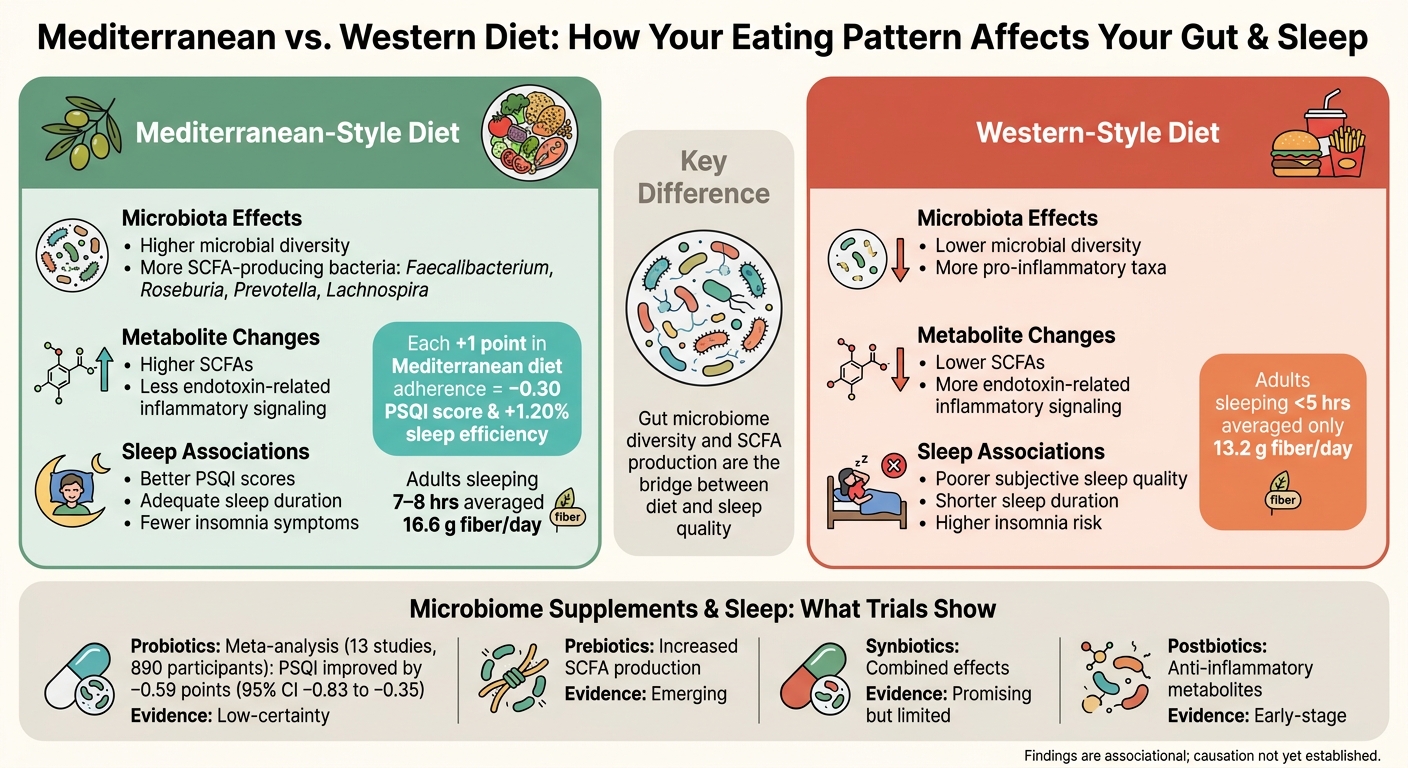
Mediterranean vs. Western Diet: Gut Microbiome & Sleep Quality Compared
Mediterranean-Style vs. Western-Style Eating Patterns
The clearest diet-and-sleep pattern in the research shows up when two broad eating styles are compared.
A Mediterranean-style pattern centers on vegetables, fruits, legumes, whole grains, nuts, olive oil, and regular fish, with less red and processed meat and fewer refined foods. Across studies, this pattern is linked to better sleep quality, fewer insomnia symptoms, a more diverse microbiome, and higher SCFA production and brain health benefits. A Western-style pattern leans more on refined carbohydrates, processed meats, saturated and trans fats, and low fiber. That pattern is more often tied to worse sleep, lower microbial diversity, and less SCFA output.[46][13][21][47][41]
One prospective cohort found that each 1-point increase in Mediterranean diet adherence score was linked to a lower PSQI score (β ≈ −0.30; p < 0.01) and a 1.20% higher sleep efficiency at one-year follow-up.[48]
| Dietary Pattern | Typical Microbiota Effects | Likely Metabolite Changes | Observed Sleep Associations |
|---|---|---|---|
| Mediterranean-style | Higher diversity; more SCFA-producing bacteria such as Faecalibacterium, Roseburia, Prevotella, and Lachnospira | Higher SCFAs and less endotoxin-related inflammatory signaling | Better PSQI scores, adequate sleep duration, fewer insomnia symptoms |
| Western-style | Lower diversity; more pro-inflammatory taxa | Lower SCFAs and more endotoxin-related inflammatory signaling | Poorer subjective sleep quality, shorter duration, higher insomnia risk |
Why does this matter? Because these eating patterns appear to shift the same microbial and inflammatory signals that are tied to sleep.
That said, these findings are observational. They point to association, not causation.[42][43]
What Prebiotic, Probiotic, Synbiotic, and Postbiotic Trials Show
Diet can shift the microbiome over time, but not overnight. So researchers have also tested more targeted supplements that aim at these gut-related pathways more directly.
So far, microbiome-focused supplements show small and uneven sleep benefits. Across multiple reviews, probiotic supplementation reduced PSQI global scores compared with placebo, with estimates ranging from about −0.59 to −2.10 points depending on the population studied.[45][44] One meta-analysis of 13 studies (890 participants) found a reduction of −0.59 points (95% CI −0.83 to −0.35), with moderate heterogeneity (I² = 46%).[45]
The catch is that most of the gains show up in subjective measures. Objective outcomes, such as sleep efficiency on polysomnography, show little steady benefit.[2][5] Effects also seem more visible in people with mild sleep complaints, stress, or gut imbalance.[40][7][6]
| Intervention Type | Proposed Mechanism | Strength of Current Evidence | Common Study Limits |
|---|---|---|---|
| Probiotics | GABA/serotonin modulation, reduced inflammation, gut barrier support | Low-certainty; small PSQI improvements in meta-analyses | Small samples, strain heterogeneity, subjective outcomes only |
| Prebiotics | Increased SCFA production, gut barrier integrity | Emerging; mechanistic data stronger than clinical sleep data | Few sleep-specific RCTs, limited dose standardization |
| Synbiotics | Combined prebiotic + probiotic effects on microbiota composition | Promising signals; limited dedicated trials | High variability in formulations, short follow-up |
| Postbiotics | Immune modulation, HPA axis dampening, anti-inflammatory metabolites | Early-stage; growing interest but sparse human sleep data | Definitions vary across studies; few sleep-primary RCTs |
In plain terms, the field is still sorting out what works, for whom, and under what conditions.
Where Rebirth RE-1 Fits in This Discussion
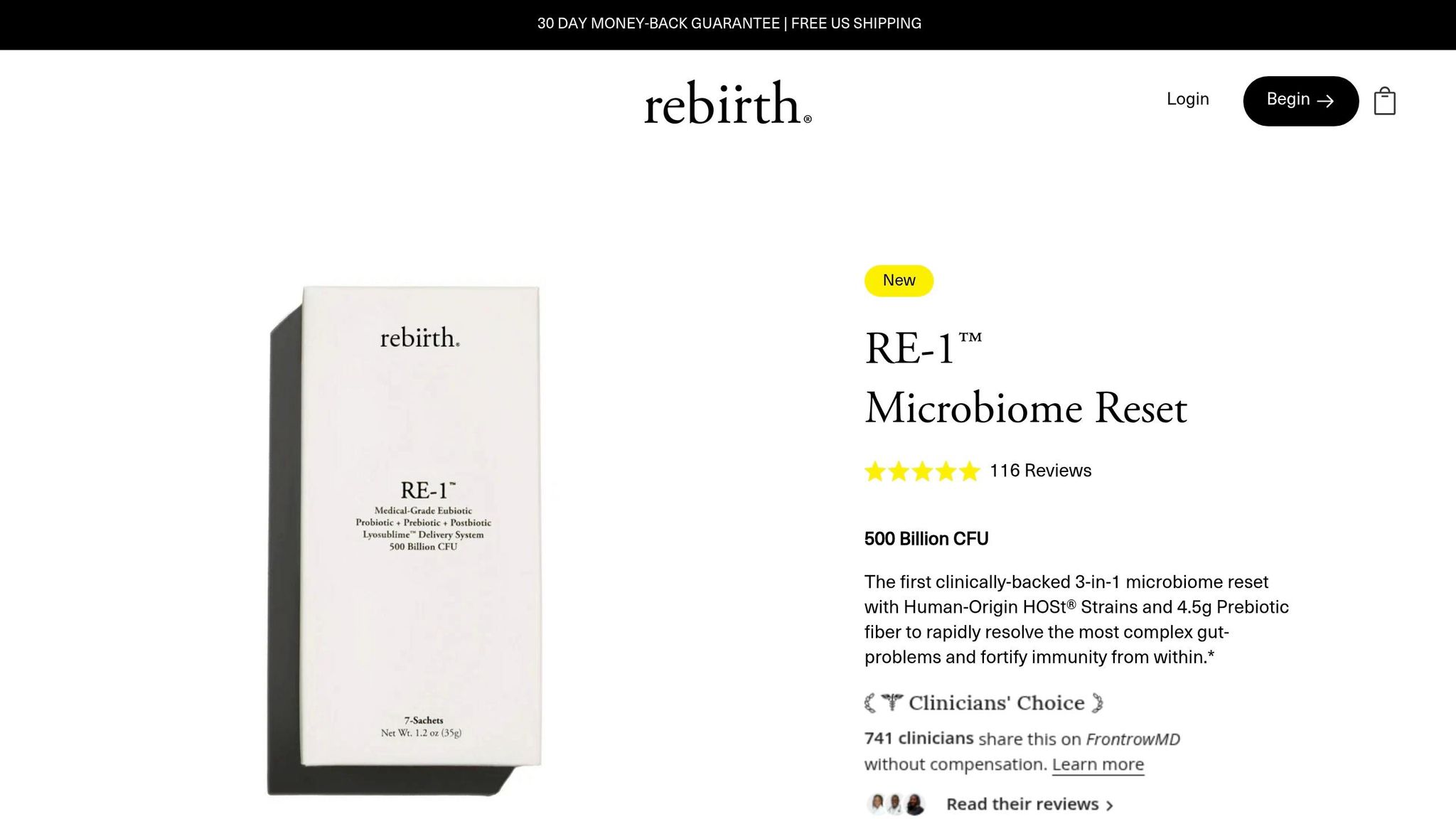
One example of a multi-component microbiome product is Rebirth RE-1. It is a 3-in-1 eubiotic synbiotic that combines prebiotics, probiotics, and postbiotics.
Its 4-week and 12-week formats line up with study windows often used in microbiome and sleep research. The 7-day reset is usually too short for sleep outcomes. In this context, it fits as a microbiome-support product, not a sleep treatment.[7][2][6]
Conclusion: What the Research Supports and What Is Still Being Studied
Key Takeaways From Current Research
The main point from this research is pretty simple: diet shapes gut microbiota, and gut microbiota may affect sleep. But there’s still a big gap between seeing a link and proving cause and effect.
So far, studies have linked better sleep with higher microbial diversity, more SCFA-producing bacteria, and stronger sleep markers. At the same time, cause and effect is still uncertain. That helps explain why diet, meal timing, and sleep habits seem to work as a connected system rather than as separate pieces.
Results from trials are mixed, too. One probiotic meta-analysis found a small improvement in PSQI scores, while broader reviews found no clear change in sleep quality or sleep duration.[2][45][50][51][16]
Practical Steps Readers Can Take Now
For most people, the biggest wins still come from day-to-day habits. Eat more fiber-rich, plant-forward foods like:
- Vegetables
- Legumes
- Whole grains
- Nuts
- Seeds
- Fruit
Fiber helps support SCFA production, and regular meal timing helps keep circadian rhythms on track. In a U.S. adult survey, people who slept the recommended 7–8 hours had the highest average fiber intake at 16.6 ± 9.6 grams per day, compared with 13.2 ± 10.1 grams per day in people sleeping fewer than 5 hours.[49]
It also helps to keep meal times steady and follow a regular sleep-wake schedule. Those patterns support the timing signals that both gut microbes and sleep-related hormone rhythms rely on.
Rebirth RE-1 is a microbiome-support product, not a sleep treatment, and it makes the most sense as a supportive add-on to those core habits.
FAQs
Can better sleep improve my gut microbiome?
Yes. Better sleep can help support a healthier gut microbiome because the gut and brain are closely linked. When you sleep well, your body is in a better position to maintain balance and diversity in gut bacteria. Poor sleep can throw that balance off, and that shift in gut bacteria may also make sleep worse.
You can help support this gut-sleep loop with a steady sleep schedule and fiber-rich whole foods. Rebiirth RE-1™ is designed to help restore gut balance with prebiotics, probiotics, and postbiotics.
How much fiber do I need to support sleep?
Aim for about 25–30 grams of fiber a day from foods like beans, lentils, whole grains, fruits, and vegetables. That kind of intake helps feed helpful gut bacteria and may boost short-chain fatty acids, which are tied to better sleep and lower inflammation.
With that in mind, Rebirth RE-1 also includes 4.5 grams of prebiotic fiber from GOS and inulin to support SCFA production.
How long does it take for diet changes to affect sleep?
Diet can shift the gut microbiome fast. A Western-style diet, for example, may lead to noticeable changes in just a few days. But short-term shifts in meal timing over 7 to 9 days seem to have only a limited effect.
When it comes to gut health and sleep, long-term dietary patterns matter most. They shape the bigger picture over time. And with targeted synbiotic support like Rebiirth RE-1, some users may notice changes within 1 week, with peak benefits often showing up after 8 to 12 weeks.