

If your sleep, meals, and light exposure are off, your gut can feel it fast. The short version: for most people, morning daylight, a steady wake time, and earlier meals matter far more for gut health than day-to-day EMF exposure.
Here’s the main takeaway in plain English:
- Your body clock affects digestion, immunity, and metabolism
- The gut microbiome follows a daily rhythm
- Late-night light, poor sleep, shift work, and irregular meals can throw that rhythm off
- EMF and circadian health are still being studied, but the evidence is much weaker than it is for light at night
- About 70% of immune cells are in the gut, so when gut rhythm slips, immune signaling can change too
- A reset usually starts with timing, not supplements: wake time, morning light, and meal timing come first
- If gut symptoms stick around, a synbiotic can be used as extra support, not the first step
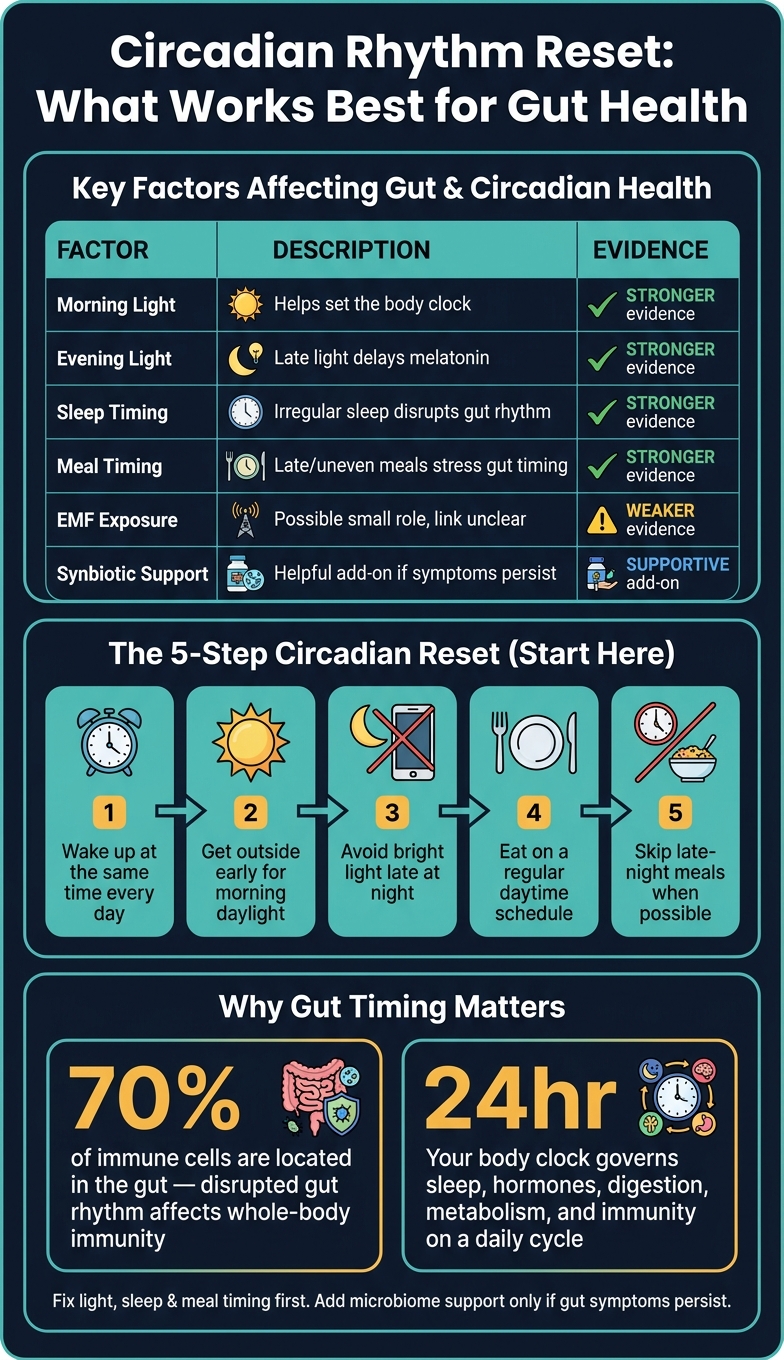
What I’d focus on first:
- Wake up at the same time every day
- Get outside early for daylight
- Avoid bright light late at night
- Eat on a regular daytime schedule
- Skip late-night meals when you can
Here’s a quick look at what matters most:
| Factor | What the article says | Evidence level |
|---|---|---|
| Morning light | Helps set the body clock | Stronger |
| Evening light | Late light can delay melatonin | Stronger |
| Sleep timing | Irregular sleep can disrupt gut rhythm | Stronger |
| Meal timing | Late or uneven meals can stress gut timing | Stronger |
| EMF exposure | May play a small role, but the link is still unclear | Weaker |
| Synbiotic support | May help if gut symptoms continue during a reset | Supportive add-on |
Bottom line: if you want the biggest payoff, start by fixing light, sleep, and food timing. That’s the core idea of the article, and everything else builds from there.
Circadian Rhythm Reset: What Works Best for Gut Health
How Sleep and Circadian Rhythms Shape Gastrointestinal Health
sbb-itb-1bbfe7f
1. Circadian Rhythm Basics and Why They Matter for Gut Health
Your body runs on a 24-hour timing system. That system helps line up sleep, hormones, digestion, metabolism, and immunity.
The Body Clock, Peripheral Clocks, and Daily Gut Timing
The brain has a master clock, and the gut has its own clocks too. They work together to time digestion across the day. Light, sleep, and meal timing help keep those clocks in sync. That day-to-day timing also shapes the microbiome itself.
How the Microbiome Changes Across the Day
The gut microbiome changes across the day based on light, sleep, and meals. When gut bacteria stay in balance, they help support digestion and barrier function [2]. When that rhythm gets thrown off, digestion and recovery can take a hit.
What Circadian Misalignment Does to Digestion and Recovery
Irregular sleep, late-night eating, and shift-work schedules can throw circadian rhythms off. When that happens, the gut barrier may weaken because tight junctions get disrupted [3]. A weaker barrier can allow LPS to enter the bloodstream and drive inflammation [3]. Circadian misalignment can also disrupt the gut-brain axis and immune response, which may affect energy, mood, and focus [2].
Next, the guide looks at EMFs and the smaller - but still debated - ways they may affect circadian signaling.
2. EMF Exposure and Circadian Disruption: What Is Known and What Is Not
EMFs are part of daily life in the U.S. They come from phones, Wi-Fi routers, Bluetooth devices, smartwatches, home wiring, and power lines. In simple terms, they fall into two main groups: radiofrequency (RF) radiation from wireless devices and low-frequency fields from the electrical grid.
That said, EMFs are not the same thing as visible light. And that difference matters if you're talking about circadian health.
EMFs vs. Light at Night: Two Different Circadian Signals
Blue-rich light from screens and LEDs is a well-known circadian signal. It can suppress melatonin through the brain's master clock. EMFs from phones and routers do not work like light at night.
Here's the key point: the circadian effect of day-to-day EMF exposure is still uncertain, while the effects of evening light exposure are much more established. So when people deal with circadian strain, the usual drivers are timing cues like light, sleep, and meals, not EMFs by themselves.
Possible Pathways: Melatonin, Clock Genes, and Sleep Architecture
Researchers have suggested a few possible routes, including effects on melatonin, clock genes, and sleep. But none of these has been confirmed.
At this point, there is no clear human mechanism linking ordinary RF or ELF exposure to measurable circadian disruption.
Research Limits Readers Should Understand
The research base is still limited, so broad cause-and-effect claims don't hold up. In this context, EMF matters mostly as a possible contributor to sleep and rhythm disruption. That pathway is more likely to affect gut health.
So the main issue isn't EMF in isolation. It's whether circadian disruption, whatever causes it, can later affect sleep, feeding patterns, and gut function. From there, the next step is looking at how that timing stress may reach the gut through the microbiome and immune system.
3. Microbiome and Immune Links: Where Circadian Disruption May Affect Health Most
Circadian disruption can throw off the gut microbiome and change immune signaling.
From Rhythm Loss to Dysbiosis and Barrier Stress
When circadian timing slips, the gut often feels it first.
Your gut microbiome changes in both makeup and activity over the course of the day. If sleep timing, meal timing, or light exposure get out of sync, that daily microbial rhythm can start to fall apart. Helpful bacteria can lose their usual patterns, while less helpful species may start to take over. That shift is called dysbiosis, and it can affect digestion and gut function.
Once microbial timing is off, the gut barrier can become less stable, and inflammation risk goes up. In plain terms, the gut lining gets a bit more stressed. That strain is one reason immune signaling tends to change next.
Immune Effects: SCFAs and Inflammation
About 70% of the body's immune cells are located in the gut [1], so microbiome disruption can affect a lot more than digestion.
Dysbiosis can increase inflammatory signals such as TNF-α, IL-6, and IL-8 while reducing IL-10.
Helpful bacteria also produce SCFAs, especially butyrate. These compounds help support gut lining repair and keep microbial balance in check. When that balance is disturbed, SCFA production can drop, and the gut's protective layer can weaken.
Where a Microbiome Reset May Fit
If circadian disruption has already affected your gut through irregular sleep, getting microbial balance back may take more than fixing your schedule alone. A targeted synbiotic may help support that process.
Rebirth RE-1 may fit here as a short-term microbiome reset: a 3-in-1 eubiotic synbiotic with prebiotics, probiotics, postbiotics, and Human Origin Strains. It works best alongside steady sleep, light, and meal timing.
4. Urban Lifestyle Factors That Drive Circadian and Gut Imbalance
City life often stacks the deck against your body clock. Artificial light, limited daylight, odd hours, and late meals can all pull sleep and digestion out of sync. The biggest troublemakers are light late at night, too little light in the morning, and inconsistent timing.
Artificial Light, Screens, and Too Little Daylight
Morning daylight helps set your body clock. It tells your system, “the day starts now.” At night, screens and indoor lighting can push that clock later, making it harder to wind down and keep sleep on a steady schedule. Over time, those habits can weaken sleep timing and make gut balance harder to maintain [2].
Irregular Schedules and Late-Night Eating
Irregular schedules and late-night eating add even more mixed signals. One day the body gets a daytime pattern, the next it gets a nighttime one. That strain can show up as lower energy, poorer focus, and less steady digestion and gut dysbiosis [2]. It can also blunt immune resilience [2].
When the body keeps bouncing between day and night cues, sleep and digestion have a harder time staying aligned. That’s why the next step is to fix light, sleep, and meal timing first.
5. Reset Strategies for Circadian Alignment and Microbiome Support
Start with steady light, sleep, and meal timing so your body gets clear signals each day.
The Core Reset: Light Timing, Sleep Timing, and Meal Timing
Set a consistent wake time and stick to it, even on weekends. Get outside early in the day to give your circadian clock a strong cue. At night, keep things darker by dimming indoor lights and cutting screen time before bed. For meals, aim for a regular eating schedule and skip late-night eating. When light, sleep, and food timing stay steady, circadian signals tend to stay in sync.
If gut symptoms are part of the picture, add microbiome support once those timing basics are in place.
Optional Microbiome Support During a Reset
Rebirth RE-1™ is a clinically supported 3-in-1 synbiotic that supports microbiome balance, digestion, and immune resilience [2]. It works best when paired with steady sleep, light, and meal timing.
Reset Strategies Compared: Goals and Evidence Strength
Here’s the short version of how these reset steps stack up by impact:
- Morning light exposure - anchors the circadian clock; best-supported
- Evening light reduction - protects melatonin onset; best-supported
- Consistent wake time - stabilizes the sleep-wake cycle; core step
- Daytime meal window - aligns food timing with the clock; well-supported
- Optional: Rebirth RE-1™ - microbiome support during a reset; clinically supported [2]
The conclusion distills these steps into the smallest set of actions with the biggest payoff.
Conclusion: The Simplest Actions With the Biggest Likely Payoff
Timing matters most because it affects sleep, digestion, and your gut’s daily rhythm. For most people, light, sleep, and meal timing matter more than EMF exposure itself.
That’s why the best reset usually starts with the basics:
- a steady wake time
- morning daylight
- earlier meals
If gut symptoms show up, add microbiome support during the reset. Rebirth RE-1™ is a 3-in-1 synbiotic with prebiotics, probiotics, postbiotics, and Human Origin Strains (HOSt™), made to support gut balance during a reset when schedule changes alone aren’t enough.
Use microbiome support as a helper, not the first move.
Start with timing first. Add microbiome support only if you need extra help during the reset.
FAQs
How long does a circadian reset take?
A circadian reset for gut and sleep synchronization often starts to show noticeable changes in about 7 days.
More meaningful stabilization usually happens around 4 weeks. Longer-term gains often show up at 8 to 12 weeks when routines and targeted interventions stay consistent.
Can shift workers still support gut health?
Yes. Shift workers can support gut health by keeping meal timing as steady as possible and making a few lifestyle changes to help cut circadian misalignment.
Irregular schedules can throw off the gut microbiome and weaken the intestinal barrier. A simple way to help is to eat bigger meals earlier in the day, stick to a consistent eating window, and consider using Rebiirth RE-1 to help restore microbiome balance and support gut barrier integrity.
When should I add a synbiotic?
Use a synbiotic when you want targeted support for gut-associated lymphoid tissue (GALT), digestive comfort, or microbiome balance. It can be a good fit during recovery from irregular eating patterns, shift work, or chronic stress, when your routine - and your gut - may feel a bit off.
Rebiirth RE-1 can be used in a 7-day, 4-week, or 12-week reset program. Take one sachet with water each morning on an empty stomach. Before you start, talk with a healthcare professional.